
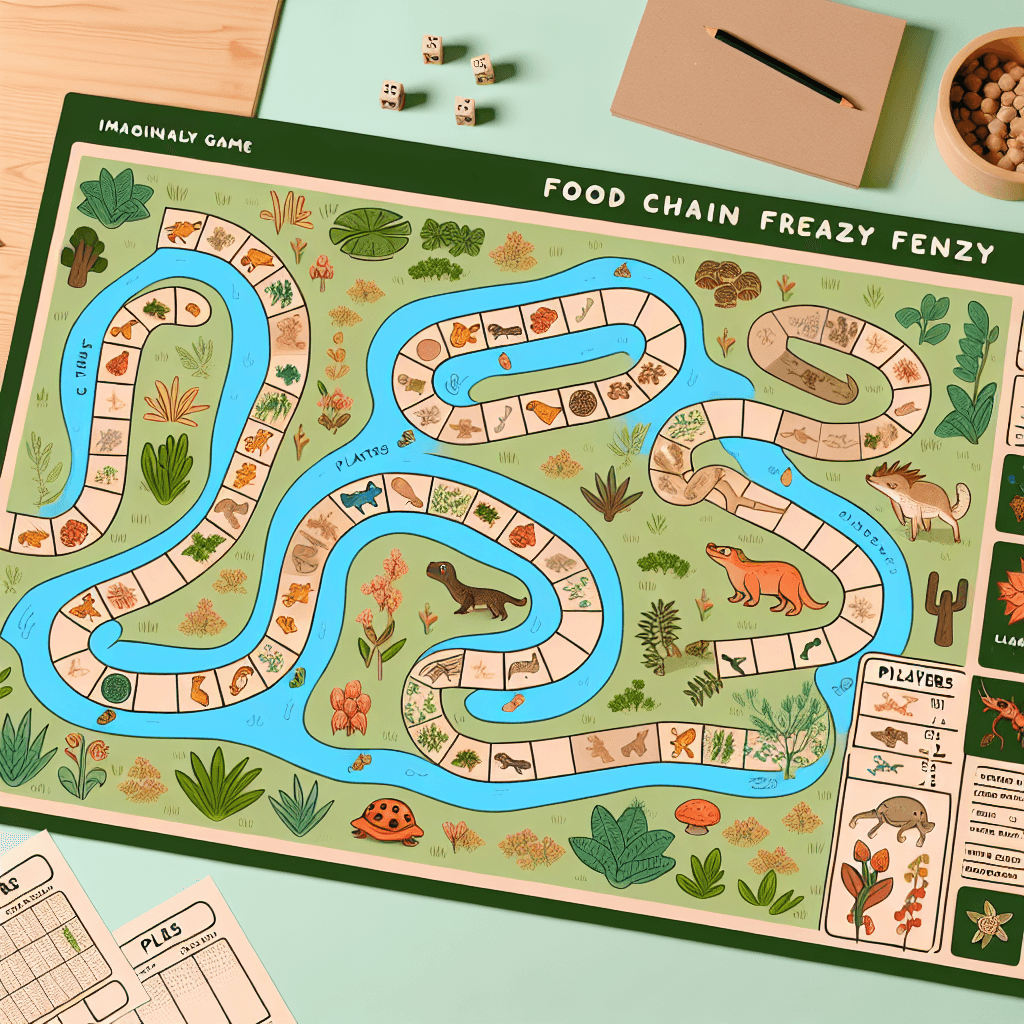
Food Chain Frenzy: A Board Game Adventure
Inquiry Framework
Question Framework
Driving Question
The overarching question that guides the entire project.How can we design a board game that teaches others about the interconnected roles of living things in local food chains, and what actions can we take to protect these relationships?Essential Questions
Supporting questions that break down major concepts.- How do different animals and plants depend on each other for survival in a food chain?
- How can we classify animals based on their diet (carnivore, herbivore, omnivore) and how does this impact their role in a food chain?
- How do plants and animals use their senses to respond to their environment, and how does this affect their survival in a food chain?
- What actions can we take to protect plants and animals in our local environments and support healthy food chains?
- How do First Nations, Métis, and Inuit knowledge contribute to our understanding of food chains and the relationships between plants, animals, and the environment?
Standards & Learning Goals
Learning Goals
By the end of this project, students will be able to:- Students will be able to accurately represent food chains using illustrations, diagrams, stories, or words.
- Students will be able to classify animals as carnivores, herbivores, or omnivores based on their diet.
- Students will be able to explain how plants and animals use their senses to respond to stimuli in their environment.
- Students will be able to describe actions that can be taken to protect plants and animals in local environments.
- Students will be able to integrate First Nations, Métis, and Inuit knowledge of plants and animals into their understanding of food chains and environmental relationships.
- Students will be able to design a board game that effectively teaches others about food chains, animal classifications, and environmental stewardship
Alberta Education Curriculum
Entry Events
Events that will be used to introduce the project to studentsMystery Meal Challenge
Students participate in a 'Mystery Meal Challenge' where they receive a set of clues about an animal's diet and habitat. Working in teams, they must deduce the animal's identity and its place in the food chain, sparking curiosity about the relationships between living things. This activity culminates in a class discussion about the roles of carnivores, herbivores, and omnivores, setting the stage for designing a board game that explores these concepts further.Portfolio Activities
Portfolio Activities
These activities progressively build towards your learning goals, with each submission contributing to the student's final portfolio.Who Eats What?
Students will research different animals and classify them as carnivores, herbivores, or omnivores, justifying their classifications with evidence from their diet.Steps
Here is some basic scaffolding to help students complete the activity.Final Product
What students will submit as the final product of the activityA 'Who Eats What?' classification chart, organized by animal type (carnivore, herbivore, omnivore) with pictures or drawings of the animals and examples of their food sources.Alignment
How this activity aligns with the learning objectives & standardsCovers SCI3.6, SCI3.7, SCI3.8, SCI3.9: Focuses on classifying animals based on their diet.Sensory Survival
Students investigate how specific animals use their senses to respond to stimuli in their environment, focusing on survival.Steps
Here is some basic scaffolding to help students complete the activity.Final Product
What students will submit as the final product of the activityA presentation (poster or short oral report) detailing how a chosen animal uses its senses to find food, detect predators, and respond to other environmental stimuli.Alignment
How this activity aligns with the learning objectives & standardsCovers SCI3.10, SCI3.11, SCI3.12: Explores how animals use their senses to find food and avoid predators.Protect Our Planet
Students will brainstorm and propose actions to protect plants and animals in their local environments, focusing on maintaining healthy food chains.Steps
Here is some basic scaffolding to help students complete the activity.Final Product
What students will submit as the final product of the activityA 'Protect Our Planet' action plan with specific, actionable steps that students (and others) can take to protect local plants and animals and their habitats.Alignment
How this activity aligns with the learning objectives & standardsCovers SCI3.13, SCI3.14: Encourages students to think about protecting local environments.Indigenous Knowledge Keepers
Students will research and present First Nations, Métis, and Inuit perspectives on local food chains, including traditional knowledge about animal behavior, food sources, and seasonal patterns.Steps
Here is some basic scaffolding to help students complete the activity.Final Product
What students will submit as the final product of the activityA research report or presentation that includes information on First Nations, Métis, and Inuit knowledge of local food chains, including animal behaviors, food sources, migration patterns, and seasonal patterns, properly cited.Alignment
How this activity aligns with the learning objectives & standardsCovers SCI3.15: Integrates Indigenous knowledge to broaden understanding of food chains.Rubric & Reflection
Portfolio Rubric
Grading criteria for assessing the overall project portfolioFood Chain Frenzy Board Game Portfolio Rubric
Animal Classification and Presentation
This category assesses the student's ability to accurately classify animals based on their diet and present this information in a clear, organized chart.Animal Classification Accuracy
Accuracy of animal classification as carnivore, herbivore, or omnivore, supported by dietary evidence.
Exemplary
4 PointsClassifies all animals correctly with thorough and accurate dietary evidence. Demonstrates sophisticated understanding of animal diets.
Proficient
3 PointsClassifies most animals correctly with clear dietary evidence. Demonstrates thorough understanding of animal diets.
Acceptable
2 PointsClassifies some animals correctly, but dietary evidence is limited or partially inaccurate. Shows emerging understanding of animal diets.
Beginning
1 PointsStruggles to classify animals correctly; provides little or no dietary evidence. Shows initial understanding of animal diets.
Chart Organization and Clarity
Organization and clarity of the classification chart, including appropriate visuals and clear categorization.
Exemplary
4 PointsChart is exceptionally well-organized, visually appealing, and easy to understand. Categories are clearly defined and visually distinct.
Proficient
3 PointsChart is well-organized, visually appealing, and easy to understand. Categories are clearly defined.
Developing
2 PointsChart is somewhat organized, but clarity and visual appeal could be improved. Categories are generally defined.
Beginning
1 PointsChart is poorly organized, lacks clarity, and is not visually appealing. Categories are not well-defined.
Sensory Survival Investigation and Presentation
This category evaluates the student's investigation into animal senses and the effectiveness of their presentation in communicating this information.Sensory Adaptation Research and Accuracy
Depth of research and accuracy in describing how the animal uses its senses to find food, detect predators, and respond to environmental stimuli.
Exemplary
4 PointsDemonstrates sophisticated understanding of sensory adaptations, providing comprehensive details and accurate research. Applies concepts innovatively.
Proficient
3 PointsDemonstrates thorough understanding of sensory adaptations, providing clear details and accurate research.
Developing
2 PointsShows emerging understanding of sensory adaptations, but some details may be limited or partially inaccurate.
Beginning
1 PointsShows initial understanding of sensory adaptations; information is minimal and may lack accuracy.
Presentation Effectiveness
Effectiveness of the presentation (poster or oral report) in conveying information about the animal's sensory adaptations, including visual aids.
Exemplary
4 PointsPresentation is exceptionally engaging, informative, and visually appealing, demonstrating outstanding communication skills. Visuals enhance understanding significantly.
Proficient
3 PointsPresentation is engaging, informative, and visually appealing, demonstrating effective communication skills. Visuals support understanding.
Developing
2 PointsPresentation is somewhat informative, but engagement and visual appeal could be improved. Visuals are present but may not fully support understanding.
Beginning
1 PointsPresentation lacks engagement and clarity; visuals are minimal or ineffective. Demonstrates minimal communication skills.
Environmental Protection Action Plan
This category assesses the student's ability to identify environmental issues and propose actionable solutions to protect local ecosystems.Action Relevance and Feasibility
Relevance and feasibility of proposed actions to protect local plants and animals and their habitats.
Exemplary
4 PointsProposes highly relevant, innovative, and feasible actions that demonstrate a sophisticated understanding of environmental issues and solutions. Shows leadership potential.
Proficient
3 PointsProposes relevant and feasible actions that demonstrate a thorough understanding of environmental issues and solutions.
Developing
2 PointsProposes actions that are somewhat relevant and feasible, but demonstrates an emerging understanding of environmental issues and solutions.
Beginning
1 PointsProposes actions that are not relevant or feasible; demonstrates limited understanding of environmental issues and solutions.
Action Plan Clarity and Detail
Clarity and detail of the action plan, including specific steps, responsible parties, and timelines.
Exemplary
4 PointsAction plan is exceptionally detailed, clear, and well-organized, with specific steps, clearly defined responsible parties, and realistic timelines.
Proficient
3 PointsAction plan is detailed, clear, and well-organized, with specific steps, responsible parties, and timelines.
Developing
2 PointsAction plan is somewhat detailed, but clarity and organization could be improved. Steps, responsible parties, and timelines are generally defined.
Beginning
1 PointsAction plan lacks detail, clarity, and organization. Steps, responsible parties, and timelines are not well-defined.
Integration of Indigenous Knowledge
This category evaluates the student's research and presentation of First Nations, Métis, and Inuit perspectives on local food chains.Indigenous Knowledge Research and Accuracy
Depth of research and accuracy in presenting First Nations, Métis, and Inuit knowledge related to local food chains.
Exemplary
4 PointsDemonstrates sophisticated understanding of Indigenous knowledge, providing comprehensive details and accurate research. Sources are properly cited.
Proficient
3 PointsDemonstrates thorough understanding of Indigenous knowledge, providing clear details and accurate research. Sources are properly cited.
Developing
2 PointsShows emerging understanding of Indigenous knowledge, but some details may be limited or partially inaccurate. Citation may be incomplete.
Beginning
1 PointsShows initial understanding of Indigenous knowledge; information is minimal and may lack accuracy. Citation is lacking.
Indigenous Knowledge Integration
Integration of Indigenous knowledge into the report or presentation, demonstrating its relevance to understanding local food chains.
Exemplary
4 PointsSeamlessly integrates Indigenous knowledge, demonstrating its profound relevance to understanding local food chains and promoting environmental stewardship.
Proficient
3 PointsEffectively integrates Indigenous knowledge, demonstrating its relevance to understanding local food chains.
Developing
2 PointsPartially integrates Indigenous knowledge, but its relevance to understanding local food chains could be clearer.
Beginning
1 PointsMinimally integrates Indigenous knowledge; its relevance to understanding local food chains is unclear.