
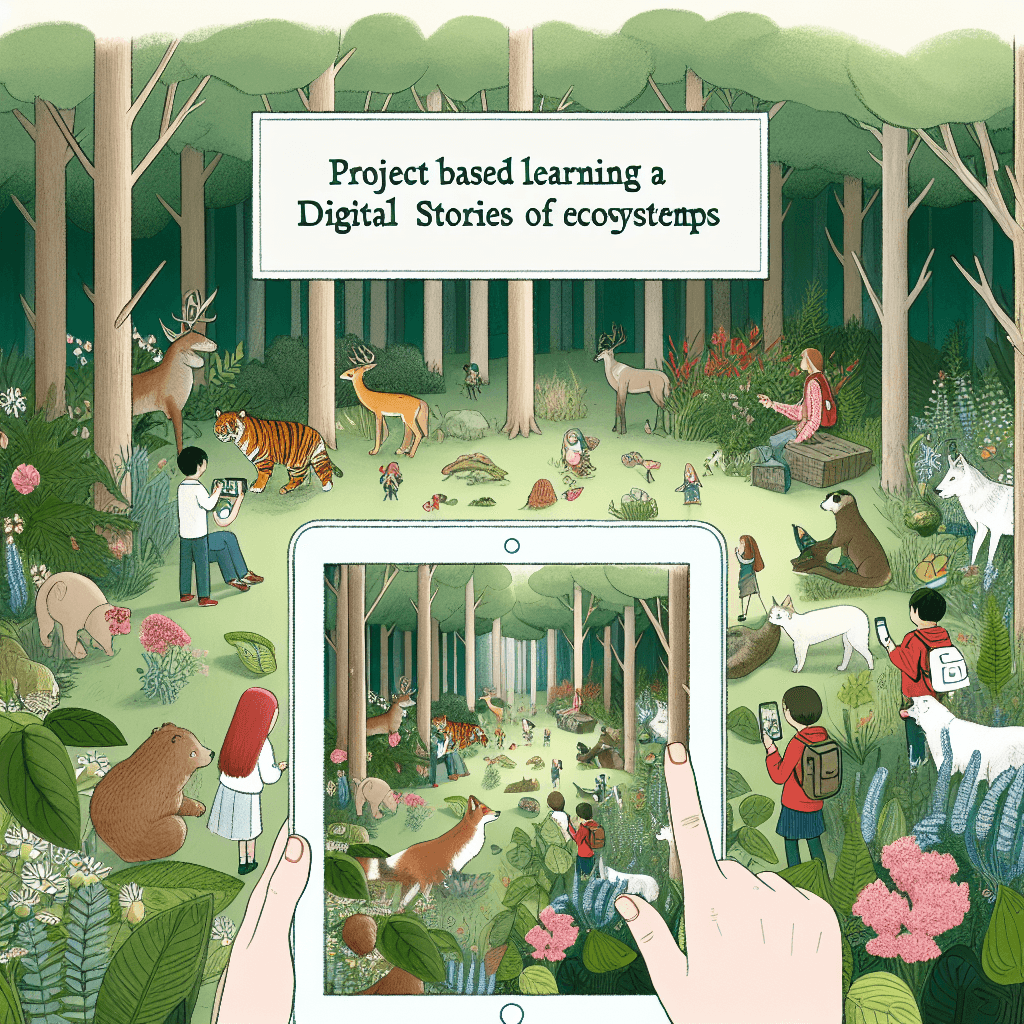
Forest Whisperers: Digital Stories of Ecosystems
Inquiry Framework
Question Framework
Driving Question
The overarching question that guides the entire project.How can we, as young storytellers, create engaging digital stories that explore the complex interactions within different forest ecosystems, highlighting their unique characteristics, the interdependence of plants and animals, and the human impact on these crucial environments?Essential Questions
Supporting questions that break down major concepts.- What characteristics define different forest ecosystems?
- How do the plants and animals in a forest ecosystem depend on each other?
- What is the human impact on forest ecosystems and how can we mitigate it?
- How do climate and geography influence the types of forests found in various regions?
- What role do forests play in our global environment?
- How have human cultures historically depended on and altered forest ecosystems?
Standards & Learning Goals
Learning Goals
By the end of this project, students will be able to:- Students will define and describe the key characteristics of different forest ecosystems, using digital storytelling as a medium to present their findings.
- Students will analyze the interdependence of plants and animals within forest ecosystems, demonstrating understanding through their narratives.
- Students will evaluate the human impact on forest ecosystems, proposing ways to mitigate negative effects in their digital stories.
- Students will explore the influence of climate and geography on the distribution and characteristics of forests globally.
- Students will investigate the cultural and historical relationships between humans and forests, integrating these perspectives into their stories.
- Students will develop skills in using digital tools and technologies to communicate complex environmental concepts creatively.
College, Career, and Civic Life (C3) Framework
Next Generation Science Standards (NGSS)
Entry Events
Events that will be used to introduce the project to studentsVirtual Forest Mystery
Students are introduced to the project with a virtual reality tour of various forest types around the world. During the tour, they discover 'mystery spots' within each forest that contain clues and riddles about the unique features and stories of the ecosystem.Portfolio Activities
Portfolio Activities
These activities progressively build towards your learning goals, with each submission contributing to the student's final portfolio.Forest Ecosystem Detective
Students will begin their journey by investigating the various forest ecosystems. This activity focuses on identifying the characteristics of different forests such as tropical, temperate, and boreal forests using geographic tools and virtual tours.Steps
Here is some basic scaffolding to help students complete the activity.Final Product
What students will submit as the final product of the activityA presentation showcasing the main characteristics of a chosen forest type.Alignment
How this activity aligns with the learning objectives & standardsAligns with D2.Geo.3.3-5 (Using geographic tools and technologies to answer questions about spatial distributions).Interdependence Web Designers
In this activity, students dive deeper into how plants and animals within a forest ecosystem rely on each other. They will create an interactive web to model these relationships.Steps
Here is some basic scaffolding to help students complete the activity.Final Product
What students will submit as the final product of the activityAn interactive digital web of plant and animal interdependencies in a forest ecosystem.Alignment
How this activity aligns with the learning objectives & standardsAligns with D2.Geo.12.3-5 (Explaining the interdependence within natural systems).Human Impact Explorers
Students will explore how human activities impact forest ecosystems and brainstorm solutions to mitigate these effects, ultimately creating a part of their digital story on conservation and change.Steps
Here is some basic scaffolding to help students complete the activity.Final Product
What students will submit as the final product of the activityA storyboard illustrating human impacts and mitigation strategies in forest ecosystems.Alignment
How this activity aligns with the learning objectives & standardsAligns with NGSS.5-ESS3-1 (Using science ideas to protect the Earth’s resources and environment).Forest Cultural Curators
In this activity, students explore and present the historical and cultural significance of their chosen forest. They uncover how different human cultures have historically interacted with and altered these ecosystems.Steps
Here is some basic scaffolding to help students complete the activity.Final Product
What students will submit as the final product of the activityA digital exhibit highlighting the cultural and historical connections humans have with forests.Alignment
How this activity aligns with the learning objectives & standardsAligns with D2.Geo.4.3-5 (Explaining cultural roles in human characteristics of places).Digital Forest Storytellers
The culminating activity where students compile all their findings and creations into a cohesive digital story, effectively communicating their learning journey and insights about forest ecosystems.Steps
Here is some basic scaffolding to help students complete the activity.Final Product
What students will submit as the final product of the activityA comprehensive digital story about forest ecosystems, integrating scientific, cultural, and conservation insights.Alignment
How this activity aligns with the learning objectives & standardsAligns with multiple standards including D2.Geo.4.3-5, D2.Geo.12.3-5, and NGSS.5-ESS3-1, as it brings together cultural, interdependent, and human impact aspects with creative communication skills.Rubric & Reflection
Portfolio Rubric
Grading criteria for assessing the overall project portfolioForest Ecosystem Digital Storytelling Rubric
Content Understanding and Analysis
Assesses students' grasp of forest ecosystems, including characteristics, interdependencies, human impacts, and cultural significance.Forest Characteristics
Evaluates students' understanding of the specific characteristics of their chosen forest, such as types of flora and fauna and their roles in the ecosystem.
Exemplary
4 PointsShows comprehensive understanding of forest characteristics, clearly details unique features and their ecological roles with thorough evidence.
Proficient
3 PointsDemonstrates thorough understanding of forest characteristics and provides details on unique features and ecological roles.
Developing
2 PointsShows basic understanding of forest characteristics with limited details on features and roles.
Beginning
1 PointsShows minimal understanding of forest characteristics with few or no details provided.
Interdependence Analysis
Assesses students’ ability to analyze and represent the interdependence of plants and animals within the forest ecosystem.
Exemplary
4 PointsDemonstrates superior analysis of interdependence using an interactive web with accurate and detailed relationships between species.
Proficient
3 PointsEffectively analyzes interdependence with a clear and mostly accurate interactive web of species relationships.
Developing
2 PointsProvides a basic analysis of interdependence with some inaccuracies in species relationships.
Beginning
1 PointsAttempts to analyze interdependence but lacks clarity and accuracy in species relationships.
Human Impact and Mitigation
Evaluates students' exploration of human impacts on forests and proposed mitigation strategies.
Exemplary
4 PointsProvides an insightful exploration of human impacts with innovative mitigation strategies and clear connections to conservation.
Proficient
3 PointsPresents a solid exploration of human impacts with feasible mitigation strategies and good conservation connections.
Developing
2 PointsExplores some human impacts but with limited mitigation strategies and unclear conservation connections.
Beginning
1 PointsMinimal exploration of human impacts with few or no mitigation strategies.
Cultural and Historical Connections
Assesses students' understanding and presentation of the cultural significance and historical connections of forest ecosystems.
Exemplary
4 PointsExcellently showcases cultural significance and historical connections with diverse, well-researched examples.
Proficient
3 PointsClearly presents cultural significance and historical connections using well-chosen examples.
Developing
2 PointsShows basic presentation of cultural significance with limited examples and details.
Beginning
1 PointsProvides minimal cultural and historical connections with vague or incorrect examples.
Creativity and Communication
Evaluates students’ creativity and effectiveness in communicating ideas through digital storytelling.Creative Storytelling
Measures the originality and engagement of the digital story, including narrative structure and use of media.
Exemplary
4 PointsDemonstrates exceptional creativity with a compelling, well-structured narrative using innovative multimedia elements.
Proficient
3 PointsShows solid creativity with a clear, engaging narrative and effective use of media.
Developing
2 PointsPresents a basic narrative with limited originality and use of media.
Beginning
1 PointsMinimal creativity in narrative with ineffective or absent multimedia elements.
Communication and Presentation
Assesses clarity, organization, and effectiveness of the digital presentation in communicating the project’s insights.
Exemplary
4 PointsPresents ideas clearly and logically with a highly organized and visually appealing presentation.
Proficient
3 PointsCommunicates ideas effectively with a well-organized and visually clear presentation.
Developing
2 PointsCommunicates ideas with some clarity but lacks consistency in organization and visual appeal.
Beginning
1 PointsDisplays confused communication, poor organization, and lacks visual coherency.
Technological Proficiency
Assesses the effective use of digital tools and technologies in creating the digital story.Digital Tool Integration
Measures how well students utilize digital tools to enhance their storytelling and present complex information.
Exemplary
4 PointsSkillfully integrates multiple digital tools to create an innovative, detailed, and engaging digital story.
Proficient
3 PointsEffectively uses digital tools to create a cohesive and informative digital story.
Developing
2 PointsUses some digital tools with basic integration but lacks cohesion and depth.
Beginning
1 PointsStruggles with using digital tools, resulting in a disjointed and incomplete digital story.