
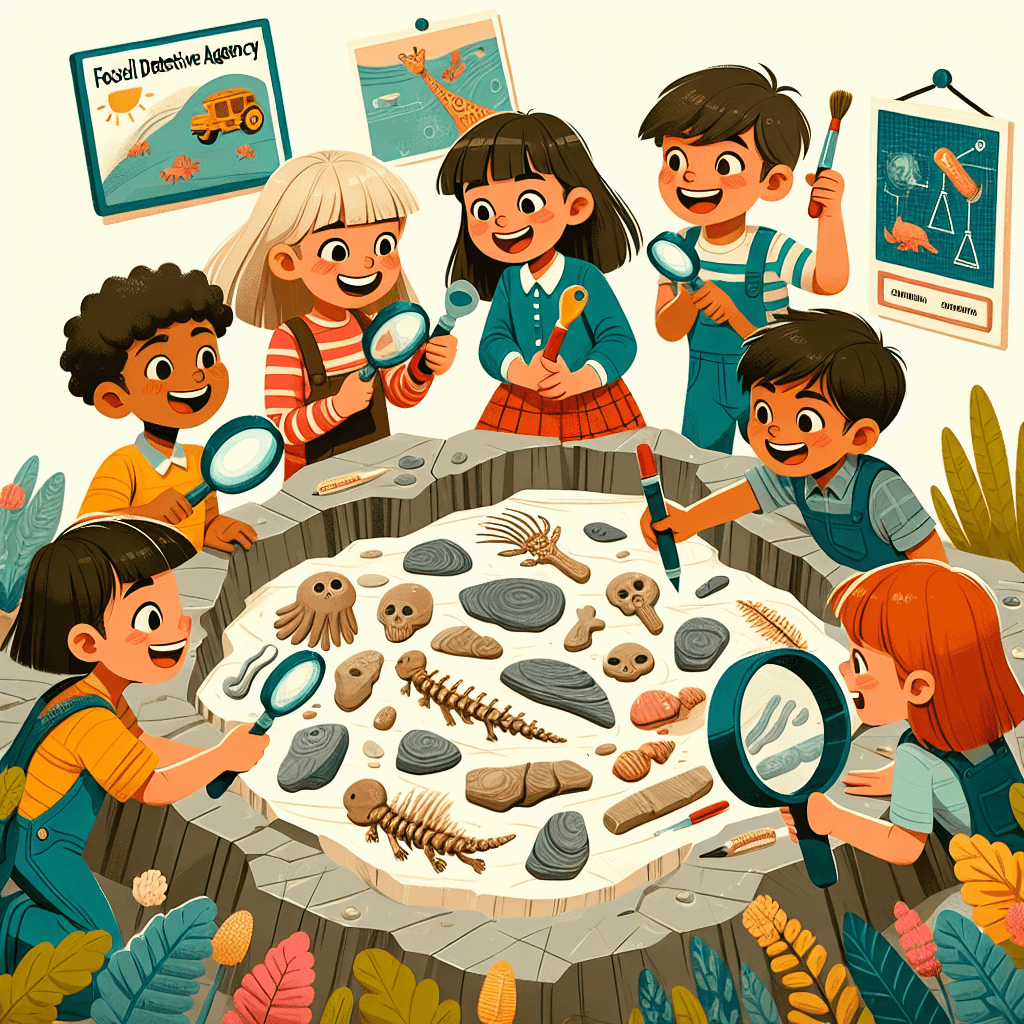
Fossil Detective Agency: Uncover Rock Layer Mysteries
Inquiry Framework
Question Framework
Driving Question
The overarching question that guides the entire project.How can we, as fossil detectives, use evidence from fossils and rock layers to uncover the mysteries of Earth's changing landscapes over time?Essential Questions
Supporting questions that break down major concepts.- What are fossils and how are they formed?
- How can fossils and rock layers tell us about changes in Earth's landscapes over time?
- What evidence can we find to support the idea that water and land environments have changed over time?
- Why is it important to study fossils and rock formations?
- How do patterns in rock formations and fossils help us understand Earth's history?
Standards & Learning Goals
Learning Goals
By the end of this project, students will be able to:- Understand the formation of fossils and their role in interpreting Earth's history.
- Analyze patterns in rock formations and fossils to deduce changes in Earth's landscapes over time.
- Develop skills in scientific inquiry by acting as 'fossil detectives' to gather and interpret geologic evidence.
- Communicate findings effectively, using evidence from fossils and rock layers to support their explanations of landscape changes.
Next Generation Science Standards (NGSS)
Entry Events
Events that will be used to introduce the project to studentsVirtual Reality (VR) Paleo Adventure
Embark on a VR journey where students virtually explore ancient habitats, witnessing the transition from water to land. Through interactive hotspots, they pause to gather fossil evidence, fostering a deeper connection to real-world paleontology and honing critical thinking about landscape transformations.Portfolio Activities
Portfolio Activities
These activities progressively build towards your learning goals, with each submission contributing to the student's final portfolio.Fossil Formation Fun
Students will learn about how fossils are formed by engaging in a hands-on activity that simulates fossilization. They will understand the various conditions necessary for fossil formation, which is key to understanding how we interpret Earth's history through fossils.Steps
Here is some basic scaffolding to help students complete the activity.Final Product
What students will submit as the final product of the activityA class report summarizing the conditions for fossilization and initial observations from the experiment.Alignment
How this activity aligns with the learning objectives & standardsAligns with NGSS 4-ESS1-1 by helping students understand the formation of fossils, supporting the explanation of past environments.Rock Layer Investigator
Students investigate how rock layers form and what they tell us about Earth's past. Through modeling and observation, they will uncover how different rock types indicate various historical environmental conditions.Steps
Here is some basic scaffolding to help students complete the activity.Final Product
What students will submit as the final product of the activityA labeled diagram of the rock layer model with explanations of what each layer suggests about past environments.Alignment
How this activity aligns with the learning objectives & standardsSupports NGSS 4-ESS1-1 by helping students analyze patterns in rock layers to understand changes in Earth's landscapes.Fossil and Rock Pattern Detective
Students put their detective skills to the test by analyzing patterns in an assortment of fossil and rock layer photographs to deduce the sequence of historical events. This activity enhances their ability to draw conclusions from indirect evidence.Steps
Here is some basic scaffolding to help students complete the activity.Final Product
What students will submit as the final product of the activityA sequenced timeline of photographs with annotations explaining the changes in landscape over time.Alignment
How this activity aligns with the learning objectives & standardsMeets NGSS 4-ESS1-1 by using fossil and rock evidence to explain changes over time.Geologic Evidence Presentation
In this culminating activity, students create a presentation showcasing their understanding of how geologic evidence from fossils and rock formations can unravel Earth's history. They will synthesize information from previous activities and communicate their findings effectively.Steps
Here is some basic scaffolding to help students complete the activity.Final Product
What students will submit as the final product of the activityA presentation or poster explaining the historical significance of specific fossils or rock formations, showcasing students' inquiry skills and understanding.Alignment
How this activity aligns with the learning objectives & standardsFully aligned with NGSS 4-ESS1-1 by requiring students to use geologic evidence to explain landscape changes, thus demonstrating their learning.Rubric & Reflection
Portfolio Rubric
Grading criteria for assessing the overall project portfolioFossil Detective Agency Rubric
Scientific Understanding
Evaluates students' comprehension of fossil formation, rock layers, and their significance in explaining Earth's history.Understanding of Fossil Formation
Assesses students' grasp of how fossils are formed and their role in interpreting historical environments.
Exemplary
4 PointsDemonstrates detailed knowledge of fossil formation processes and effectively explains their significance in understanding Earth's history.
Proficient
3 PointsShows thorough knowledge of fossil formation and provides clear explanations of their importance in understanding historical environments.
Developing
2 PointsDisplays basic knowledge of fossil formation with inconsistent explanations about their significance.
Beginning
1 PointsExhibits limited understanding of fossil formation and struggles to explain their importance.
Analysis of Rock Layers
Assesses students' ability to analyze rock layers and deduce their significance regarding landscape changes over time.
Exemplary
4 PointsPerforms comprehensive analysis of rock layers, illustrating a deep understanding of how they indicate landscape changes.
Proficient
3 PointsConducts effective analysis of rock layers with consistent insights into landscape changes.
Developing
2 PointsShows some ability to analyze rock layers, but explanations of landscape changes are superficial.
Beginning
1 PointsStruggles to analyze rock layers effectively and provides minimal insight into landscape changes.
Scientific Inquiry and Skills
Assesses students' ability to apply inquiry skills in conducting experiments, analyzing data, and drawing conclusions.Application of Inquiry Skills
Evaluates students' competency in designing and conducting scientific experiments, and interpreting results.
Exemplary
4 PointsExcellently designs and conducts experiments, demonstrating significant insights and drawing well-supported conclusions.
Proficient
3 PointsEffectively designs and conducts experiments, providing clear conclusions based on evidence.
Developing
2 PointsInconsistently designs and conducts experiments with partially supported conclusions.
Beginning
1 PointsDemonstrates minimal skill in designing and conducting experiments, with incomplete or unsupported conclusions.
Communication of Scientific Ideas
Evaluates students’ ability to communicate their findings effectively through presentations and written reports.Clarity and Coherence in Presentation
Assesses the organization, clarity, and coherence of students’ presentations and reports.
Exemplary
4 PointsPresents ideas with exceptional clarity and logic, using evidence persuasively to enhance explanations.
Proficient
3 PointsPresents ideas clearly and logically, using relevant evidence to support key points.
Developing
2 PointsPresents ideas with some clarity, but lacks consistent evidence or coherent structure.
Beginning
1 PointsStruggles to present ideas clearly, with disorganized information and minimal evidence.