
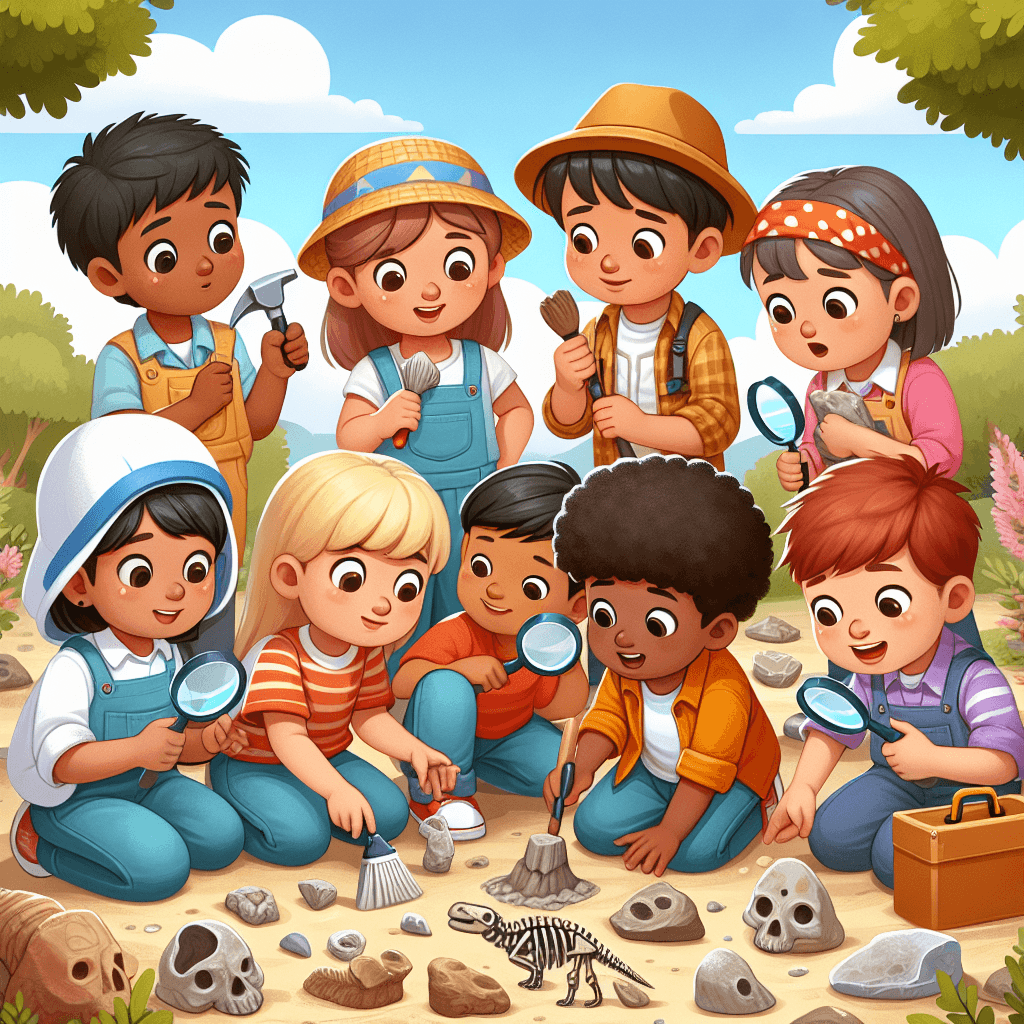
Fossil Finders: Acting Like Scientists
Inquiry Framework
Question Framework
Driving Question
The overarching question that guides the entire project.How can we, as junior paleontologists, use the study of fossils and the tools of scientists to understand and explain how life on Earth has changed over time?Essential Questions
Supporting questions that break down major concepts.- How do scientists use fossils to learn about the past?
- What tools do scientists use when studying fossils?
- How can we tell the difference between different types of fossils?
- How do fossils help us understand how animals and plants have changed over time?
Standards & Learning Goals
Learning Goals
By the end of this project, students will be able to:- Students will be able to identify and classify different types of fossils.
- Students will be able to describe how fossils are formed.
- Students will be able to explain how fossils provide evidence of changes in life on Earth over time.
- Students will be able to use scientific tools to study fossils.
- Students will be able to communicate their findings about fossils to others, acting as junior paleontologists
Entry Events
Events that will be used to introduce the project to studentsFossil Dig Adventure
The classroom is transformed into a 'fossil dig site' using sandboxes or designated areas. Students, equipped with brushes and small tools, excavate hidden 'fossils' (plaster casts or 3D printed models). This hands-on experience sparks curiosity about what they've found and the process of fossil discovery.Portfolio Activities
Portfolio Activities
These activities progressively build towards your learning goals, with each submission contributing to the student's final portfolio.Time Traveler: Fossils as Evidence
Students will analyze a set of fossil data (pictures and descriptions) to infer how organisms and environments have changed over millions of years.Steps
Here is some basic scaffolding to help students complete the activity.Final Product
What students will submit as the final product of the activityA written explanation of how the provided fossils demonstrate change over time, including specific examples.Alignment
How this activity aligns with the learning objectives & standardsLearning Goal: Students will be able to explain how fossils provide evidence of changes in life on Earth over time.Paleontologist's Toolkit
Students will learn about and use common tools that paleontologists use, such as magnifying glasses, brushes, and measuring tools, to examine and document 'fossil' specimens.Steps
Here is some basic scaffolding to help students complete the activity.Final Product
What students will submit as the final product of the activityA detailed observation log for each 'fossil,' including measurements, descriptions, and sketches.Alignment
How this activity aligns with the learning objectives & standardsLearning Goal: Students will be able to use scientific tools to study fossils.Rubric & Reflection
Portfolio Rubric
Grading criteria for assessing the overall project portfolioFossil Analysis and Paleontological Skills Rubric
Fossil Analysis
Assessment of the student's ability to identify, classify, and explain how fossils provide evidence of changes in life on Earth.Fossil Identification
Accuracy of fossil identification and classification.
Exemplary
4 PointsAccurately identifies and classifies all fossils with detailed and precise explanations, demonstrating a comprehensive understanding of fossil types.
Proficient
3 PointsCorrectly identifies and classifies most fossils with clear explanations, showing a solid understanding of fossil types.
Developing
2 PointsIdentifies and classifies some fossils correctly, but explanations are basic and may contain minor inaccuracies, indicating a developing understanding of fossil types.
Beginning
1 PointsStruggles to identify and classify fossils, with limited or inaccurate explanations, showing a beginning understanding of fossil types.
Fossil Evidence Explanation
Quality and depth of explanation of how fossils provide evidence of changes in life on Earth over time.
Exemplary
4 PointsProvides an insightful and comprehensive explanation of how fossils demonstrate changes in plant and animal life over time, including specific examples and advanced connections to environmental changes.
Proficient
3 PointsGives a thorough explanation of how fossils show changes in plant and animal life over time, including relevant examples and clear connections to environmental factors.
Developing
2 PointsOffers a basic explanation of how fossils indicate changes in plant and animal life over time, with some examples and limited connections to environmental changes.
Beginning
1 PointsProvides a minimal explanation of how fossils relate to changes in life on Earth, with few or no examples, and lacks connection to environmental factors.
Paleontological Skills
Assessment of the student's ability to use paleontological tools to study fossils and create detailed observation logs.Tool Application
Accuracy and detail of observations and measurements using paleontological tools.
Exemplary
4 PointsUses paleontological tools with precision and captures detailed, accurate observations and measurements, demonstrating exceptional skill in scientific data collection.
Proficient
3 PointsUses paleontological tools effectively and records accurate observations and measurements, showing competence in scientific data collection.
Developing
2 PointsUses paleontological tools with some accuracy, but observations and measurements may lack detail or contain minor errors, indicating a developing skill in data collection.
Beginning
1 PointsStruggles to use paleontological tools effectively, resulting in inaccurate or incomplete observations and measurements, showing a beginning skill in data collection.
Observation Log Quality
Completeness and clarity of the observation log, including sketches and written descriptions.
Exemplary
4 PointsCreates a comprehensive and exceptionally clear observation log, featuring detailed sketches and insightful written descriptions that demonstrate a deep understanding of the fossil specimens.
Proficient
3 PointsDevelops a complete and clear observation log with detailed sketches and thorough written descriptions that accurately capture the features of the fossil specimens.
Developing
2 PointsProduces a partially complete observation log with basic sketches and descriptions that capture some features of the fossil specimens, but may lack detail.
Beginning
1 PointsCreates an incomplete observation log with minimal sketches and descriptions that provide limited information about the fossil specimens.