
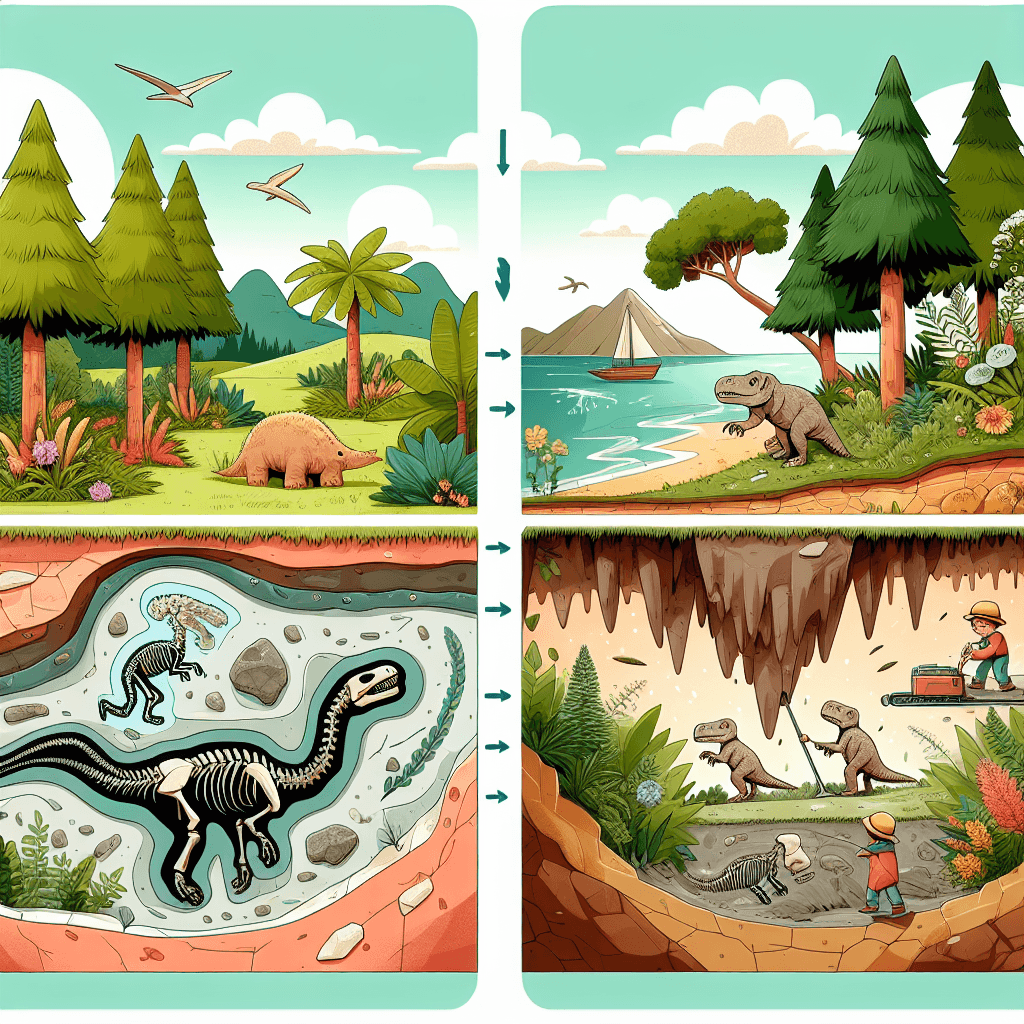
Fossil Formation: A Journey Through Time
Inquiry Framework
Question Framework
Driving Question
The overarching question that guides the entire project.How can we piece together Earth's history, like detectives, using clues from fossils, rocks, and the landscape to understand how continents move and change over millions of years?Essential Questions
Supporting questions that break down major concepts.- How does the distribution of fossils and rocks support the theory of plate tectonics?
- In what ways do the shapes of continents and seafloor structures provide evidence of past plate motions?
- How do tectonic processes influence the creation and destruction of seafloor?
- What can we learn about Earth's history from the study of ancient land and water patterns preserved in rocks and fossils?
Standards & Learning Goals
Learning Goals
By the end of this project, students will be able to:- Students will be able to analyze and interpret data on the distribution of fossils and rocks to provide evidence of past plate motions.
- Students will be able to describe how tectonic processes continually generate new ocean sea floor at ridges and destroy old sea floor at trenches.
- Students will be able to use maps of ancient land and water patterns, based on investigations of rocks and fossils, to explain how Earth’s plates have moved great distances, collided, and spread apart.
- Students will be able to explain how the shapes of continents (including continental shelves) provide evidence of the past plate motions.
- Students will be able to explain how the locations of ocean structures (such as ridges, fracture zones, and trenches) provide evidence of the past plate motions.
- Students will be able to construct a model of how fossils are created over time over many years
NGSS
Entry Events
Events that will be used to introduce the project to studentsThe Mysterious Fossil Anomaly
Students receive a mysterious package containing a 'newly discovered' fossil with an unusual anomaly. They must analyze the fossil and its surrounding rock matrix to determine its origin, age, and the environmental conditions present during its formation, sparking curiosity about fossil creation and geological history. This event challenges their conventional thinking about fossil formation timelines and the dynamic nature of Earth's processes.Portfolio Activities
Portfolio Activities
These activities progressively build towards your learning goals, with each submission contributing to the student's final portfolio.Tectonic Time Travelers: Fossil Formation Model
Students will construct a 3D model that illustrates how plate tectonics and geological processes lead to the formation of fossils over millions of years. The model should demonstrate the creation of seafloor at ridges, the destruction at trenches, and how continental movement affects fossil distribution.Steps
Here is some basic scaffolding to help students complete the activity.Final Product
What students will submit as the final product of the activityA 3D model (physical or digital) showing the process of fossil formation, including the creation of new seafloor at ridges, subduction at trenches, and the movement of continents with embedded fossils. A written explanation should accompany the model.Alignment
How this activity aligns with the learning objectives & standardsMS-ESS-2.3 (Analyze and interpret data on the distribution of fossils and rocks, continental shapes, and seafloor structures to provide evidence of the past plate motions.)Rubric & Reflection
Portfolio Rubric
Grading criteria for assessing the overall project portfolioTectonic Time Travelers: Fossil Formation Model Rubric
Model Construction and Explanation
Assessment of the model's geological accuracy, fossil integration, and explanatory clarity.Geological Accuracy
Accuracy of geological representations, including seafloor spreading, subduction zones, and continental drift.
Exemplary
4 PointsModel accurately and innovatively represents all geological features and processes with precise detail and demonstrates a deep understanding of their interactions.
Proficient
3 PointsModel accurately represents the major geological features and processes, demonstrating a thorough understanding of their interactions.
Developing
2 PointsModel includes some geological features and processes, but may contain inaccuracies or lack detail in their representation.
Beginning
1 PointsModel shows a limited understanding of geological features and processes, with significant inaccuracies or omissions.
Fossil Integration
Integration of fossils within the model to demonstrate their formation and distribution across tectonic plates.
Exemplary
4 PointsFossils are seamlessly integrated into the model, demonstrating a sophisticated understanding of their placement and distribution in relation to plate tectonics. Explanations show novel insights into fossil formation.
Proficient
3 PointsFossils are effectively integrated into the model, demonstrating a clear understanding of their placement and distribution in relation to plate tectonics.
Developing
2 PointsFossils are included in the model, but their placement and distribution may not accurately reflect their relationship to plate tectonics.
Beginning
1 PointsFossils are minimally represented or absent from the model, indicating a limited understanding of their relationship to plate tectonics.
Explanation Clarity
Clarity and completeness of the written explanation describing the model and linking plate tectonics to fossil formation and distribution.
Exemplary
4 PointsThe written explanation is exceptionally clear, detailed, and insightful, providing a comprehensive analysis of the model and its implications for understanding fossil formation and distribution. Demonstrates novel and creative thinking.
Proficient
3 PointsThe written explanation is clear, detailed, and provides a thorough description of the model and its implications for understanding fossil formation and distribution.
Developing
2 PointsThe written explanation provides some description of the model, but may lack detail or clarity in explaining its implications for understanding fossil formation and distribution.
Beginning
1 PointsThe written explanation is incomplete, unclear, or lacks a connection to the model and its implications for understanding fossil formation and distribution.
Model Design and Aesthetics
Evaluation of the model's construction quality and effective use of visual elements.Construction Quality
Quality of construction, including neatness, attention to detail, and effective use of materials or software.
Exemplary
4 PointsModel construction is exceptionally neat, detailed, and demonstrates skillful and innovative use of materials or software to enhance understanding and engagement.
Proficient
3 PointsModel construction is neat, detailed, and demonstrates effective use of materials or software.
Developing
2 PointsModel construction is adequate, but may lack neatness or attention to detail, and use of materials or software may be limited.
Beginning
1 PointsModel construction is poor, lacking neatness, detail, and effective use of materials or software.
Visual Communication
Effective use of visual elements to enhance understanding of complex geological processes and fossil formation.
Exemplary
4 PointsVisual elements are used exceptionally effectively to enhance understanding of complex geological processes and fossil formation, demonstrating creativity and insight.
Proficient
3 PointsVisual elements are used effectively to enhance understanding of complex geological processes and fossil formation.
Developing
2 PointsVisual elements are used, but their impact on enhancing understanding of geological processes and fossil formation is limited.
Beginning
1 PointsVisual elements are minimal or ineffective in enhancing understanding of geological processes and fossil formation.