
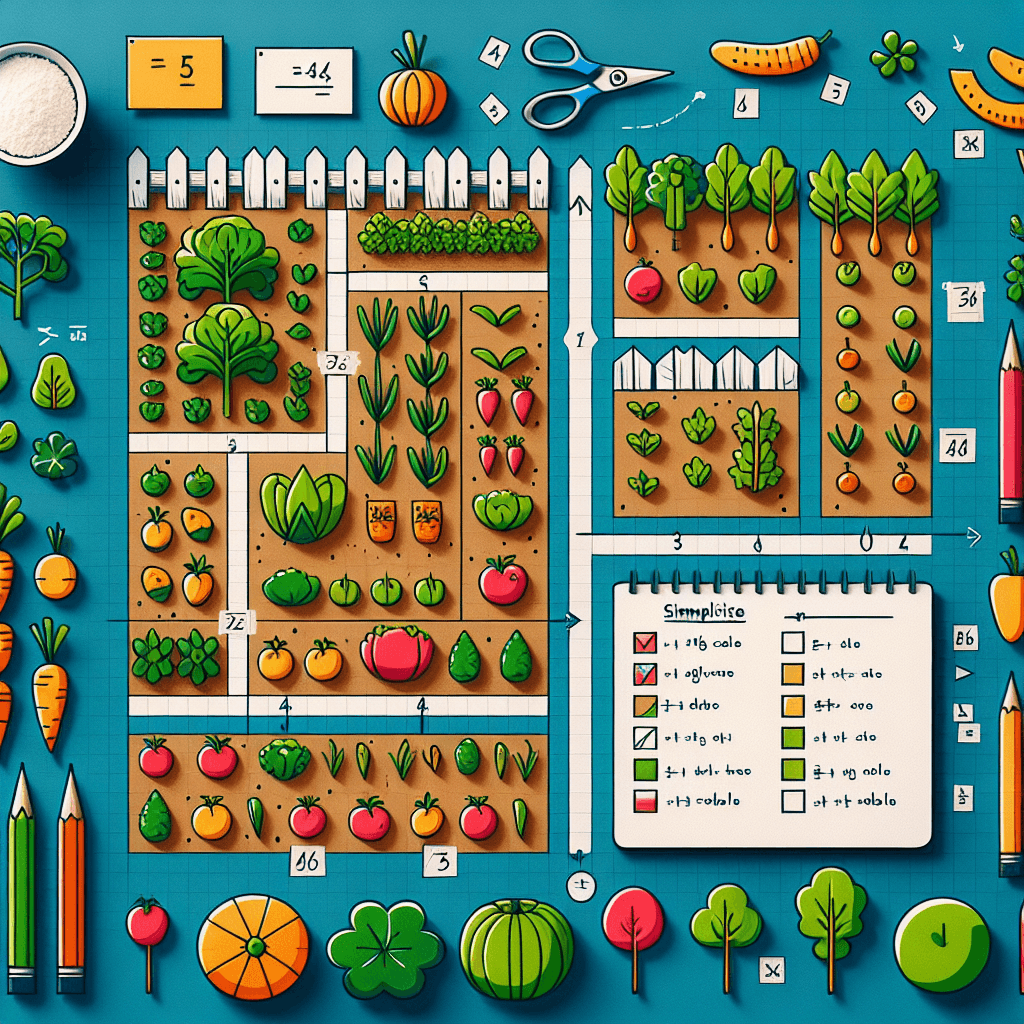
Fraction Farm: Design a Fractional Vegetable Garden
Inquiry Framework
Question Framework
Driving Question
The overarching question that guides the entire project.How can we use our understanding of fractions to design a vegetable farm that maximizes space and efficiency for crop growth?Essential Questions
Supporting questions that break down major concepts.- What are fractions and how can they be used in real-world applications like farming?
- How can we compare and use fractions to make decisions about space and resources?
- In what ways can understanding fractions help in designing an efficient and productive vegetable farm?
- Why is it important to understand equivalent fractions when planning space allocation in farming?
- How do adding and subtracting fractions help in calculating the total space needed for different crops on a farm?
Standards & Learning Goals
Learning Goals
By the end of this project, students will be able to:- Students will understand and apply the concept of equivalent fractions to optimize the use of space in a farming context.
- Students will develop strategies to add and subtract fractions in real-world scenarios, specifically in planning the layout of a vegetable farm.
- Students will use visual fraction models to solve complex problems regarding space allocation, part-to-whole relationships, and efficiency in farming.
- Students will interpret fractions as division and apply this understanding to distribute resources across the farming plots efficiently.
Common Core Standards
Entry Events
Events that will be used to introduce the project to studentsVirtual Farmer's Market Visit
Kick off with a virtual tour of a bustling farmer's market. Students will engage with real farmers discussing how they use fractions to allocate and sell produce, providing a real-world context to fractions.Design Your Dream Farm
Students are challenged to design their dream vegetable farm layout using a set amount of space, where they must use fraction-based reasoning to divide the land for different vegetables.Interactive Farm Planning Game
Introduce an online farm simulation game where students plan and modify a virtual vegetable farm by manipulating fractions to overcome spatial limitations and optimize growth.Portfolio Activities
Portfolio Activities
These activities progressively build towards your learning goals, with each submission contributing to the student's final portfolio.Design a Fraction Plot
In this activity, students draft a preliminary layout of their Fraction Farm, learning how to use fractions to divide up their plot into different sections efficiently.Steps
Here is some basic scaffolding to help students complete the activity.Final Product
What students will submit as the final product of the activityA draft layout of the fractional farm with labeled sections indicating fractional land allocation.Alignment
How this activity aligns with the learning objectives & standardsSupports 5.NF.1 and 5.NF.3 by interpreting fractions as divisions and applying equivalent fractions to divide space effectively.Fraction Addition and Subtraction Challenge
Incorporate spatial challenges that require addition and subtraction of fractional areas to reallocate resources and optimize farming space without expanding the total land area.Steps
Here is some basic scaffolding to help students complete the activity.Final Product
What students will submit as the final product of the activityA revised and optimized farm layout that incorporates changes made through fraction addition and subtraction.Alignment
How this activity aligns with the learning objectives & standardsCovers 5.NF.2 by applying the solving of word problems using addition and subtraction of fractions to a practical and visual design implementation.Equivalence Efficiency Workshop
This activity focuses on deepening the understanding of equivalent fractions and their importance in farming plot design to ensure each section is proportionate and properly sized despite changes.Steps
Here is some basic scaffolding to help students complete the activity.Final Product
What students will submit as the final product of the activityAn educational poster that illustrates the efficient use of farm space through equivalent fractions, using visual aids and examples.Alignment
How this activity aligns with the learning objectives & standardsReinforces 5.NF.1 by applying equivalent fractions to achieve a balanced farm layout.Fraction Farm Showcase
Culminating in a presentation where students present their final farm designs, explaining the fraction-based decisions and optimizations made to maximize efficiency.Steps
Here is some basic scaffolding to help students complete the activity.Final Product
What students will submit as the final product of the activityA fully-developed Fraction Farm design, supported by a comprehensive presentation on the use of fractions in its creation.Alignment
How this activity aligns with the learning objectives & standardsSynthesizes standards 5.NF.1, 5.NF.2, and 5.NF.3 by having students apply their accumulated knowledge in a real-world, practical presentation.Fraction Basics Bootcamp
Before students can design their Fraction Farm, they need to have a solid understanding of fractions, including equivalency and the ability to add and subtract them. This activity introduces the fundamentals of fractions through hands-on activities and visual models.Steps
Here is some basic scaffolding to help students complete the activity.Final Product
What students will submit as the final product of the activityStudents will compile a math journal entry with examples and explanations of fractions, equivalence, addition, and subtraction.Alignment
How this activity aligns with the learning objectives & standardsAligns with 5.NF.1 and 5.NF.2 by introducing the concepts of addition and subtraction of fractions with unlike denominators and solving word problems using fractions.Rubric & Reflection
Portfolio Rubric
Grading criteria for assessing the overall project portfolioFraction Farm Design Rubric
Understanding Fractions
Evaluation of students' ability to comprehend and apply fractions in real-world scenarios.Fraction Concepts
Measures understanding and application of fraction concepts, including addition, subtraction, and equivalence.
Exemplary
4 PointsDemonstrates sophisticated understanding of fractions, effectively adding, subtracting, and using equivalent fractions in farm design.
Proficient
3 PointsShows thorough understanding of fractions, appropriately using addition, subtraction, and equivalence in farm planning.
Developing
2 PointsExhibits emerging understanding of fractions, with some inconsistencies in application during farm design.
Beginning
1 PointsDisplays initial understanding of fractions with significant struggles in applying concepts to farm layout.
Equivalent Fraction Application
Assesses the ability to use equivalent fractions to optimize farm layout efficiently.
Exemplary
4 PointsApplies equivalent fractions adeptly to achieve optimal space utilization and balance in farm layout.
Proficient
3 PointsUses equivalent fractions successfully to balance farm sections and maximize space efficiently.
Developing
2 PointsOccasionally applies equivalent fractions with partial effectiveness in farm planning.
Beginning
1 PointsStruggles to use equivalent fractions effectively, leading to unoptimized farm designs.
Problem Solving and Critical Thinking
Assesses ability to solve spatial layout challenges using fractions and critical thinking in farm design.Spatial Reasoning
Evaluates use of addition and subtraction of fractions to solve spatial layout challenges.
Exemplary
4 PointsDemonstrates exceptional spatial reasoning by using fractions to innovatively solve layout challenges and optimize resources.
Proficient
3 PointsEffectively uses fractions to solve spatial challenges, showing clear problem-solving strategies.
Developing
2 PointsApplies fractions to solve spatial problems with varying success, needing further development of strategies.
Beginning
1 PointsHas difficulty applying fractions to solve spatial challenges, requiring significant support and guidance.
Presentation and Communication
Evaluates students' ability to communicate their design process and mathematical reasoning effectively.Clarity of Presentation
Assesses clarity and coherence of presenting the farm design process using fractions.
Exemplary
4 PointsCommunicates the design process with clarity and depth, showcasing precise use of fractions and effective use of visuals.
Proficient
3 PointsPresents the design process clearly, accurately explaining fraction use and employing understandable visuals.
Developing
2 PointsPresents the design process with some clarity, though explanations may lack detail and coherence.
Beginning
1 PointsStruggles to communicate the design process clearly, with vague explanations and unclear visuals.