
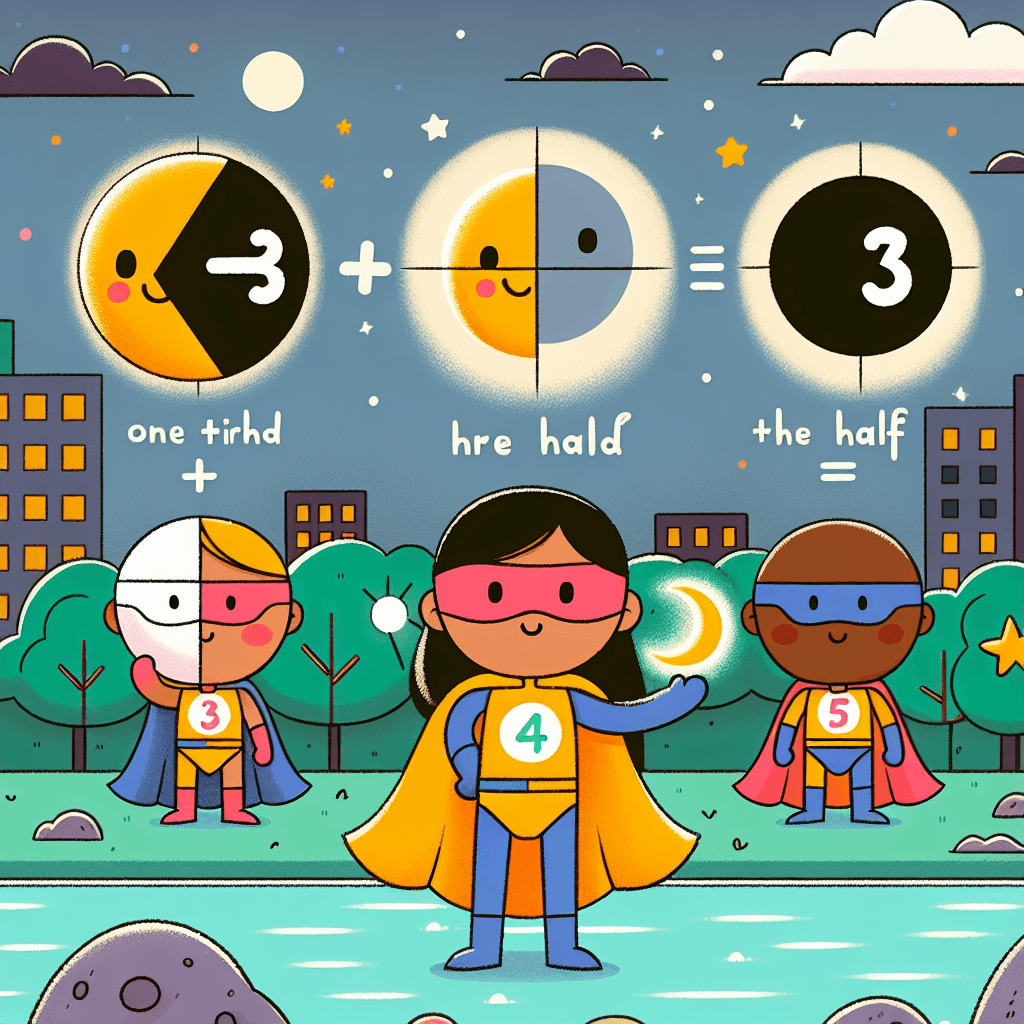
Fraction Heroes: Comics with Superheroes!
Inquiry Framework
Question Framework
Driving Question
The overarching question that guides the entire project.How can we design a superhero comic that uses fractions to illustrate solving real-world problems?Essential Questions
Supporting questions that break down major concepts.- What are fractions and how can they be used to solve problems?
- How can we represent and manipulate fractions visually and numerically?
- In what ways can fractions help us understand parts of a whole in real-world scenarios?
- How can we create a story with superheroes using fractions to solve real-life math problems?
Standards & Learning Goals
Learning Goals
By the end of this project, students will be able to:- Students will understand and apply the concept of fractions to solve real-world problems, using both visual and numerical methods.
- Students will create a superhero comic that integrates fractions as a core element in the story to resolve conflicts or challenges.
- Students will demonstrate the ability to represent fractions visually in their comic scenes and narrate their importance in problem-solving.
- Students will enhance their critical thinking and creative skills by designing a storyline that incorporates mathematical concepts effectively.
Custom Standard Provided by Teacher
Entry Events
Events that will be used to introduce the project to studentsSuperhero Comic Strip
Kickstart the project with a guest presentation from a comic book artist who introduces students to the world of comics. Students are tasked with creating their unique superhero whose powers are derived from fractions, leading to the initial brainstorming of character designs and story plots.Virtual Reality Superhero Adventure
Introduce students to a virtual reality experience where they navigate through a superhero's world solving fraction challenges. This immersive experience allows students to 'become' superheroes and explore how fractions are integrated into saving the day.Comic-Con Fraction Day
Host a mini Comic-Con where each student presents a superhero idea that incorporates fractions as their power. Guest speakers discuss the role of math in creative fields, sparking discussions and leading to the introduction of the students' projects.Portfolio Activities
Portfolio Activities
These activities progressively build towards your learning goals, with each submission contributing to the student's final portfolio.Fraction Superhero Profile Build
In this activity, students will begin by defining their superhero's identity and powers that are rooted in fraction concepts. The activity is designed to help students understand the basic operations of fractions while letting their creativity shine through character development.Steps
Here is some basic scaffolding to help students complete the activity.Final Product
What students will submit as the final product of the activityA detailed superhero profile that explains the character's powers based on fractions, complete with examples of fraction operations.Alignment
How this activity aligns with the learning objectives & standardsAligns with standard 4.3 by focusing on understanding and applying fraction operations in a narrative context that involves problem-solving.Fraction Challenge Storyboard
Students draft a storyboard for their comic, including specific fraction problems that their superhero will have to solve. This activity advances their skills in visual fraction representation and narrative integration.Steps
Here is some basic scaffolding to help students complete the activity.Final Product
What students will submit as the final product of the activityA comprehensive storyboard that connects visual and narrative elements with real-world fraction problems to be solved by the superhero.Alignment
How this activity aligns with the learning objectives & standardsAddresses standard 4.3 through visual representation and narrative structuring of fraction challenges in story problems.Comic Creation: Fractions in Action
In this final activity, students bring their comic stories to life by illustrating the adventure of their fraction superhero, complete with dialogue and visual fraction problem-solving.Steps
Here is some basic scaffolding to help students complete the activity.Final Product
What students will submit as the final product of the activityA finished comic book where fractions play a central role in the superhero's story, integrating visual art with mathematical concepts.Alignment
How this activity aligns with the learning objectives & standardsSupports standard 4.3 by combining visual and numerical fraction representation in a completed narrative format that involves problem-solving.Rubric & Reflection
Portfolio Rubric
Grading criteria for assessing the overall project portfolioFraction Superhero Comic Rubric
Mathematical Concept Application
Assesses the student's ability to integrate and apply fraction operations and concepts within the superhero narrative and illustrations.Fraction Operations Accuracy
Evaluates the correctness and variety of fraction operations (addition, subtraction, multiplication, division) utilized in the superhero's powers and story.
Exemplary
4 PointsDemonstrates a sophisticated and accurate use of fraction operations, showing a variety of methods to solve different problems within the storyline.
Proficient
3 PointsUses fraction operations correctly and includes a good variety of methods to solve problems in the narrative.
Developing
2 PointsDisplays some correct use of fraction operations, but with limited variety and occasional errors in the storyline.
Beginning
1 PointsStruggles to correctly apply fraction operations, with significant errors and insufficient methods demonstrated in the story.
Integration of Fractions in Plot
Measures how well fractions are integrated into the main plot challenges and resolutions within the comic.
Exemplary
4 PointsFractions are deeply integrated into the main plot and serve as core elements in both challenges and solutions throughout the story.
Proficient
3 PointsFractions are effectively integrated into the plot, playing important roles in the challenges and their resolutions.
Developing
2 PointsFractions are somewhat integrated into the plot, with limited roles in challenges and their resolutions.
Beginning
1 PointsFractions are poorly integrated into the plot and have minimal impact on challenges and resolutions.
Creative and Visual Expression
Assesses the creative and visual quality of the comic, including the originality of the superhero concept and clarity of visual fraction representation.Originality and Creativity
Evaluates the originality of the superhero concept, character development, and the innovative use of fractions as powers.
Exemplary
4 PointsPresents a highly original superhero concept with creative use of fractions that enriches the narrative and character development.
Proficient
3 PointsDevelops an original superhero concept with effective use of fractions, contributing positively to the narrative.
Developing
2 PointsShows some originality in the superhero concept and fraction use, but lacks depth in character development.
Beginning
1 PointsHas limited originality in concept and fraction integration, resulting in a weak narrative and character.
Visual Representation of Fractions
Focuses on the clarity and accuracy of visual fraction representations in the comic panels.
Exemplary
4 PointsProvides clear, accurate, and creative visual representations of fractions that significantly enhance the narrative.
Proficient
3 PointsDisplays clear and accurate visual fraction representations that effectively support the narrative.
Developing
2 PointsIncludes some accurate visual fraction representations, but clarity and support for the narrative are inconsistent.
Beginning
1 PointsContains unclear or inaccurate visual fraction representations that detract from the narrative.
Narrative Structure and Cohesion
Assesses the overall structure, coherence, and logical flow of the comic storyline.Narrative Coherence
Evaluates the logical flow of events within the comic and the clear connection between problems and resolutions using fractions.
Exemplary
4 PointsExhibits a coherent and logically flowing narrative where each problem and resolution is clearly connected through the use of fractions.
Proficient
3 PointsPresents a mostly coherent narrative with clear connections between most problems and resolutions involving fractions.
Developing
2 PointsCreates a partly coherent narrative with some connections between problems and resolutions, though some logical gaps exist.
Beginning
1 PointsDemonstrates a disjointed narrative with weak or unclear connections between problems and resolutions using fractions.
Character and Plot Development
Measures the depth and development of the superhero's character and the plot's richness.
Exemplary
4 PointsFeatures richly developed characters and a dynamic plot with engaging fraction-based challenges.
Proficient
3 PointsIncludes well-developed characters and an engaging plot with relevant fraction-based challenges.
Developing
2 PointsShows partially developed characters and a plot that includes some fraction-based challenges, though often underdeveloped.
Beginning
1 PointsContains poorly developed characters and a weak plot with minimal fraction-based challenges.
Problem-Solving and Critical Thinking
Evaluates the student's ability to demonstrate problem-solving and critical thinking skills in mathematical contexts within the comic.Problem-Solving Strategies
Assesses the variety and effectiveness of problem-solving strategies used by the superhero to navigate fraction challenges.
Exemplary
4 PointsUtilizes a wide range of effective and innovative problem-solving strategies to address fraction challenges.
Proficient
3 PointsEmploys effective problem-solving strategies that suitably address fraction challenges.
Developing
2 PointsIncludes some problem-solving strategies, but their effectiveness is inconsistent in addressing fraction challenges.
Beginning
1 PointsLacks effective problem-solving strategies, leading to unresolved or poorly addressed fraction challenges.