
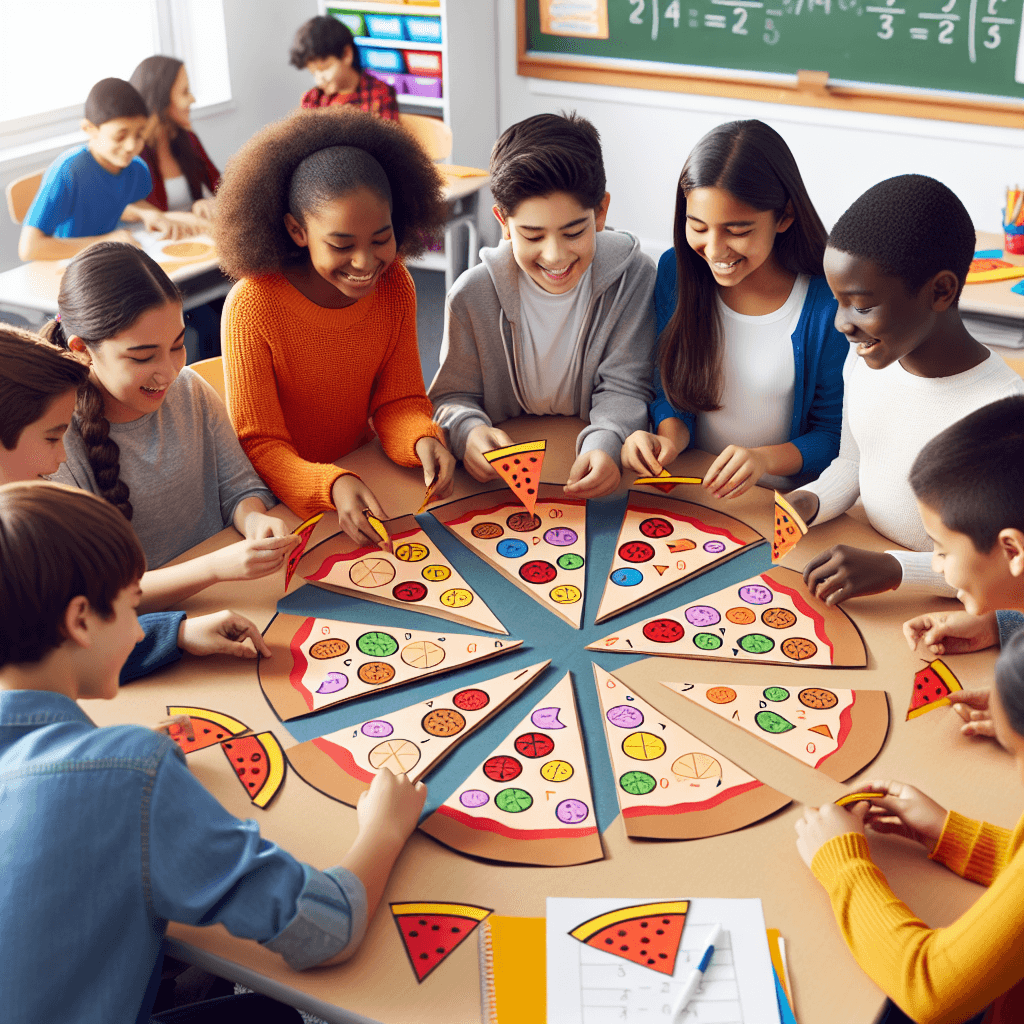
Fraction Pizza Party: Designing Pizzas with Fractions
Inquiry Framework
Question Framework
Driving Question
The overarching question that guides the entire project.How can we design pizzas to understand and use fractions in representing parts of a whole in real-life scenarios?Essential Questions
Supporting questions that break down major concepts.- What is a fraction?
- How can we represent fractions using real-world objects?
- Why are fractions important in everyday life?
- How can we use fractions to describe parts of a whole?
- What strategies can we use to compare different fractions?
Standards & Learning Goals
Learning Goals
By the end of this project, students will be able to:- Students will understand what a fraction is and how it represents part of a whole.
- Students will be able to represent fractions using real-world objects such as pizzas.
- Students will demonstrate the ability to compare different fractions using visual models.
- Students will understand the importance of fractions in everyday life scenarios.
- Students will develop strategies for dividing objects into fractions.
Common Core Standards
Entry Events
Events that will be used to introduce the project to studentsFraction Feast Challenge
Organize a food-themed math race where students must solve fraction-based puzzles to earn pizza toppings for their team. This fast-paced, competitive entry event aims to stimulate motivation and teamwork, offering students a tangible reward while setting the stage for more in-depth exploration of fractions.Pizza Art Showcase
Host a gallery walk where students view famous paintings and discuss how artists use fractions and proportions within art. Afterward, students will create their own pizza-inspired artwork, applying their knowledge of fractions to design pizza slices, combining creativity with conceptual math learning.Portfolio Activities
Portfolio Activities
These activities progressively build towards your learning goals, with each submission contributing to the student's final portfolio.Pizza Piece Fractions
Students will begin by learning the basic concept of fractions, focusing on simple fractions such as 1/2, 1/3, and 1/4. They will use actual pizza slices to visualize how fractions break down a whole into parts.Steps
Here is some basic scaffolding to help students complete the activity.Final Product
What students will submit as the final product of the activityA labeled paper pizza showing different fraction breakdowns like 1/2, 1/3, etc.Alignment
How this activity aligns with the learning objectives & standardsAligns with MA.2.FR.1 - Developing an understanding of fractions by visualizing what fractions mean.Fraction Sundae Toppings
In this activity, students will create their own 'fraction sundaes' using a variety of toppings, each representing a different fraction. They'll practice organizing toppings to demonstrate equal parts and different combinations equaling a whole.Steps
Here is some basic scaffolding to help students complete the activity.Final Product
What students will submit as the final product of the activityA paper or physical sundae complete with fractional toppping labels that add up to a whole.Alignment
How this activity aligns with the learning objectives & standardsAligns with MA.2.FR.1 as students use fractions to create parts of a whole in a practical, engaging format.Fraction Pizza Designer
Combining their understanding of fractions with creativity, students will design and decorate their own paper pizzas. They'll decide on different toppings for each fractional portion of the pizza.Steps
Here is some basic scaffolding to help students complete the activity.Final Product
What students will submit as the final product of the activityA completed paper pizza, creatively designed and accurately labeled with fractions for each topping.Alignment
How this activity aligns with the learning objectives & standardsSupports MA.2.FR.1 by applying fractions to design, helping students visualize fractions as parts of a whole.Fraction Comparison Tasting
Students will bring in snacks of different sizes or types to compare fractions by visually identifying which fractions are larger, smaller, or equal in size, supporting their comprehension of fraction comparison.Steps
Here is some basic scaffolding to help students complete the activity.Final Product
What students will submit as the final product of the activityA comparison chart showing different sized fractions and student observations on orders of size.Alignment
How this activity aligns with the learning objectives & standardsMatches MA.2.FR.1 by enabling students to understand and visually compare the sizes of different fractions using real-life contexts.Rubric & Reflection
Portfolio Rubric
Grading criteria for assessing the overall project portfolioFraction Pizza Party Performance Assessment
Conceptual Understanding of Fractions
Evaluates students' grasp of fractions as parts of a whole and their ability to identify, label, and represent fractional parts accurately.Fraction Identification
Measures ability to accurately identify and label fractions using real-world objects such as pizzas and sundaes.
Exemplary
4 PointsAccurately identifies and labels all fractions using real-world examples, consistently and without errors.
Proficient
3 PointsCorrectly identifies and labels most fractions using real-world examples with minimal errors.
Developing
2 PointsIdentifies and labels fractions using real-world examples inconsistently, with some errors.
Beginning
1 PointsStruggles to identify and label fractions using real-world examples, with frequent errors.
Understanding of Fractional Concepts
Assesses student's comprehension of fractions as parts of a whole and their use in real-life situations.
Exemplary
4 PointsDemonstrates a sophisticated understanding of fractions, effectively explaining their significance in real-world contexts.
Proficient
3 PointsShows thorough understanding of fractions, accurately explaining their relevance in real-world scenarios.
Developing
2 PointsShows basic understanding of fractions, with partial ability to explain their use in real-life contexts.
Beginning
1 PointsDemonstrates limited understanding of fractions and struggles to explain their practical use.
Application and Creativity
Focuses on students' ability to apply their understanding of fractions creatively through the design and presentation of their projects.Creative Application of Fractions
Evaluates creativity and originality in applying fractions to design projects like pizzas and sundaes.
Exemplary
4 PointsApplies fractions in highly creative and original ways, producing outstanding and innovative designs.
Proficient
3 PointsEffectively applies fractions with creativity, producing quality designs with some originality.
Developing
2 PointsApplies fractions with limited creativity, producing designs that show basic understanding.
Beginning
1 PointsStruggles to apply fractions creatively, producing rudimentary and incomplete designs.
Accuracy of Application
Measures the precision and correctness in applying fractional concepts to real-world scenarios within the projects.
Exemplary
4 PointsConsistently applies fractional concepts accurately across all projects, demonstrating precision and correctness.
Proficient
3 PointsApplies fractional concepts accurately in most cases, with few errors in real-world applications.
Developing
2 PointsInconsistently applies fractional concepts, with noticeable errors in some real-world projects.
Beginning
1 PointsStruggles to apply fractional concepts accurately, with frequent and significant errors.
Use of Strategy in Fractional Application
Assesses the student’s ability to strategize and use different methods for dividing objects into fractional parts.
Exemplary
4 PointsDemonstrates advanced strategic thinking in applying various methods to divide objects into fractional parts.
Proficient
3 PointsShows effective use of strategies in dividing objects into fractional parts with occasional guidance.
Developing
2 PointsDisplays basic strategic skills, requiring support to divide objects correctly into fractional parts.
Beginning
1 PointsStruggles with applying strategies to divide objects into fractional parts, needing continuous support.
Communication and Collaboration
Evaluates the ability to explain and discuss fraction concepts and collaborate with peers in group projects.Explanation and Communication
Measures clarity and effectiveness of communication when explaining fractional concepts and project results.
Exemplary
4 PointsExplains and communicates fractional concepts clearly, confidently, and persuasively, facilitating understanding among peers.
Proficient
3 PointsCommunicates fractional concepts effectively, contributing positively to group understanding.
Developing
2 PointsCommunicates fractional concepts adequately, but with some lack of clarity and conviction.
Beginning
1 PointsStruggles to communicate fractional concepts, with significant clarity issues.
Collaboration and Teamwork
Assesses participation and effectiveness in collaborative activities and group discussions about fractions.
Exemplary
4 PointsConsistently contributes ideas and actively engages with peers to facilitate group tasks and discussions.
Proficient
3 PointsParticipates well in group activities, contributing ideas and engaging with peers.
Developing
2 PointsParticipates inconsistently in group activities, needing encouragement to contribute.
Beginning
1 PointsShows little to no participation in group activities, requiring significant encouragement to engage.