
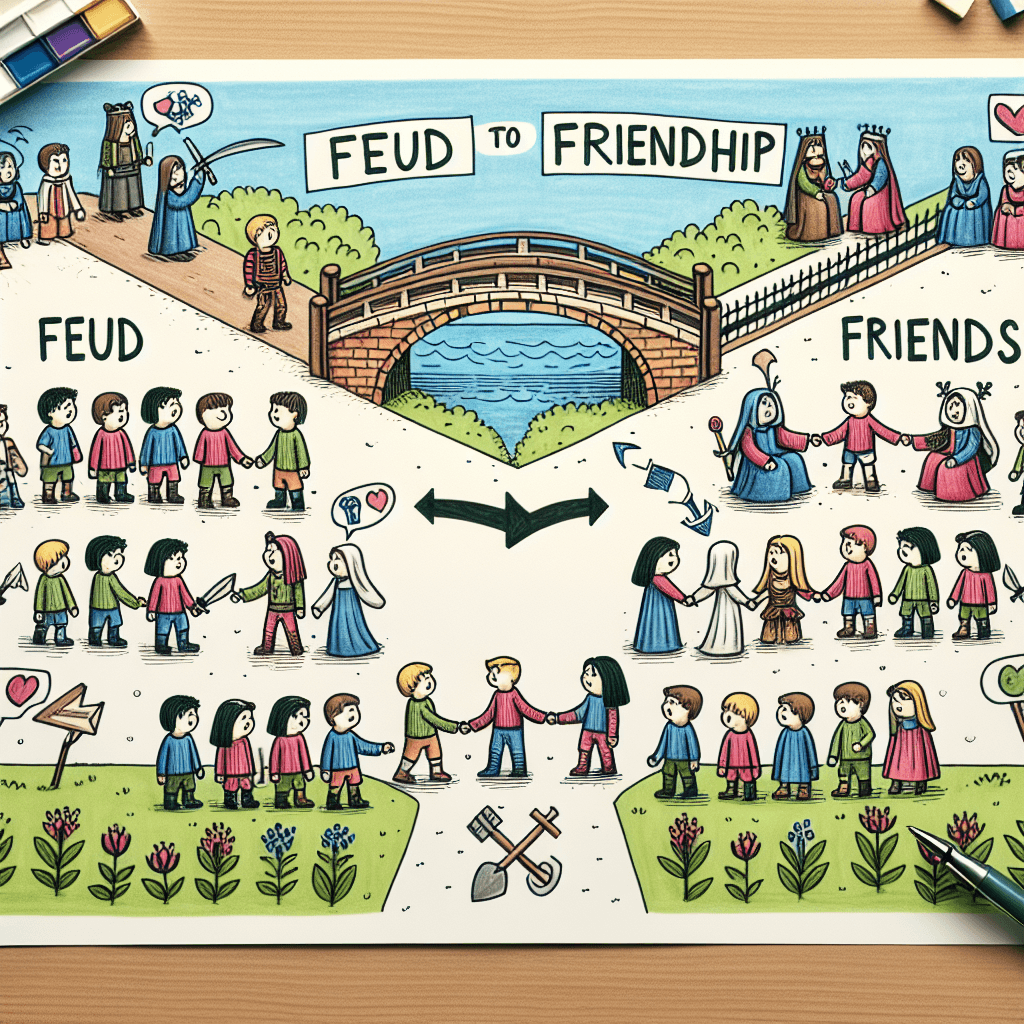
From Feud to Friendship: Solving Verona's Problems
Inquiry Framework
Question Framework
Driving Question
The overarching question that guides the entire project.How can we transform the tragic feud in Romeo and Juliet into an opportunity for collaborative problem-solving that reflects the themes of conflict, perspective, and cultural influence?Essential Questions
Supporting questions that break down major concepts.- What are the key themes and conflicts in Romeo and Juliet, and how do they propel the narrative?
- How can understanding different perspectives in a conflict lead to more effective communication and resolution?
- In what ways do cultural and social contexts influence characters' decisions and these conflicts?
- How might the outcomes of the story change if characters adopted collaborative problem-solving techniques?
- What lessons about human nature and society can be drawn from the conflicts in Romeo and Juliet?
Standards & Learning Goals
Learning Goals
By the end of this project, students will be able to:- Understand and analyze the key themes and conflicts in Romeo and Juliet.
- Evaluate how character motivations and interactions influence the outcomes of the conflicts in the play.
- Explore different perspectives within the text to enhance conflict resolution and collaborative problem-solving skills.
- Propose and articulate alternative resolutions to the conflicts in Romeo and Juliet through collaborative efforts.
- Reflect on the influence of cultural and social contexts on characters' decisions and the development of conflicts.
Common Core Standards
Entry Events
Events that will be used to introduce the project to studentsMystery Role Play
Each student receives a mysterious role related to an event in a modern-day version of Romeo and Juliet. As they role-play, they must uncover hidden motives and alliances, sparking intrigue and encouraging them to think critically about character relationships and conflict resolution.Portfolio Activities
Portfolio Activities
These activities progressively build towards your learning goals, with each submission contributing to the student's final portfolio.Theme and Conflict Detective
Students will analyze key themes and conflicts in Romeo and Juliet to understand their role in propelling the narrative forward. This activity will help students gather textual evidence to support their understanding and insights about the play.Steps
Here is some basic scaffolding to help students complete the activity.Final Product
What students will submit as the final product of the activityA graphic organizer filled with quotes and explanations demonstrating understanding of themes and conflicts.Alignment
How this activity aligns with the learning objectives & standardsAligns with CCSS.ELA-LITERACY.RL.9-10.1 by requiring students to cite textual evidence in their analysis.Character Perspective Mapping
Students will delve deeper into character motivations and interactions to explore different perspectives and the potential for conflict resolution in Romeo and Juliet. This activity encourages students to consider how characters' motivations drive the plot and affect relationships.Steps
Here is some basic scaffolding to help students complete the activity.Final Product
What students will submit as the final product of the activityA completed character map highlighting motivations and relationships, accompanied by group discussion notes.Alignment
How this activity aligns with the learning objectives & standardsSupports CCSS.ELA-LITERACY.RL.9-10.3 by analyzing character development and interactions.Collaborative Conflict Resolution Workshop
Through a guided workshop, students focus on rewriting a key conflict scene in Romeo and Juliet to demonstrate collaborative problem-solving. This activity combines creative writing and group collaboration to formulate new resolutions.Steps
Here is some basic scaffolding to help students complete the activity.Final Product
What students will submit as the final product of the activityA re-written scene presented to the class, showcasing an alternative resolution through collaboration.Alignment
How this activity aligns with the learning objectives & standardsIntegrates CCSS.ELA-LITERACY.SL.9-10.1 through discussions and CCSS.ELA-LITERACY.W.9-10.1 by writing revised scenes that support collaborative claims.Argumentative Writing: Propose a Solution
Students will write an argumentative piece that proposes a solution to a conflict in Romeo and Juliet. The activity focuses on constructing a coherent argument using textual evidence and reasoning.Steps
Here is some basic scaffolding to help students complete the activity.Final Product
What students will submit as the final product of the activityAn argumentative essay proposing a feasible solution to a conflict from the play.Alignment
How this activity aligns with the learning objectives & standardsMeets CCSS.ELA-LITERACY.W.9-10.1 by supporting claims with valid reasoning and evidence.Rubric & Reflection
Portfolio Rubric
Grading criteria for assessing the overall project portfolioRomeo & Juliet Conflict to Collaboration
Textual Analysis
Evaluation of students' ability to analyze and interpret key themes and conflicts in Romeo and Juliet, and support their conclusions with textual evidence.Identification of Themes and Conflicts
Assess students' ability to identify and articulate the key themes and conflicts in the text with textual evidence.
Exemplary
4 PointsThoroughly identifies and articulates multiple key themes and conflicts with comprehensive textual evidence and insightful analysis.
Proficient
3 PointsIdentifies and articulates some key themes and conflicts with appropriate textual evidence and sound analysis.
Developing
2 PointsIdentifies key themes and conflicts with limited or inconsistent textual evidence and analysis.
Beginning
1 PointsStruggles to identify key themes and conflicts with minimal or inaccurate textual evidence.
Character Perspective Analysis
Evaluate students' ability to analyze and interpret character motivations and their influence on plot and relationships.
Exemplary
4 PointsExcellently analyzes character motivations and relationships, providing comprehensive and nuanced observations with a deep understanding of plot influence.
Proficient
3 PointsThoroughly analyzes character motivations and relationships with clear observations and understanding of plot influence.
Developing
2 PointsProvides basic analysis of character motivations and relationships with some observations about plot influence.
Beginning
1 PointsOffers minimal or superficial analysis of character motivations and limited observations of plot influence.
Collaborative Problem-Solving
Assessment of students' ability to apply collaborative strategies to rewrite a conflict scene from Romeo and Juliet and demonstrate the impact of these strategies.Application of Collaborative Strategies
Measure how effectively students use collaborative strategies to alter a conflict scene and the depth of understanding reflected in their revisions.
Exemplary
4 PointsCreative and sophisticated application of collaborative strategies with a clear and insightful demonstration of improved conflict outcomes.
Proficient
3 PointsEffective use of collaborative strategies with well-articulated demonstration of improved conflict outcomes.
Developing
2 PointsBasic application of collaborative strategies with some attempt to demonstrate improved conflict outcomes.
Beginning
1 PointsMinimal application of collaborative strategies with unclear demonstration of conflict outcomes.
Performance and Presentation
Evaluate students' ability to present and articulate their revised scene to an audience, demonstrating clear understanding and creative problem-solving.
Exemplary
4 PointsOutstanding and engaging presentation with clear articulation of creative solutions, showing leadership and confidence.
Proficient
3 PointsClear and effective presentation with well-articulated solutions and confident delivery.
Developing
2 PointsAdequate presentation with some clarity in articulated solutions, but inconsistent delivery.
Beginning
1 PointsUnclear or incomplete presentation with limited articulation of solutions and lacking confidence.
Argumentative Writing
Evaluation of students' ability to construct a strong argumentative essay proposing solutions to a conflict in Romeo and Juliet, supporting their claims with relevant evidence.Argument Construction
Assess students' ability to construct logical and coherent arguments with clear claims and supporting evidence.
Exemplary
4 PointsConstructs highly logical and coherent arguments with insightful claims and extensive supporting evidence from the text.
Proficient
3 PointsDevelops clear and logical arguments with well-supported claims and relevant evidence.
Developing
2 PointsForms basic arguments with some claims and supporting evidence, but lacks coherence.
Beginning
1 PointsAttempts basic argument construction with unclear claims and limited evidence support.
Use of Textual Evidence
Evaluate how students incorporate textual evidence to support their proposed solutions in the essay.
Exemplary
4 PointsIncorporates a wide range of relevant textual evidence that strongly supports all claims and enhances argumentation.
Proficient
3 PointsUses relevant textual evidence to support claims effectively, enhancing credibility of the argument.
Developing
2 PointsIncorporates some textual evidence, but its support for claims is unclear or inconsistent.
Beginning
1 PointsLimited use of textual evidence with minimal support for claims, weakening the argument.