
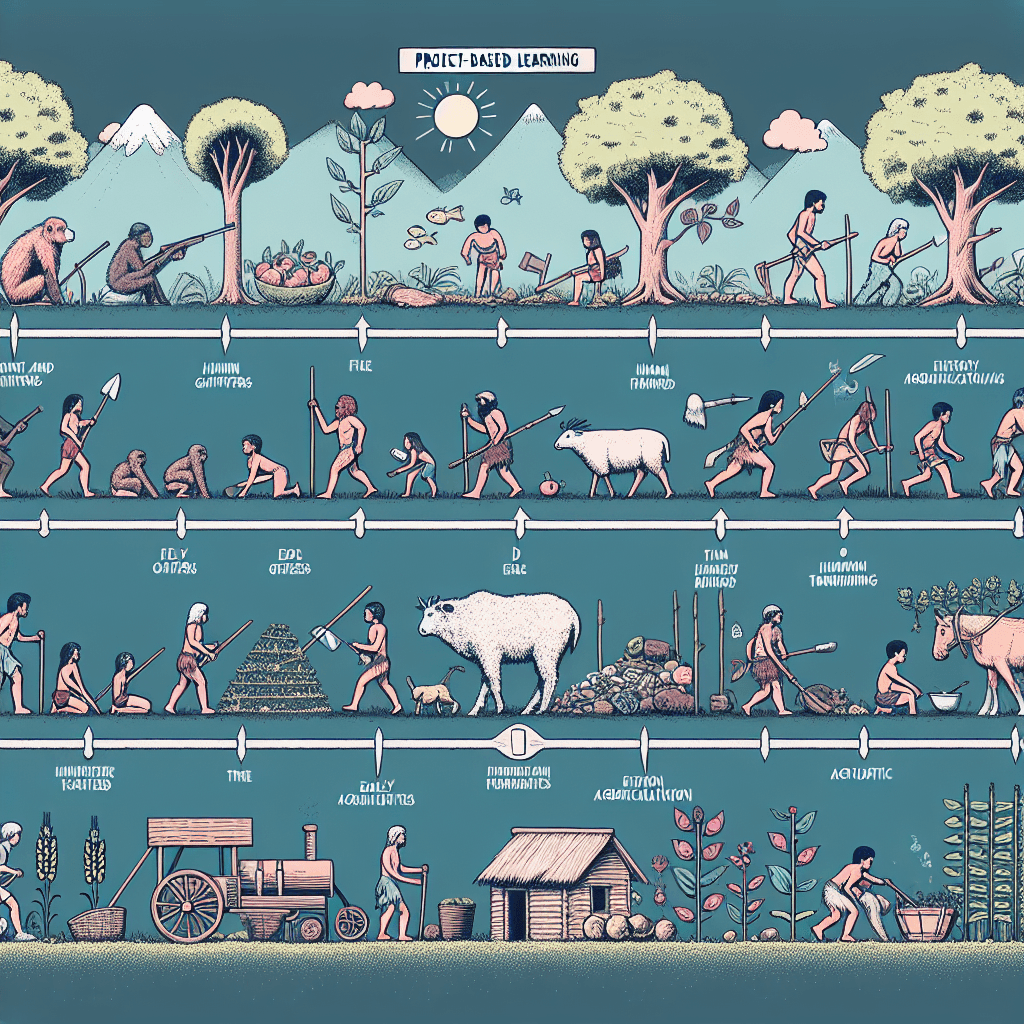
From Hunter-Gatherers to Farmers: An Agricultural Revolution Timeline
Inquiry Framework
Question Framework
Driving Question
The overarching question that guides the entire project.How did the domestication of plants and animals transform early human societies and their interactions with the environment, and how might these transformations shape our future world?Essential Questions
Supporting questions that break down major concepts.- How did early humans adapt to their environment to develop agriculture?
- What were the economic and social consequences of the agricultural revolution?
- How did the domestication of plants and animals lead to the development of specialized jobs and economies?
- How has agriculture changed over time, and what might it look like in the future?
- How did the environment and geography influence the development of early agricultural practices?
- What were the unintended consequences of early economic decisions related to agriculture?
- In what ways did agriculture and the rise of civilizations impact land use?
- What problems arose during the development of civilizations related to agriculture, and how can we analyze them through different social studies disciplines?
- How did changes in early civilizations affect agriculture and the environment?
- How did agriculture influence the movement of people, goods, and ideas in early civilizations?
Standards & Learning Goals
Learning Goals
By the end of this project, students will be able to:- Understand the role of agriculture in the development of early human societies.
- Analyze the impact of plant and animal domestication on societal structures and the environment.
- Evaluate the changes in agriculture from early man to modern times and into the future.
- Apply interdisciplinary perspectives to examine problems that arose during the development of civilizations related to agriculture.
Teacher Specified Standards
Entry Events
Events that will be used to introduce the project to studentsTimeline Mystery
Provide students with a jumbled timeline of key events in agricultural history, from early domestication to modern farming techniques. Students must work together to research and correctly order the events, creating a visual representation of the evolution of agriculture and setting the stage for the project's culminating timeline product.Portfolio Activities
Portfolio Activities
These activities progressively build towards your learning goals, with each submission contributing to the student's final portfolio.Early Human Habitats: A Geographic Study
Students will research and map the geographic locations of early human settlements, focusing on areas where the domestication of plants and animals first occurred. They will analyze how the physical environment influenced the development of agricultural practices.Steps
Here is some basic scaffolding to help students complete the activity.Final Product
What students will submit as the final product of the activityA detailed map with annotated analyses of how the physical environment influenced early agricultural practices in selected settlements.Alignment
How this activity aligns with the learning objectives & standardsAligns with 6.G.HE.1 (Analyze how physical environments shaped the development of River Valley Civilizations) and 6.G.MM.1 (Compare how humans and the environment of a region influenced the movement of people, goods, and ideas.)The Domestication Chain Reaction
Students will create a visual representation (e.g., flowchart, infographic) illustrating the step-by-step process of plant and animal domestication and its effects on societal development. They will focus on how domestication led to surplus, specialization, and early economic systems.Steps
Here is some basic scaffolding to help students complete the activity.Final Product
What students will submit as the final product of the activityA visual representation (flowchart, infographic) illustrating the chain reaction from plant/animal domestication to societal and economic changes.Alignment
How this activity aligns with the learning objectives & standardsAligns with 6.H.CE.1 (Analyze the causes and effects of the rise of River Valley Civilizations) and 6.E.MI.2 (Predict and analyze unintended costs and benefits of economic decisions.)River Valley Civilizations: Land Use Analysis
Students will investigate how changes in River Valley Civilizations affected land use. They will analyze the transformations in land management, irrigation, and settlement patterns.Steps
Here is some basic scaffolding to help students complete the activity.Final Product
What students will submit as the final product of the activityA comparative analysis (maps, diagrams) showing changes in land use in a selected River Valley Civilization, along with a written explanation of the causes and consequences.Alignment
How this activity aligns with the learning objectives & standardsAligns with 6.G.HI.1 (Explain how changes in River Valley Civilizations and Classical Empires affected land use) and 6.I.CC.5 (Describe a specific problem from the development of civilizations using each of the social studies disciplines.)Agricultural Innovations Through Time
Students will research and present on a specific agricultural innovation from a particular time period (e.g., irrigation systems in Mesopotamia, crop rotation in medieval Europe, the Green Revolution in the 20th century). They will analyze its impact on food production, society, and the environment.Steps
Here is some basic scaffolding to help students complete the activity.Final Product
What students will submit as the final product of the activityA presentation (slideshow, poster) on a specific agricultural innovation, detailing its historical context, functionality, and impact.Alignment
How this activity aligns with the learning objectives & standardsAligns with 6.I.UE.1 (Develop claims, citing relevant evidence, in response to compelling and supporting questions) and Learning Goal #3 (Evaluate the changes in agriculture from early man to modern times and into the future.)Rubric & Reflection
Portfolio Rubric
Grading criteria for assessing the overall project portfolioPortfolio Rubric: Transforming Agriculture
Geographic Analysis of Early Settlements
Evaluates student understanding of how geographic factors influenced the development of agriculture in early human settlements.Research & Mapping Accuracy
Assesses the accuracy and completeness of the map and research on selected early human settlements.
Exemplary
4 PointsMap is exceptionally accurate and detailed, showcasing comprehensive research and a deep understanding of geographic influences. All locations are clearly marked with precise geographic features, and analyses are thoroughly supported with evidence.
Proficient
3 PointsMap is accurate and includes most key details. Research is thorough, and analyses demonstrate a good understanding of geographic influences. Most locations are clearly marked with relevant geographic features, and analyses are supported with evidence.
Developing
2 PointsMap contains some inaccuracies or lacks detail. Research is adequate but may be missing key information. Analyses show a basic understanding of geographic influences but may be superficial. Some locations are marked, but geographic features or analyses may be lacking.
Beginning
1 PointsMap is largely inaccurate or incomplete. Research is minimal, and analyses demonstrate a limited understanding of geographic influences. Few locations are marked, and geographic features or analyses are insufficient.
Environmental Influence Analysis
Evaluates the depth and insightfulness of the analysis explaining how the environment supported or challenged agriculture.
Exemplary
4 PointsAnalysis demonstrates sophisticated insight into the complex interactions between the environment and agricultural practices, offering nuanced explanations and comprehensive supporting evidence. Clearly articulates both positive and negative environmental influences and their impact on agricultural development.
Proficient
3 PointsAnalysis provides a thorough explanation of how the environment supported or challenged agricultural practices, with clear supporting evidence. Accurately identifies both positive and negative environmental influences and their impact on agricultural development.
Developing
2 PointsAnalysis offers a basic explanation of the environmental influences on agricultural practices but may lack depth or sufficient supporting evidence. Identifies some positive or negative environmental influences but may oversimplify their impact on agricultural development.
Beginning
1 PointsAnalysis provides a superficial or incomplete explanation of the environmental influences on agricultural practices, with minimal supporting evidence. Fails to adequately identify positive or negative environmental influences and their impact on agricultural development.
Domestication Chain Reaction
Assesses student understanding of the cascading effects of plant and animal domestication on societal development.Visual Representation Clarity
Evaluates the clarity and effectiveness of the visual representation (flowchart, infographic) in illustrating the domestication chain reaction.
Exemplary
4 PointsVisual representation is exceptionally clear, well-organized, and visually appealing, effectively illustrating the complex chain reaction from domestication to societal changes. Annotations are concise, insightful, and enhance understanding of the processes involved.
Proficient
3 PointsVisual representation is clear, organized, and effectively illustrates the chain reaction from domestication to societal changes. Annotations are clear and provide sufficient explanation of the processes involved.
Developing
2 PointsVisual representation is somewhat unclear or disorganized, making it difficult to fully understand the chain reaction from domestication to societal changes. Annotations may be missing or unclear.
Beginning
1 PointsVisual representation is confusing, poorly organized, and fails to effectively illustrate the chain reaction from domestication to societal changes. Annotations are minimal or absent.
Cause-and-Effect Analysis
Assesses the student's ability to explain the cause-and-effect relationships between domestication, surplus, specialization, and economic systems.
Exemplary
4 PointsAnalysis demonstrates a sophisticated understanding of the intricate cause-and-effect relationships, providing nuanced explanations and compelling evidence. Clearly articulates the link between domestication, food surplus, job specialization, and the development of complex economic systems.
Proficient
3 PointsAnalysis provides a clear and thorough explanation of the cause-and-effect relationships, with relevant supporting evidence. Accurately describes the link between domestication, food surplus, job specialization, and the development of economic systems.
Developing
2 PointsAnalysis offers a basic explanation of the cause-and-effect relationships but may lack depth or sufficient supporting evidence. Identifies some connections between domestication, surplus, specialization, and economic systems but may oversimplify the processes involved.
Beginning
1 PointsAnalysis provides a superficial or incomplete explanation of the cause-and-effect relationships, with minimal supporting evidence. Fails to adequately explain the link between domestication, food surplus, job specialization, and the development of economic systems.
River Valley Civilizations: Land Use Analysis
Evaluates student understanding of how changes in River Valley Civilizations affected land use patterns and the environment.Before-and-After Comparison
Assesses the clarity and accuracy of the before-and-after comparison (maps, diagrams) illustrating changes in land use.
Exemplary
4 PointsComparison is exceptionally clear, detailed, and visually compelling, providing a comprehensive illustration of changes in land use over time. Effectively highlights the key differences in land use patterns before and after civilization development. Demonstrates deep understanding of the spatial and temporal changes.
Proficient
3 PointsComparison is clear, accurate, and effectively illustrates changes in land use over time. Highlights the key differences in land use patterns before and after civilization development.
Developing
2 PointsComparison is somewhat unclear or lacks detail, making it difficult to fully understand the changes in land use over time. May miss some key differences in land use patterns.
Beginning
1 PointsComparison is confusing, inaccurate, and fails to effectively illustrate the changes in land use over time. Fails to highlight key differences in land use patterns.
Causes and Consequences Analysis
Evaluates the depth and comprehensiveness of the analysis explaining the causes and consequences of land use changes, including environmental impacts and societal adaptations.
Exemplary
4 PointsAnalysis demonstrates a sophisticated understanding of the complex causes and consequences of land use changes, offering nuanced explanations and comprehensive supporting evidence. Clearly articulates both environmental impacts and societal adaptations, showcasing insightful perspectives.
Proficient
3 PointsAnalysis provides a thorough explanation of the causes and consequences of land use changes, with clear supporting evidence. Accurately identifies both environmental impacts and societal adaptations.
Developing
2 PointsAnalysis offers a basic explanation of the causes and consequences of land use changes but may lack depth or sufficient supporting evidence. Identifies some environmental impacts or societal adaptations but may oversimplify their significance.
Beginning
1 PointsAnalysis provides a superficial or incomplete explanation of the causes and consequences of land use changes, with minimal supporting evidence. Fails to adequately identify environmental impacts or societal adaptations.
Agricultural Innovations Through Time
Assesses student understanding of the impact of agricultural innovations on food production, society, and the environment.Presentation Clarity and Accuracy
Evaluates the clarity, organization, and accuracy of the presentation (slideshow, poster) explaining the selected agricultural innovation.
Exemplary
4 PointsPresentation is exceptionally clear, well-organized, and visually engaging, providing a comprehensive and accurate explanation of the agricultural innovation. Effectively uses visuals to enhance understanding and convey key information. Demonstrates exceptional attention to detail.
Proficient
3 PointsPresentation is clear, organized, and accurately explains the agricultural innovation. Uses visuals effectively to support understanding.
Developing
2 PointsPresentation is somewhat unclear or disorganized, making it difficult to fully understand the agricultural innovation. Visuals may be lacking or ineffective.
Beginning
1 PointsPresentation is confusing, poorly organized, and fails to accurately explain the agricultural innovation. Visuals are minimal or absent.
Historical Context and Impact Analysis
Assesses the student's ability to analyze the historical context of the innovation and its impact on food production, society, and the environment.
Exemplary
4 PointsAnalysis demonstrates a sophisticated understanding of the historical context of the innovation and its multifaceted impact on food production, society, and the environment, offering nuanced explanations and compelling evidence. Clearly articulates both intended and unintended consequences.
Proficient
3 PointsAnalysis provides a clear and thorough explanation of the historical context of the innovation and its impact on food production, society, and the environment, with relevant supporting evidence. Accurately describes both intended and unintended consequences.
Developing
2 PointsAnalysis offers a basic explanation of the historical context and impact of the innovation but may lack depth or sufficient supporting evidence. Identifies some consequences but may oversimplify their significance.
Beginning
1 PointsAnalysis provides a superficial or incomplete explanation of the historical context and impact of the innovation, with minimal supporting evidence. Fails to adequately identify the consequences on food production, society, and the environment.