
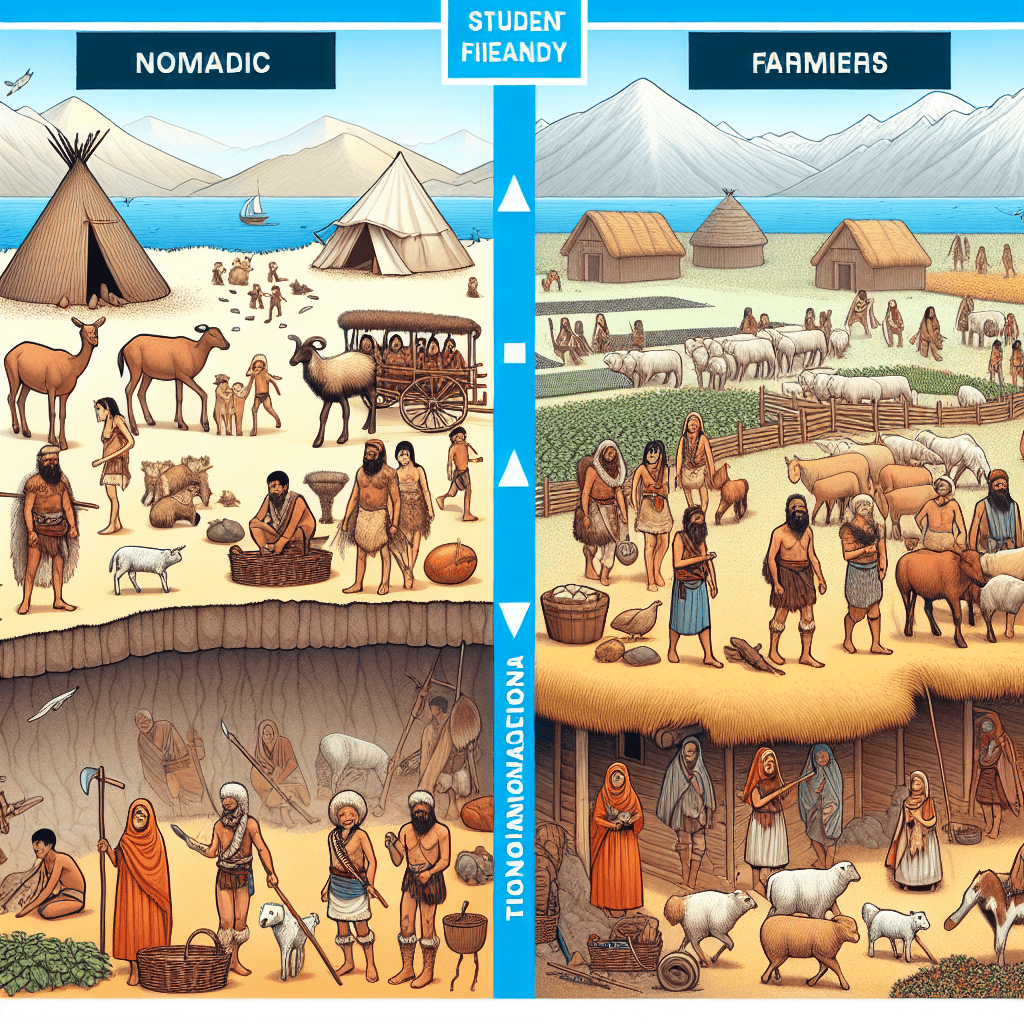
From Nomads to Farmers: Shaping Civilizations Through Agriculture
Inquiry Framework
Question Framework
Driving Question
The overarching question that guides the entire project.How did the transition to agriculture, shaped by geography and resource availability, transform human societies and pave the way for the civilizations we know today?Essential Questions
Supporting questions that break down major concepts.- How did the shift from hunting and gathering to agriculture change human societies?
- In what ways did geography influence the development of early agricultural communities?
- What are the similarities and differences between early agricultural civilizations?
- How did agriculture contribute to the development of modern societies?
- What can primary and secondary sources tell us about the lives of people in early agricultural societies?
Standards & Learning Goals
Learning Goals
By the end of this project, students will be able to:- Analyze the causes and effects of the transition from hunter-gatherer societies to agricultural communities.
- Evaluate the impact of geography and resource availability on the development of early agricultural societies.
- Compare and contrast the social, economic, and political structures of different early agricultural civilizations.
- Interpret primary and secondary sources to understand the daily lives and perspectives of people in early agricultural societies.
- Explain how the development of agriculture influenced the rise of modern societies and contemporary issues.
Common Core
C3 Framework
Entry Events
Events that will be used to introduce the project to studentsThe Mystery Seed
A mysterious package arrives containing only a handful of unidentified seeds and a cryptic note hinting at a lost civilization. Students must analyze the seeds, research potential origins, and hypothesize how these seeds could have transformed a hunter-gatherer society, sparking their curiosity about the agricultural revolution.Portfolio Activities
Portfolio Activities
These activities progressively build towards your learning goals, with each submission contributing to the student's final portfolio.Seed Source Analysis
Students document their initial analysis of the mystery seeds and the cryptic note from the entry event. This activity will set the stage for deeper research into early agricultural societies.Steps
Here is some basic scaffolding to help students complete the activity.Final Product
What students will submit as the final product of the activityA detailed observation log including seed descriptions, note transcription, and initial hypotheses.Alignment
How this activity aligns with the learning objectives & standardsPrepares students for CCSS.ELA-LITERACY.RH.6-8.1 by encouraging close reading and initial textual analysis of the cryptic note. It also introduces D2.His.1.6-8 by prompting initial thoughts on historical context.Hunter-Gatherer vs. Agricultural Society Comparison Chart
Students create a comparison chart contrasting hunter-gatherer and early agricultural societies. This activity will help students understand the key differences between these two ways of life.Steps
Here is some basic scaffolding to help students complete the activity.Final Product
What students will submit as the final product of the activityA completed comparison chart highlighting the key differences between hunter-gatherer and agricultural societies.Alignment
How this activity aligns with the learning objectives & standardsAddresses learning goals related to analyzing the transition from hunter-gatherer to agricultural societies and evaluating the impact of geography. It also supports C3 Framework D2.His.1.6-8 by encouraging analysis of different perspectives and historical contexts.Geographic Influence Report
Students investigate how geography influenced the development of a specific early agricultural society. This activity will explore how environmental factors played a role in shaping these societies.Steps
Here is some basic scaffolding to help students complete the activity.Final Product
What students will submit as the final product of the activityA written report detailing the influence of geography on the chosen early agricultural society.Alignment
How this activity aligns with the learning objectives & standardsDirectly addresses the learning goal of evaluating the impact of geography on early agricultural societies and aligns with CCSS.ELA-LITERACY.WHST.6-8.2 by requiring students to write informative texts about historical topics.Primary Source Perspective Analysis
Students analyze a primary source (e.g., excerpts from the Epic of Gilgamesh, Egyptian tomb paintings) to understand the daily lives and perspectives of people in early agricultural societies.Steps
Here is some basic scaffolding to help students complete the activity.Final Product
What students will submit as the final product of the activityA written reflection analyzing a primary source and its insights into early agricultural societies.Alignment
How this activity aligns with the learning objectives & standardsDirectly aligns with CCSS.ELA-LITERACY.RH.6-8.1 by requiring students to cite specific textual evidence to support their analysis of primary sources. It also supports the learning goal of interpreting primary and secondary sources to understand the lives and perspectives of people in early agricultural societies.Civilization Showcase Debate
Students participate in a debate comparing and contrasting different early agricultural civilizations.Steps
Here is some basic scaffolding to help students complete the activity.Final Product
What students will submit as the final product of the activityActive participation in a debate, demonstrating knowledge of different early agricultural civilizations and their characteristics.Alignment
How this activity aligns with the learning objectives & standardsSupports the learning goal of comparing and contrasting different early agricultural civilizations and directly aligns with CCSS.ELA-LITERACY.SL.7.1 by engaging students in collaborative discussions. It also promotes D2.His.1.6-8 by requiring analysis of connections among historical contexts.Modern Agriculture Connection Essay
Students write an essay connecting the development of agriculture to modern societies and contemporary issues, demonstrating an understanding of the long-term impact of the agricultural revolution.Steps
Here is some basic scaffolding to help students complete the activity.Final Product
What students will submit as the final product of the activityA well-researched essay connecting the development of agriculture to modern societies and contemporary issues.Alignment
How this activity aligns with the learning objectives & standardsAddresses the learning goal of explaining how the development of agriculture influenced the rise of modern societies and contemporary issues and aligns with CCSS.ELA-LITERACY.WHST.6-8.2 by requiring students to write informative texts about historical topics.Rubric & Reflection
Portfolio Rubric
Grading criteria for assessing the overall project portfolioAgricultural Revolution Portfolio Rubric
Seed Source Analysis
Evaluation of student's initial analysis of the mystery seeds and the cryptic note, focusing on observation skills and hypothesis development.Observation & Detail
Accuracy and depth of seed observations and note transcription.
Exemplary
4 PointsProvides comprehensive and accurate observations of seed characteristics and a flawless transcription of the cryptic note, demonstrating exceptional attention to detail.
Proficient
3 PointsProvides accurate observations of seed characteristics and a complete transcription of the cryptic note, demonstrating good attention to detail.
Developing
2 PointsProvides some observations of seed characteristics and an incomplete transcription of the cryptic note, showing basic attention to detail.
Beginning
1 PointsProvides minimal or inaccurate observations of seed characteristics and a significantly incomplete transcription of the cryptic note, lacking attention to detail.
Hypothesis Development
Quality and creativity of initial hypotheses about the seed's origin and connection to a lost civilization.
Exemplary
4 PointsDevelops a well-reasoned and creative hypothesis, demonstrating insightful connections between the seed's characteristics, the cryptic note, and potential civilizations.
Proficient
3 PointsDevelops a logical hypothesis, connecting the seed's characteristics and the cryptic note to a potential civilization.
Developing
2 PointsDevelops a basic hypothesis with a limited connection between the seed's characteristics, the cryptic note, and a potential civilization.
Beginning
1 PointsStruggles to develop a coherent hypothesis, showing little connection between the seed's characteristics, the cryptic note, and any civilization.
Hunter-Gatherer vs. Agricultural Society Comparison Chart
Assessment of the comparison chart contrasting hunter-gatherer and early agricultural societies, focusing on accuracy and completeness.Accuracy of Information
Correctness of information presented about hunter-gatherer and agricultural societies.
Exemplary
4 PointsPresents accurate and detailed information about both hunter-gatherer and agricultural societies, demonstrating a comprehensive understanding of their characteristics.
Proficient
3 PointsPresents mostly accurate information about both hunter-gatherer and agricultural societies, demonstrating a good understanding of their characteristics.
Developing
2 PointsPresents some accurate information but includes inaccuracies or omissions about hunter-gatherer or agricultural societies, showing a basic understanding.
Beginning
1 PointsPresents inaccurate or minimal information about hunter-gatherer and agricultural societies, demonstrating a limited understanding.
Completeness of Comparison
Thoroughness of the comparison across key categories (food, shelter, social structure, technology).
Exemplary
4 PointsCompares hunter-gatherer and agricultural societies across all key categories with insightful details and comprehensive examples.
Proficient
3 PointsCompares hunter-gatherer and agricultural societies across most key categories with clear details and relevant examples.
Developing
2 PointsCompares hunter-gatherer and agricultural societies across some key categories with limited details and examples.
Beginning
1 PointsProvides a superficial comparison of hunter-gatherer and agricultural societies, missing key categories and lacking detail.
Geographic Influence Report
Evaluation of the written report detailing the influence of geography on a chosen early agricultural society.Geographic Research
Accuracy and depth of research on the geography of the chosen region.
Exemplary
4 PointsDemonstrates thorough and accurate research on the geography of the chosen region, including climate, rivers, soil, and other relevant environmental factors.
Proficient
3 PointsDemonstrates accurate research on the geography of the chosen region, including key environmental factors.
Developing
2 PointsDemonstrates basic research on the geography of the chosen region, with some inaccuracies or omissions.
Beginning
1 PointsDemonstrates minimal or inaccurate research on the geography of the chosen region.
Analysis of Influence
Clarity and depth of explanation of how geography influenced the society’s agriculture, settlement patterns, and culture.
Exemplary
4 PointsProvides a clear, insightful, and well-supported explanation of how geography profoundly influenced the society’s agriculture, settlement patterns, and culture, demonstrating a sophisticated understanding of the interconnections.
Proficient
3 PointsProvides a clear explanation of how geography influenced the society’s agriculture, settlement patterns, and culture, with supporting details.
Developing
2 PointsProvides a basic explanation of how geography influenced some aspects of the society’s agriculture, settlement patterns, or culture, but lacks depth or supporting details.
Beginning
1 PointsStruggles to explain how geography influenced the society’s agriculture, settlement patterns, or culture, providing minimal or unclear connections.
Primary Source Perspective Analysis
Assessment of the written reflection analyzing a primary source and its insights into early agricultural societies.Source Selection & Relevance
Appropriateness and relevance of the chosen primary source to the study of early agricultural societies.
Exemplary
4 PointsSelects a highly relevant and insightful primary source that offers a unique perspective on early agricultural societies.
Proficient
3 PointsSelects a relevant primary source that provides valuable information about early agricultural societies.
Developing
2 PointsSelects a somewhat relevant primary source, but its connection to early agricultural societies is not always clear.
Beginning
1 PointsSelects an irrelevant or inappropriate primary source for the analysis of early agricultural societies.
Depth of Analysis
Quality of the analysis and insights derived from the primary source regarding daily life, social structures, and beliefs.
Exemplary
4 PointsProvides a deep and insightful analysis of the primary source, revealing nuanced understandings of daily life, social structures, and beliefs in early agricultural societies.
Proficient
3 PointsProvides a clear and thoughtful analysis of the primary source, revealing important aspects of daily life, social structures, and beliefs in early agricultural societies.
Developing
2 PointsProvides a basic analysis of the primary source, identifying some aspects of daily life, social structures, or beliefs in early agricultural societies, but lacks depth.
Beginning
1 PointsStruggles to analyze the primary source, providing minimal or superficial insights into daily life, social structures, or beliefs in early agricultural societies.
Civilization Showcase Debate
Assessment of student participation in a debate comparing and contrasting different early agricultural civilizations.Knowledge & Research
Demonstrated knowledge of the assigned civilization's social, economic, and political structures.
Exemplary
4 PointsDemonstrates comprehensive and detailed knowledge of the assigned civilization's social, economic, and political structures, supported by thorough research.
Proficient
3 PointsDemonstrates good knowledge of the assigned civilization's social, economic, and political structures, supported by solid research.
Developing
2 PointsDemonstrates basic knowledge of the assigned civilization's social, economic, and political structures, but research may be limited.
Beginning
1 PointsDemonstrates minimal or inaccurate knowledge of the assigned civilization's social, economic, and political structures, lacking sufficient research.
Argumentation & Collaboration
Effectiveness in presenting arguments, responding to opposing viewpoints, and collaborating within the group.
Exemplary
4 PointsPresents compelling and well-reasoned arguments, effectively responds to opposing viewpoints with insightful counterarguments, and demonstrates exceptional collaboration within the group.
Proficient
3 PointsPresents clear and logical arguments, responds to opposing viewpoints respectfully, and collaborates effectively within the group.
Developing
2 PointsPresents some arguments, but may struggle to respond to opposing viewpoints or collaborate effectively within the group.
Beginning
1 PointsStruggles to present coherent arguments, respond to opposing viewpoints, or collaborate within the group.
Modern Agriculture Connection Essay
Assessment of the essay connecting the development of agriculture to modern societies and contemporary issues.Historical Context
Accuracy and depth of understanding of the historical development of agriculture and its impact on societies.
Exemplary
4 PointsDemonstrates a sophisticated understanding of the historical development of agriculture and its profound impact on societies, providing nuanced insights and comprehensive details.
Proficient
3 PointsDemonstrates a thorough understanding of the historical development of agriculture and its significant impact on societies, providing clear and accurate details.
Developing
2 PointsDemonstrates a basic understanding of the historical development of agriculture and its impact on societies, but may lack depth or detail.
Beginning
1 PointsDemonstrates a limited or inaccurate understanding of the historical development of agriculture and its impact on societies.
Contemporary Relevance
Clarity and relevance of the connection between agriculture and a chosen contemporary issue (e.g., food security, sustainable farming).
Exemplary
4 PointsEstablishes a clear, insightful, and highly relevant connection between the development of agriculture and a chosen contemporary issue, demonstrating a sophisticated understanding of the issue's complexities.
Proficient
3 PointsEstablishes a clear and relevant connection between the development of agriculture and a chosen contemporary issue, providing supporting evidence and logical reasoning.
Developing
2 PointsEstablishes a basic connection between the development of agriculture and a chosen contemporary issue, but the connection may be superficial or lack supporting evidence.
Beginning
1 PointsStruggles to establish a clear or relevant connection between the development of agriculture and a chosen contemporary issue.