
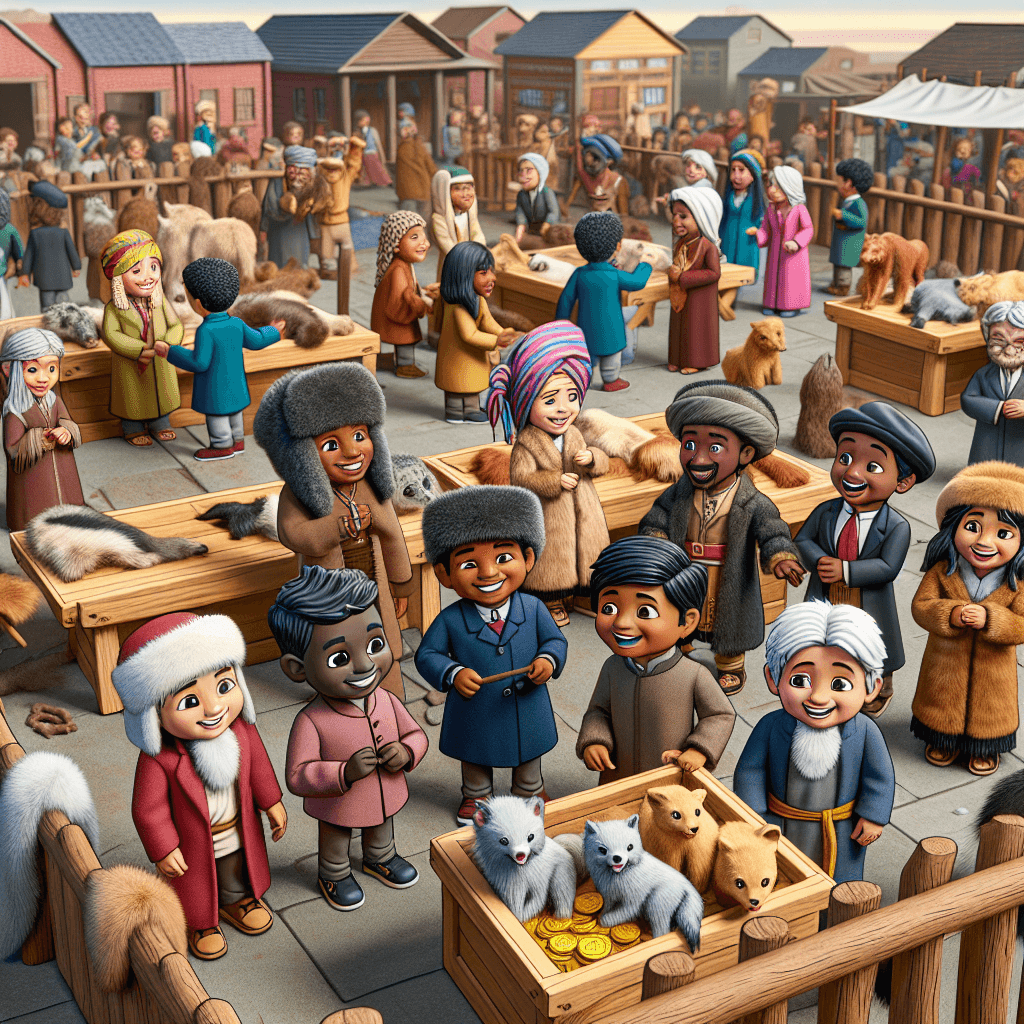
Fur Trade Marketplace Simulation
Inquiry Framework
Question Framework
Driving Question
The overarching question that guides the entire project.How can we create a virtual marketplace to simulate the fur trade and understand its impact on different cultures and economies, as well as the roles and responsibilities of those involved?Essential Questions
Supporting questions that break down major concepts.- What was the fur trade, and why was it important?
- How did fur trading impact the cultures and economies of different groups involved?
- What were the roles and responsibilities of various people involved in the fur trade?
- How can we simulate a marketplace to understand the fur trade exchanges?
- What goods and services were exchanged in the fur trade marketplace?
- How did geographical location affect the fur trade?
- How can language and communication influence trade and negotiation?
Standards & Learning Goals
Learning Goals
By the end of this project, students will be able to:- Students will understand the historical significance of the fur trade and its impact on cultures and economies of the involved parties.
- Students will identify and explain the roles and responsibilities of different people involved in the fur trade.
- Students will apply their knowledge to create a virtual marketplace that simulates the fur trade exchanges.
- Students will demonstrate understanding of a marketplace by simulating trade transactions and economic principles.
- Students will explore how geographical factors influenced the fur trade routes and exchanges.
- Students will enhance their communication skills by simulating negotiations and trade in the virtual marketplace.
- Students will analyze the goods and services exchanged during the fur trade and understand the reasons behind these exchanges.
Social Studies Standards
Common Core Standards
Next Generation Science Standards
Entry Events
Events that will be used to introduce the project to studentsInteractive Mystery Box Challenge
Students receive mysterious packages containing artifacts, maps, and letters related to the fur trade. Their task is to use these clues to uncover the story of a fur trading expedition, encouraging exploration of historical contexts and economic strategies.Portfolio Activities
Portfolio Activities
These activities progressively build towards your learning goals, with each submission contributing to the student's final portfolio.Fur Trade Marketplace Design Studio
In this creative activity, students will design the layout and components of their virtual marketplace. They will incorporate their knowledge from previous activities on historical context and roles.Steps
Here is some basic scaffolding to help students complete the activity.Final Product
What students will submit as the final product of the activityA comprehensive design plan for the virtual fur trade marketplace.Alignment
How this activity aligns with the learning objectives & standardsAligns with Next Generation Science Standards NGSS.ESS3.B - Understanding how natural resources shape economic and cultural practices.Mystery Box Artifact Analysts
Students will begin their journey into the fur trade by analyzing artifacts from a mystery box. This activity will help them understand the historical context of the fur trade and set the foundation for their virtual marketplace.Steps
Here is some basic scaffolding to help students complete the activity.Final Product
What students will submit as the final product of the activityA group presentation on the findings and historical context of the fur trading expedition.Alignment
How this activity aligns with the learning objectives & standardsAligns with Social Studies Standards 4.1.1 - Understanding the influence of events, people, and ideas on local and regional communities.Rubric & Reflection
Portfolio Rubric
Grading criteria for assessing the overall project portfolioFur Trade Marketplace Simulation Rubric
Historical Understanding
Evaluates the student's comprehension of the fur trade and its impact on cultures and economies.Historical Context
Assesses understanding of historical events and their significance in the fur trade.
Exemplary
4 PointsDemonstrates a deep understanding of the historical context of the fur trade by providing comprehensive insights into events and their long-term impacts on cultures and economies.
Proficient
3 PointsShows a thorough understanding of the historical context with most events and their impacts clearly explained.
Developing
2 PointsShows emerging understanding with some important events and impacts identified, though explanations may lack depth.
Beginning
1 PointsProvides minimal understanding, struggling to identify key events and their significance.
Artifact Analysis
Evaluates the ability to analyze and interpret historical artifacts related to the fur trade.
Exemplary
4 PointsSkillfully interprets artifacts, providing well-supported analyses that reveal significant insights into the historical context.
Proficient
3 PointsAccurately interprets artifacts, offering supported analyses that reflect understanding of their historical context.
Developing
2 PointsInterprets artifacts with limited success, showing some connection to historical context.
Beginning
1 PointsStruggles to interpret artifacts, with little connection to historical context.
Collaboration and Communication
Assesses student's ability to engage in effective teamwork and communicate ideas clearly in a group setting.Collaborative Contribution
Measures effectiveness and effort in group activities and discussions related to the project.
Exemplary
4 PointsActively leads and contributes to group discussions and project work, taking initiative to support peers.
Proficient
3 PointsContributes meaningfully to group work and discussions, consistently supporting team efforts.
Developing
2 PointsParticipates in group work with occasional contributions; may require prompting to engage.
Beginning
1 PointsNeeds assistance to participate in group work and suggests minimal input.
Communication Skills
Assesses clarity and effectiveness of communication during discussions and presentations.
Exemplary
4 PointsCommunicates ideas clearly and persuasively, using appropriate language and tone, and actively engages with the audience.
Proficient
3 PointsCommunicates ideas clearly, using appropriate language and engaging with the audience.
Developing
2 PointsCommunicates ideas with partial clarity, sometimes struggling with language or engagement.
Beginning
1 PointsStruggles to communicate ideas clearly, often lacking engagement or appropriate language.
Marketplace Design and Creativity
Evaluates originality and practicality of the virtual marketplace design.Design Originality
Assesses the creativity and uniqueness of the marketplace design.
Exemplary
4 PointsCreates an innovative and unique marketplace design that effectively represents historical insights and marketplace dynamics.
Proficient
3 PointsDesigns a practical and creative marketplace with some unique elements, clearly reflecting historical insights.
Developing
2 PointsDesign includes some creative elements but lacks originality or may not fully reflect historical insights.
Beginning
1 PointsStruggles to create a unique design; lacks creativity and connection to historical content.
Implementation Practicality
Assesses the feasibility and practicality of implementing the marketplace design.
Exemplary
4 PointsDemonstrates highly feasible design that considers user interaction, resource allocation, and marketplace dynamics effectively.
Proficient
3 PointsPresents a feasible marketplace design addressing most aspects of practical implementation effectively.
Developing
2 PointsDesign is partially feasible, with noticeable gaps in practical implementation.
Beginning
1 PointsDesign lacks practicality, with significant barriers to implementation.