
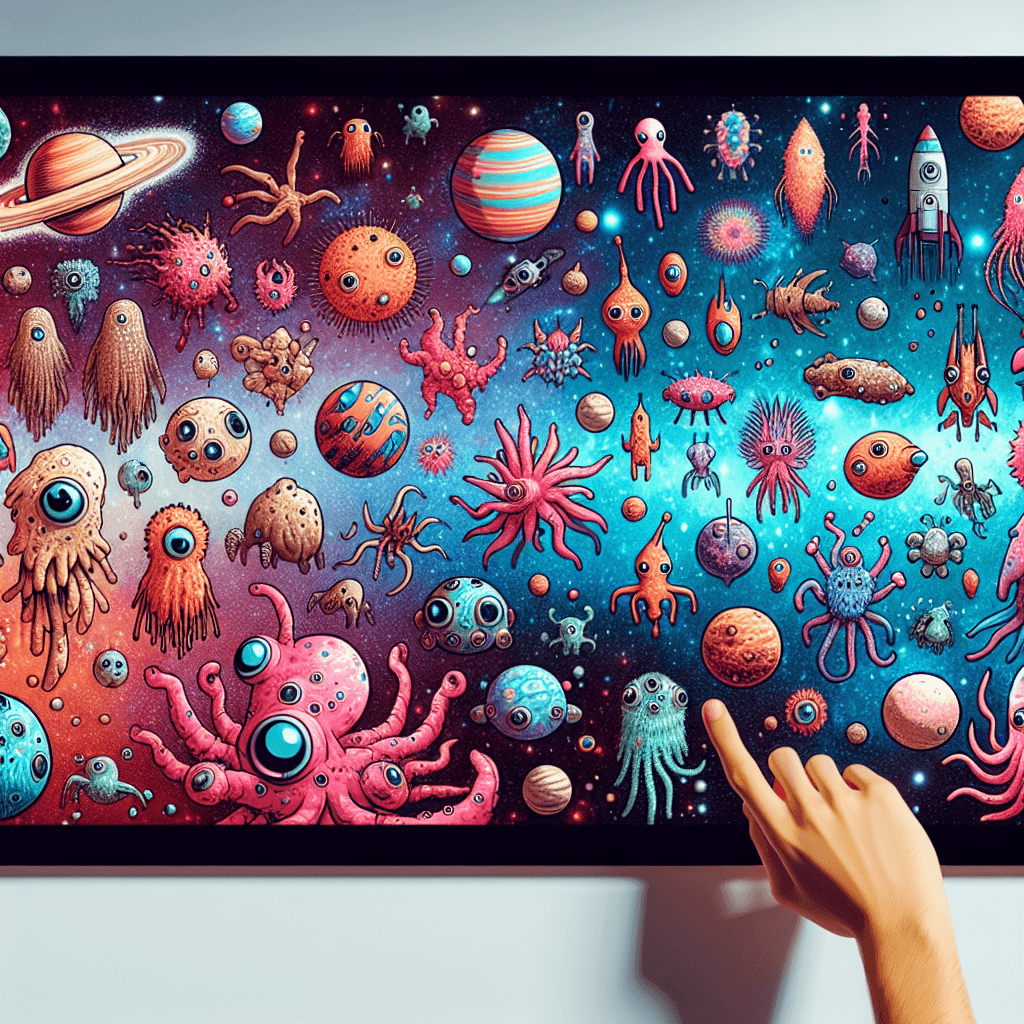
Galactic Bio-Catalog: Sorting Strange New Species
Inquiry Framework
Question Framework
Driving Question
The overarching question that guides the entire project.How can we, as space explorers, create a Galactic Bio-Catalog to organize and describe the strange new species we discovered based on their physical features?Essential Questions
Supporting questions that break down major concepts.- As space explorers, how can we organize and describe the strange new creatures we find so others can learn about them?
- How do the physical features of an animal tell us which group it belongs to?
- Why do scientists group plants and animals together based on how they look or act?
- How can we use numbers and categories to sort a large collection of living things?
- What descriptive words and drawings help a reader understand a new species?
Standards & Learning Goals
Learning Goals
By the end of this project, students will be able to:- Students will identify and describe specific physical characteristics of various species to determine their classification groups.
- Students will develop a 'Galactic Bio-Catalog' that models how living things are organized into groups and subgroups based on similarities.
- Students will use descriptive adjectives and scientific vocabulary to write clear, informative profiles for newly discovered species.
- Students will sort and organize data into categories, representing their findings through simple charts or graphs to show the variety of life discovered.
- Students will create detailed illustrations that accurately represent the physical features described in their scientific writing.
Arizona Science Standards
Common Core State Standards (English Language Arts)
Common Core State Standards (Math)
National Core Arts Standards (Visual Arts)
Entry Events
Events that will be used to introduce the project to studentsThe Explorer’s Lost Field Journal
Students find a 'Lost Field Journal' belonging to a famous space explorer, filled with half-finished sketches of bizarre organisms. The journal's last page challenges the finder to complete the drawings and organize them into a 'Bio-Catalog' so the next group of explorers knows exactly what to look for based on similarities and differences.Portfolio Activities
Portfolio Activities
These activities progressively build towards your learning goals, with each submission contributing to the student's final portfolio.The Xeno-Sketch Expedition
Students step into the role of space explorers to 'discover' and document their first alien species. Using the 'Lost Field Journal' as inspiration, students will create a detailed artistic rendering of a new life form, focusing on specific physical traits (number of eyes, limb types, body coverings) that will later be used for classification.Steps
Here is some basic scaffolding to help students complete the activity.Final Product
What students will submit as the final product of the activityA 'Discovery Sketch' featuring a hand-drawn alien species with at least five labeled physical traits.Alignment
How this activity aligns with the learning objectives & standardsThis activity aligns with VA:Cr1.1.1a (Observation and investigation in preparation for making a work of art) and CCSS.ELA-LITERACY.L.1.5.A (Sort words into categories) by having students observe specific physical features and label them using descriptive vocabulary.Mission: Sort-o-Rama
Now that several species have been discovered, the class must work together to find patterns. Students will compare their Discovery Sketches with those of their peers to identify common physical traits, sorting the entire 'galactic collection' into categories.Steps
Here is some basic scaffolding to help students complete the activity.Final Product
What students will submit as the final product of the activityA 'Species Sorting Mat' that displays creatures grouped by a specific attribute (e.g., 'Has Wings' vs. 'No Wings') and a total count for each group.Alignment
How this activity aligns with the learning objectives & standardsThis activity aligns with CCSS.MATH.CONTENT.1.MD.C.4 (Organize, represent, and interpret data) and CCSS.ELA-LITERACY.L.1.5.A (Sort words into categories) by requiring students to group items based on shared attributes and interpret the resulting data.The Great Galaxy Map of Life
Students will transition from simple sorting to building a formal classification model. They will take a large group (e.g., 'Land Walkers') and break it down into smaller subgroups (e.g., 'Six-Legged' and 'Four-Legged') to show how scientists organize living things more specifically.Steps
Here is some basic scaffolding to help students complete the activity.Final Product
What students will submit as the final product of the activityA 'Galactic Hierarchy Poster' that visually maps out a main group and its specific subgroups using the discovered species.Alignment
How this activity aligns with the learning objectives & standardsThis activity is the primary alignment for 1.L4U1.10 (Develop a model to describe how animals and plants are classified). It introduces the concept of groups and subgroups, which is the core of biological classification.The Explorer’s Data Log
Students will write the text for their Bio-Catalog. Each student selects one species and writes a formal entry that explains what the species is, what group it belongs to, and what physical features helped them decide its placement.Steps
Here is some basic scaffolding to help students complete the activity.Final Product
What students will submit as the final product of the activityA 'Field Guide Entry' consisting of a polished illustration and a short, informative paragraph.Alignment
How this activity aligns with the learning objectives & standardsThis activity aligns with CCSS.ELA-LITERACY.W.1.2 (Write informative/explanatory texts) by having students name their topic (the species) and provide facts (the classification and traits).The Final Bio-Catalog Census
The project concludes with the assembly of the digital or physical 'Galactic Bio-Catalog.' Students will present their classification model and use the data they've gathered to answer questions about the planet's biodiversity, such as which group of species is the most common.Steps
Here is some basic scaffolding to help students complete the activity.Final Product
What students will submit as the final product of the activityThe completed 'Galactic Bio-Catalog' and a 'Planet Biodiversity Report' (a simple bar graph and analysis).Alignment
How this activity aligns with the learning objectives & standardsThis final activity integrates 1.L4U1.10 (Model classification), CCSS.MATH.CONTENT.1.MD.C.4 (Interpret data), and CCSS.ELA-LITERACY.W.1.2 as students finalize the catalog and analyze the variety of life they've organized.Rubric & Reflection
Portfolio Rubric
Grading criteria for assessing the overall project portfolioThe Galactic Bio-Catalog Portfolio Rubric
Scientific Classification & Modeling
Assessing the student's ability to classify living things into hierarchical groups based on observable traits.Classification Modeling (1.L4U1.10)
Focuses on the ability to develop a model that organizes species into groups and subgroups based on physical similarities.
Exemplary
4 PointsThe student independently creates a sophisticated classification model with clear groups and logical subgroups. They can articulate complex reasons why a species belongs in a specific subgroup based on multiple physical similarities.
Proficient
3 PointsThe student develops a model that classifies species into groups and subgroups according to physical similarities. They clearly explain the criteria used for sorting.
Developing
2 PointsThe student identifies similarities and sorts species into main groups, but struggle to define or organize distinct subgroups within those groups.
Beginning
1 PointsThe student identifies some similarities but requires significant support to organize species into a functional group or model.
Informative Writing & Communication
Assessing the student's ability to communicate scientific observations through structured informative writing.Informative Text Construction (W.1.2)
Evaluates the ability to write an informative entry for the Bio-Catalog, including a name, factual evidence of traits, and a sense of closure.
Exemplary
4 PointsThe student writes a highly descriptive entry with a creative name, multiple facts that perfectly align with their classification, and a clear, engaging closing sentence. Vocabulary is rich and specific.
Proficient
3 PointsThe student names their species, provides at least two facts about its traits related to its group, and provides a sense of closure. Information is clear and organized.
Developing
2 PointsThe student names the species and provides one fact, but the text may lack a closing sentence or the connection to the classification group is weak.
Beginning
1 PointsThe student provides a name or label but lacks factual details or a structured explanation of the species' characteristics.
Mathematical Data & Analysis
Assessing the student's use of mathematical tools to represent and analyze the variety of species discovered.Data Organization & Interpretation (1.MD.C.4)
Focuses on the ability to organize species into categories, count them accurately, and interpret the data using charts or graphs.
Exemplary
4 PointsThe student organizes data into three categories with 100% accuracy, creates a precise bar graph, and can independently analyze "how many more/less" between all categories.
Proficient
3 PointsThe student organizes data into up to three categories, records counts on a T-chart or bar graph accurately, and answers questions about totals in each category.
Developing
2 PointsThe student sorts species into categories but makes minor errors in counting or recording data on a chart. Struggles to interpret "more" or "less."
Beginning
1 PointsThe student requires constant guidance to sort items into categories and is unable to represent the count numerically or on a chart.
Artistic Observation & Investigation
Assessing the student's ability to represent physical characteristics through art and descriptive vocabulary.Scientific Illustration & Labeling (VA:Cr1.1.1a)
Evaluates the use of observation and intentional design to create a visual representation of a species with specific, labeled physical traits.
Exemplary
4 PointsThe student creates an exceptionally detailed illustration where every trait is distinct and purposefully designed for classification. Includes 6+ accurate, descriptive labels.
Proficient
3 PointsThe student uses observation to create a detailed drawing of a species with at least 5 clear, labeled physical traits that inform its classification.
Developing
2 PointsThe student creates a drawing with some physical traits, but labels are missing or traits are too vague to be used for clear classification.
Beginning
1 PointsThe student creates a basic drawing with few identifiable traits and minimal labeling, making classification difficult.