
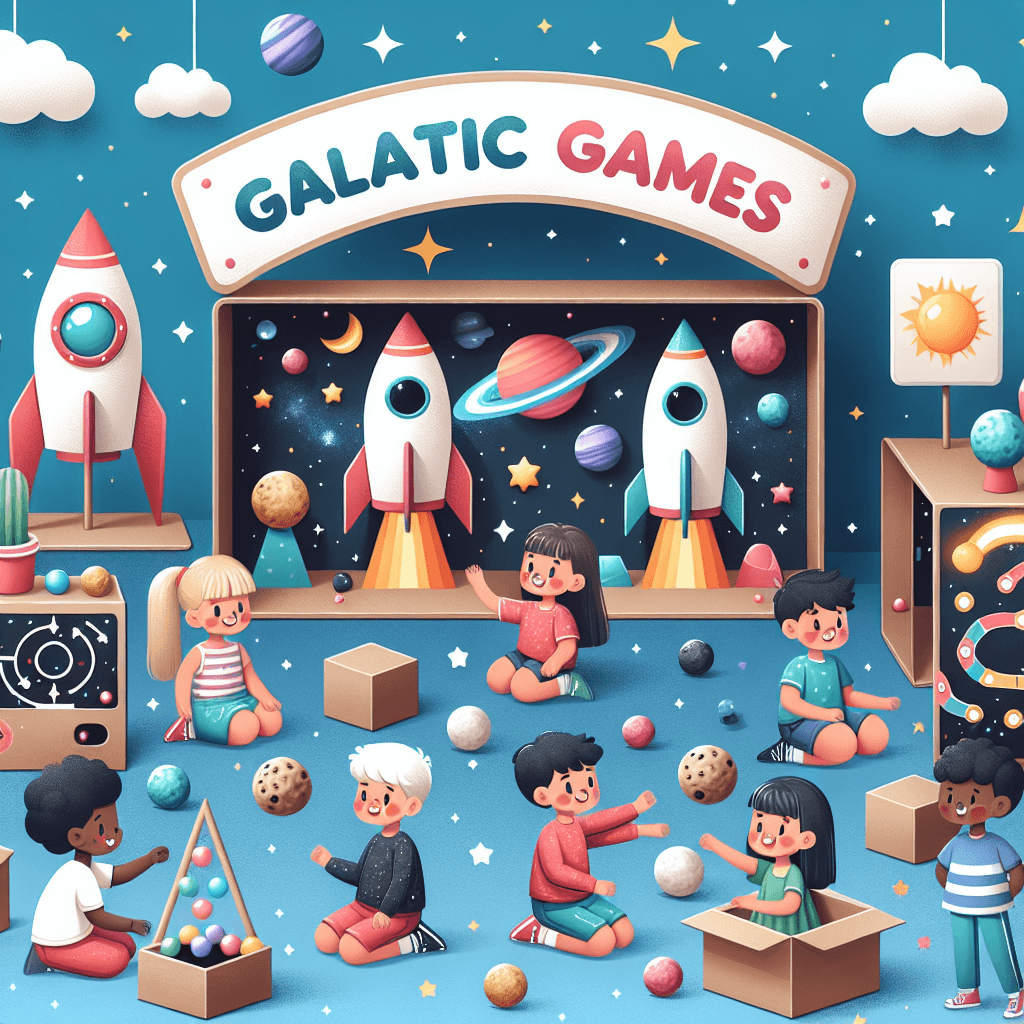
Galactic Games: A Cardboard Arcade for Our Universe
Inquiry Framework
Question Framework
Driving Question
The overarching question that guides the entire project.How can we, as engineers and science communicators, design a functional cardboard arcade that models Earth’s place in the universe to raise money for a local charity?Essential Questions
Supporting questions that break down major concepts.- How do the patterns of the Sun, Moon, and stars influence life on Earth and the games we play?
- Why does the Sun appear brighter than other stars, and how can we represent this scientific concept in an arcade game?
- How can we use mathematical measurements and geometry to design and build durable, functional arcade games from cardboard?
- In what ways can we use persuasive writing and public speaking to convince our community to support our charity through our arcade?
- How can we represent data (like shadow lengths or seasonal star movements) through the mechanics and design of an interactive game?
- How do we use operations with decimals and fractions to manage our arcade's budget and calculate the final donation for our community charity?
Standards & Learning Goals
Learning Goals
By the end of this project, students will be able to:- Students will analyze and represent the relationship between distance and the apparent brightness of stars by designing an interactive game mechanic that illustrates why the Sun appears brighter than other stars.
- Students will use patterns of daily and seasonal changes (such as shadow lengths or the position of stars) to inform the rules, scoring, or visual design of their cardboard arcade game.
- Students will apply mathematical operations with decimals and measurement conversions to create a project budget, track construction dimensions, and calculate final donation totals for the selected charity.
- Students will construct a functional arcade game using engineering design principles, demonstrating an understanding of structural stability and geometric shapes.
- Students will draft and deliver a persuasive communication piece (e.g., an advertisement or pitch) that explains the scientific concepts behind their game and encourages community members to donate to their chosen charity.
Next Generation Science Standards (NGSS)
Common Core State Standards for Mathematics (CCSS.Math)
Common Core State Standards for ELA (CCSS.ELA)
Entry Events
Events that will be used to introduce the project to studentsThe SOS from the Stars
Students enter to find a mysterious 'black box' emitting a grainy video transmission from a 'lost astronaut' who can only navigate home if Earth’s coordinates in the solar system are mapped through physical play. The astronaut challenges the class to build interactive 'navigational games' that demonstrate gravity, scale, and orbital patterns to help the mission survive.The Intergalactic Travel Bureau
The classroom is transformed into a 'Cosmic Construction Zone' with a letter from a fictional intergalactic travel agency asking for help: 'Humans don't understand their place in the galaxy!' Students must design cardboard games that serve as 'interactive brochures,' explaining Earth's relationship to the Sun and other stars to 'alien tourists' while collecting 'donations' (for their local charity).Portfolio Activities
Portfolio Activities
These activities progressively build towards your learning goals, with each submission contributing to the student's final portfolio.Luminosity Lab: The Star Power Blueprint
Before students can build, they must understand the core science. In this activity, students investigate the 'Inverse Square Law' of light in a kid-friendly way. They will experiment with flashlights at different distances to model why our Sun appears so much larger and brighter than other stars. They will then translate this concept into a 'Game Mechanic' (e.g., a target that is larger/brighter if close, or a scoring system based on distance).Steps
Here is some basic scaffolding to help students complete the activity.Final Product
What students will submit as the final product of the activityA 'Star Power Blueprint' that includes a scientific diagram and a written explanation of how their game will demonstrate the relationship between star distance and brightness.Alignment
How this activity aligns with the learning objectives & standardsNGSS 5-ESS1-1: Support an argument that differences in the apparent brightness of the sun compared to other stars is due to their relative distances from Earth.Celestial Charting: The Pattern Playbook
In this activity, students focus on the 'playing field' of their arcade game. They will use data regarding shadows or seasonal constellations to create the game's movement or rules. For example, a pinball-style game might use 'shadow ramps' that change length, or a 'constellation catcher' game where targets move based on seasonal patterns.Steps
Here is some basic scaffolding to help students complete the activity.Final Product
What students will submit as the final product of the activityAn 'Astronomy Data Map'—a visual layout of the game board that uses graphs or charts to explain how the game’s movement mimics real-world celestial patterns.Alignment
How this activity aligns with the learning objectives & standardsNGSS 5-ESS1-2: Represent data in graphical displays to reveal patterns of daily changes in length and direction of shadows, day and night, and the seasonal appearance of some stars in the night sky.Arcade Accountants: Budgeting the Galaxy
Students transition into the role of project managers. They are given a 'Virtual Budget' of $50.00 (in 'Cosmic Credits') to purchase cardboard, tape, and decorations. They must measure their desired game dimensions in centimeters and convert them to meters to understand the scale of their build, while tracking every decimal-based transaction in their ledger.Steps
Here is some basic scaffolding to help students complete the activity.Final Product
What students will submit as the final product of the activityA 'Cosmic Construction Ledger' and a 'Material Request Form' featuring precise measurements and a balanced decimal-based budget.Alignment
How this activity aligns with the learning objectives & standardsCCSS.Math.5.NBT.B.7: Add, subtract, multiply, and divide decimals to hundredths. CCSS.Math.5.MD.A.1: Convert among different-sized standard measurement units.The Cosmic Pitch: Advocacy in Action
To ensure the arcade raises money for their chosen local charity, students must become advocates. In this activity, they write a persuasive 'Charity Pitch' to be displayed on their arcade cabinet. They must argue why their specific charity deserves support, linking the importance of science or community to the cause.Steps
Here is some basic scaffolding to help students complete the activity.Final Product
What students will submit as the final product of the activityA 'Persuasive Marquee'—a decorated sign for the top of the arcade game that features a 3-paragraph opinion piece.Alignment
How this activity aligns with the learning objectives & standardsCCSS.ELA-Literacy.W.5.1: Write opinion pieces on topics or texts, supporting a point of view with reasons and information.The Grand Galactic Opening: Engineering & Impact
The final phase is the build and the 'Grand Opening.' Students construct their games using the cardboard constraints and then host the arcade. As players visit, the students must act as 'Science Guides,' explaining the star science (ESS1-1) and patterns (ESS1-2) behind their game while collecting donations for their charity.Steps
Here is some basic scaffolding to help students complete the activity.Final Product
What students will submit as the final product of the activityA fully functional, scientific Cardboard Arcade Game and a final 'Impact Report' showing the total money raised.Alignment
How this activity aligns with the learning objectives & standardsNGSS 3-5-ETS1-1: Define a simple design problem... constraints on materials, time, or cost. CCSS.ELA-Literacy.SL.5.4: Report on a topic or text, sequencing ideas logically.Rubric & Reflection
Portfolio Rubric
Grading criteria for assessing the overall project portfolioThe Galactic Arcade: Earth's Place in the Universe & Community Impact Rubric
Scientific Inquiry & Modeling
Assesses understanding of Earth's place in the universe and the ability to represent scientific data through interactive models.Stellar Luminosity & Modeling
Evaluates the student's ability to model and explain why the Sun appears brighter than other stars based on its distance from Earth.
Exemplary
4 PointsProvides a sophisticated argument that accurately explains the relationship between distance and luminosity. The game mechanic innovatively represents this scientific concept with precise detail.
Proficient
3 PointsClearly explains that the Sun's brightness is due to its proximity to Earth compared to other stars. The game mechanic accurately models this relationship.
Developing
2 PointsIdentifies that distance affects brightness, but the explanation is inconsistent or the game mechanic only partially represents the concept.
Beginning
1 PointsShows initial understanding of star brightness but struggles to connect it to distance or represent it in the game design.
Celestial Pattern Representation
Evaluates the accuracy and clarity of graphical displays representing celestial patterns (shadows, day/night, or seasonal stars) and their integration into game rules.
Exemplary
4 PointsCreates detailed, accurate graphical displays that reveal complex patterns. These patterns are seamlessly and creatively integrated into the core mechanics of the arcade game.
Proficient
3 PointsRepresent data correctly in a graphical display to show patterns. The game rules or board design clearly reflect these celestial patterns.
Developing
2 PointsGraphical displays are present but contain minor inaccuracies. The connection between the data and the game mechanics is emerging but loose.
Beginning
1 PointsData representation is incomplete or inaccurate. Minimal effort is made to connect celestial patterns to the game's design.
Quantitative Reasoning & Precision
Focuses on the application of 5th-grade mathematical standards to real-world financial and engineering scenarios.Decimal Operations & Budgeting
Evaluates the accuracy of adding, subtracting, multiplying, and dividing decimals within the project budget and donation tracking.
Exemplary
4 PointsThe ledger is flawless, demonstrating advanced mastery of decimal operations. Calculations for the budget, material costs, and final donations are precise and well-documented.
Proficient
3 PointsPerforms decimal operations with consistent accuracy. The budget and donation totals are calculated correctly with minor, if any, errors.
Developing
2 PointsDemonstrates emerging skills in decimal operations, but errors in addition or subtraction lead to inaccuracies in the final budget or donation count.
Beginning
1 PointsStruggles with decimal placement or basic operations, resulting in an incomplete or highly inaccurate financial record.
Measurement & Unit Conversion
Evaluates the ability to convert between standard measurement units (cm to m) during the blueprint and construction phases.
Exemplary
4 PointsConverts all measurements accurately and applies these conversions innovatively to solve complex design challenges in the build phase.
Proficient
3 PointsSuccessfully converts among different-sized standard units (e.g., cm to m) and uses these measurements to inform the game's construction.
Developing
2 PointsShows partial success in unit conversion, but inconsistencies exist between the blueprint measurements and the actual build.
Beginning
1 PointsAttempts unit conversions but frequently misplaces decimal points or fails to apply measurements to the final product.
Communication & Advocacy
Assesses the student's ability to communicate complex ideas and advocate for community needs through writing and speaking.Persuasive Advocacy Writing
Evaluates the quality of the persuasive writing used to support the chosen charity, focusing on structure, reasons, and linking words.
Exemplary
4 PointsWrites a compelling, high-quality opinion piece with sophisticated vocabulary and logical sequencing. Arguments are supported by exceptional research and clear calls to action.
Proficient
3 PointsWrites a clear opinion piece with a stated point of view, supported by facts and reasons. Uses appropriate linking words to connect ideas effectively.
Developing
2 PointsThe opinion piece is present but lacks strong supporting evidence or consistent use of linking words. The purpose is somewhat clear.
Beginning
1 PointsThe writing is incomplete or lacks a clear argument. Very few facts are used to support the choice of charity.
Oral Communication & Science Outreach
Evaluates the student's ability to present their game and the underlying science to the community during the fundraiser.
Exemplary
4 PointsPresents scientific concepts with exceptional clarity and enthusiasm. Engages the audience deeply and adapts communication to ensure all 'players' understand the science.
Proficient
3 PointsReports on the project and science clearly at an understandable pace. Sequences ideas logically and uses relevant details to support the main ideas.
Developing
2 PointsPresents information with some clarity, but may struggle with pacing or sequencing. Scientific explanations may be brief or slightly unclear.
Beginning
1 PointsRequires significant support to present the project. Communication is hesitant and lacks clear scientific detail.
Engineering & Construction
Assesses the application of engineering principles to create a physical product within constraints.Engineering Design & Iteration
Evaluates the functionality, durability, and iterative design of the cardboard arcade game.
Exemplary
4 PointsThe arcade game is exceptionally durable and functional. The student demonstrates profound growth by making multiple sophisticated adjustments based on peer testing.
Proficient
3 PointsThe game is functional and meets all specified criteria. The student makes at least one clear engineering adjustment based on feedback to improve the design.
Developing
2 PointsThe game is mostly functional but may have stability issues. Evidence of testing and adjustment is present but limited.
Beginning
1 PointsThe game is fragile or non-functional. Minimal evidence of the engineering design process or iterative testing.