
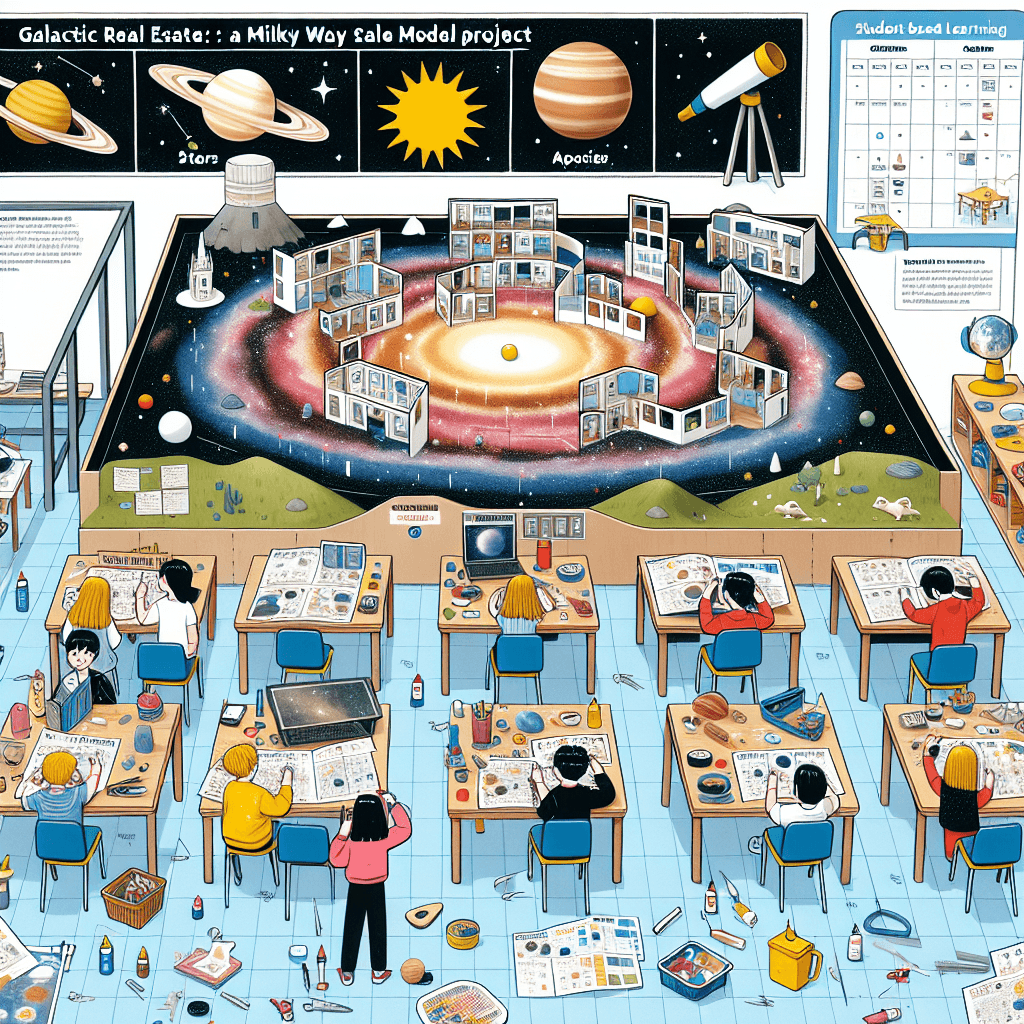
Galactic Real Estate: A Milky Way Scale Model Project
Inquiry Framework
Question Framework
Driving Question
The overarching question that guides the entire project.How can we, as galactic real estate developers, represent the vastness of the Milky Way through a scale model that helps others understand Earth’s place in the galaxy?Essential Questions
Supporting questions that break down major concepts.- How can we use scale models to represent the vast distances in space?
- How do fractions help us understand the relative sizes and distances of objects in the Milky Way?
- How does Earth's position in the Milky Way affect our observations of stars and constellations?
- What are the challenges in creating an accurate scale model of a galaxy?
- How can we apply the concept of fractions to solve real-world problems related to space and astronomy?
- What makes up a galaxy?
- What causes some stars to be brighter than others?
Standards & Learning Goals
Learning Goals
By the end of this project, students will be able to:- Calculate scaled distances between celestial objects using fractions.
- Construct a scale model of the Milky Way galaxy.
- Explain Earth's position and perspective within the Milky Way.
- Apply fraction multiplication to solve real-world scaling problems.
Teacher Provided
Entry Events
Events that will be used to introduce the project to studentsIntergalactic Travel Agency Challenge
Students work in teams as competing travel agencies specializing in tours within the Milky Way. They must design brochures and presentations that accurately depict the distances, sizes, and attractions of different galactic locations using scaled models. This encourages practical application of fractions and proportional reasoning in a real-world context.Message from the Future
Students receive a 'coded message' from future space explorers who are lost in a newly discovered arm of the Milky Way. The message contains clues about their location, but the measurements are given in an unfamiliar scale. Students must decode the message by converting the measurements and building a scale model to pinpoint the explorers' location, promoting problem-solving and critical thinking.Portfolio Activities
Portfolio Activities
These activities progressively build towards your learning goals, with each submission contributing to the student's final portfolio.Cosmic Distance Charting
Students begin by researching the actual distances between key objects in our solar system and Milky Way (e.g., Earth to Sun, Sun to center of galaxy). They then create a chart converting these distances into fractions or decimals suitable for scaling down to model size.Steps
Here is some basic scaffolding to help students complete the activity.Final Product
What students will submit as the final product of the activityA detailed chart showing the conversion of actual cosmic distances to scaled-down model distances, using fractions and decimals.Alignment
How this activity aligns with the learning objectives & standardsAligns with 5.NF.B.4a (interpreting fraction multiplication), 5.NF.B.6 (solving real-world problems involving fraction multiplication), and 5.ESS1.1 (understanding relative distances of stars).Milky Way Blueprint Design
Using the scaled distances from the previous activity, students design a blueprint for their Milky Way model. This includes determining the size of the model, the placement of key components (solar system, galactic center, spiral arms), and the materials they will use.Steps
Here is some basic scaffolding to help students complete the activity.Final Product
What students will submit as the final product of the activityA comprehensive blueprint of the Milky Way model, showing scaled distances, placement of components, and materials list.Alignment
How this activity aligns with the learning objectives & standardsAligns with 5.NF.B.5a and 5.NF.B.5b (understanding scaling with fractions), 5.ESS1.2 (researching the position of the Earth and solar system within the Milky Way), and 5.ETS1.1 (planning a prototype).Construction Zone: Building the Galaxy
Students construct their scale model of the Milky Way based on their blueprint. They use measurement tools to ensure accuracy and apply their understanding of fractions to maintain the correct proportions.Steps
Here is some basic scaffolding to help students complete the activity.Final Product
What students will submit as the final product of the activityA physical scale model of the Milky Way galaxy, demonstrating accurate representation of distances and proportions using fractions.Alignment
How this activity aligns with the learning objectives & standardsAligns with 5.NF.B.6 (solving real-world problems involving fraction multiplication), 5.ETS2.1 (using tools to make measurements), and 5.ESS1.2 (comparing the size and shape of the Milky Way to other galaxies).Stellar Brightness Analysis
Students investigate the apparent brightness of stars and how distance affects their visibility. They will incorporate brightness variations into their model, representing brighter stars with larger or more luminous elements.Steps
Here is some basic scaffolding to help students complete the activity.Final Product
What students will submit as the final product of the activityAn enhanced Milky Way model that visually represents the varying brightness of stars based on their relative distances from Earth.Alignment
How this activity aligns with the learning objectives & standardsAligns with 5.ESS1.1 (explaining differences in the apparent brightness of stars) and 5.ESS1.6 (describing the position of constellations).Galactic Presentation Showcase
Students prepare and deliver presentations about their Milky Way models. They explain their scaling methods, the challenges they faced, and what they learned about the galaxy and Earth’s place within it.Steps
Here is some basic scaffolding to help students complete the activity.Final Product
What students will submit as the final product of the activityA presentation and showcase of the completed Milky Way model, demonstrating understanding of scaling, fractions, and galactic structure.Alignment
How this activity aligns with the learning objectives & standardsAligns with all listed math and science standards, as it requires students to apply their knowledge and communicate their findings effectively.Rubric & Reflection
Portfolio Rubric
Grading criteria for assessing the overall project portfolioGalactic Real Estate: Milky Way Model Rubric
Mathematical Accuracy (Scaling and Fractions)
This category assesses the precision and correctness of the calculations used to scale down distances and sizes within the Milky Way galaxy for the model. It emphasizes the accurate application of fractions and proportional reasoning.Distance Scaling
Accuracy of converting actual cosmic distances into scaled-down model distances using fractions and decimals.
Exemplary
4 PointsAll distances are scaled accurately with precise calculations, demonstrating a sophisticated understanding of proportional relationships and fraction operations. The scaled-down distances are flawlessly represented in the model.
Proficient
3 PointsMost distances are scaled accurately with minor errors, demonstrating a thorough understanding of proportional relationships and fraction operations. The scaled-down distances are generally well-represented in the model.
Developing
2 PointsSome distances are scaled accurately, but there are noticeable errors in calculations, indicating an emerging understanding of proportional relationships and fraction operations. The scaled-down distances are inconsistently represented in the model.
Beginning
1 PointsFew distances are scaled accurately, with significant errors in calculations, suggesting a limited understanding of proportional relationships and fraction operations. The scaled-down distances are poorly represented in the model.
Proportionality
Maintaining correct proportions between different elements of the model, reflecting accurate relative sizes of celestial objects.
Exemplary
4 PointsThe model flawlessly maintains accurate proportions between all elements, demonstrating a deep understanding of relative sizes and spatial relationships within the Milky Way. The scale is consistently applied across all dimensions.
Proficient
3 PointsThe model generally maintains accurate proportions between most elements, with only minor deviations. This demonstrates a good understanding of relative sizes and spatial relationships within the Milky Way.
Developing
2 PointsThe model shows inconsistencies in proportions between elements, indicating a partial understanding of relative sizes and spatial relationships within the Milky Way. Some elements are noticeably out of scale.
Beginning
1 PointsThe model displays significant inaccuracies in proportions, suggesting a limited understanding of relative sizes and spatial relationships within the Milky Way. Many elements are out of scale.
Scientific Understanding (Astronomy Concepts)
This category assesses the students' comprehension of astronomical concepts related to the Milky Way galaxy, including Earth's position, stellar brightness, and galactic structure.Earth's Position
Accuracy in representing Earth’s position within the Milky Way galaxy in the model.
Exemplary
4 PointsEarth's position is precisely located within the model, demonstrating a sophisticated understanding of its place in the Milky Way and its relation to other galactic features. The model reflects Earth's location with respect to the solar system and galactic center.
Proficient
3 PointsEarth's position is generally accurately represented, demonstrating a thorough understanding of its place in the Milky Way. There may be minor inaccuracies in its placement relative to other galactic features.
Developing
2 PointsEarth's position is represented, but there are noticeable inaccuracies, indicating an emerging understanding of its place in the Milky Way. The model may not accurately reflect Earth's relationship to the solar system or galactic center.
Beginning
1 PointsEarth's position is poorly represented or missing, suggesting a limited understanding of its place in the Milky Way. The model does not accurately reflect Earth's location within the galaxy.
Stellar Brightness Representation
Effectiveness of incorporating variations in stellar brightness into the model based on relative distances from Earth.
Exemplary
4 PointsThe model effectively represents the varying brightness of stars with clear distinctions based on their relative distances from Earth. The use of different sized or luminous elements is sophisticated and accurate, enhancing the model's realism and scientific accuracy.
Proficient
3 PointsThe model represents the varying brightness of stars, and there are clear distinctions, demonstrating a good understanding of the relationship between distance and brightness. The use of different sized or luminous elements is effective.
Developing
2 PointsThe model attempts to represent the varying brightness of stars, but the distinctions are inconsistent or unclear. There is an emerging understanding of the relationship between distance and brightness.
Beginning
1 PointsThe model does not effectively represent the varying brightness of stars, or the attempt is minimal. There is limited understanding of the relationship between distance and brightness.
Design and Construction (Model Quality)
This category evaluates the craftsmanship and overall quality of the Milky Way model, including the effective use of materials and the neatness of construction.Craftsmanship
Neatness, precision, and overall quality of the model's construction.
Exemplary
4 PointsThe model exhibits exceptional craftsmanship with meticulous attention to detail. It is constructed neatly and precisely, demonstrating a high level of skill and care. The use of materials is effective and enhances the model's appearance.
Proficient
3 PointsThe model exhibits good craftsmanship and is constructed neatly and with reasonable precision. The use of materials is appropriate and contributes to the model's overall quality.
Developing
2 PointsThe model shows some craftsmanship, but there are noticeable flaws in neatness and precision. The use of materials is adequate but may not enhance the model's appearance.
Beginning
1 PointsThe model exhibits poor craftsmanship with significant flaws in neatness and precision. The use of materials is ineffective and detracts from the model's overall quality.
Material Use
Appropriateness and effective use of materials in constructing the model.
Exemplary
4 PointsMaterials are chosen thoughtfully and used creatively to effectively represent different components of the Milky Way. The materials enhance the model's realism and visual appeal, demonstrating a sophisticated understanding of design principles.
Proficient
3 PointsMaterials are used appropriately and effectively to represent different components of the Milky Way. The materials contribute to the model's overall quality and clarity.
Developing
2 PointsMaterials are used, but their selection or application is not always effective. Some materials may not be appropriate for representing the intended components of the Milky Way.
Beginning
1 PointsMaterials are used ineffectively or inappropriately. The materials detract from the model's overall quality and clarity.
Communication (Presentation)
This category assesses the students' ability to clearly and effectively communicate their understanding of the project, including the scaling methods used, challenges encountered, and key takeaways about the Milky Way.Explanation of Scaling Methods
Clarity and accuracy in explaining the scaling methods used to create the model.
Exemplary
4 PointsThe explanation of scaling methods is exceptionally clear, detailed, and accurate. The student demonstrates a sophisticated understanding of the mathematical principles involved and explains the reasoning behind the chosen scale. The presentation effectively communicates the scaling process.
Proficient
3 PointsThe explanation of scaling methods is clear and accurate, demonstrating a thorough understanding of the mathematical principles involved. The presentation effectively communicates the scaling process.
Developing
2 PointsThe explanation of scaling methods is understandable, but there may be some gaps in clarity or accuracy. There is an emerging understanding of the mathematical principles involved.
Beginning
1 PointsThe explanation of scaling methods is unclear or inaccurate, suggesting a limited understanding of the mathematical principles involved. The presentation does not effectively communicate the scaling process.
Discussion of Challenges and Learning
Insightful discussion of challenges encountered during the construction process and key learnings about the Milky Way.
Exemplary
4 PointsThe student provides an insightful and reflective discussion of the challenges encountered during the construction process, demonstrating a sophisticated understanding of the difficulties and how they were overcome. The student articulates key learnings about the Milky Way with clarity and depth, demonstrating a profound understanding of galactic structure and Earth's place within it.
Proficient
3 PointsThe student discusses the challenges encountered during the construction process and how they were overcome, demonstrating a thorough understanding of the difficulties. The student articulates key learnings about the Milky Way with clarity.
Developing
2 PointsThe student identifies some challenges encountered during the construction process, but the discussion lacks depth or insight. The student articulates some key learnings about the Milky Way, but the understanding may be incomplete.
Beginning
1 PointsThe student struggles to identify or discuss challenges encountered during the construction process. The student demonstrates a limited understanding of key learnings about the Milky Way.