
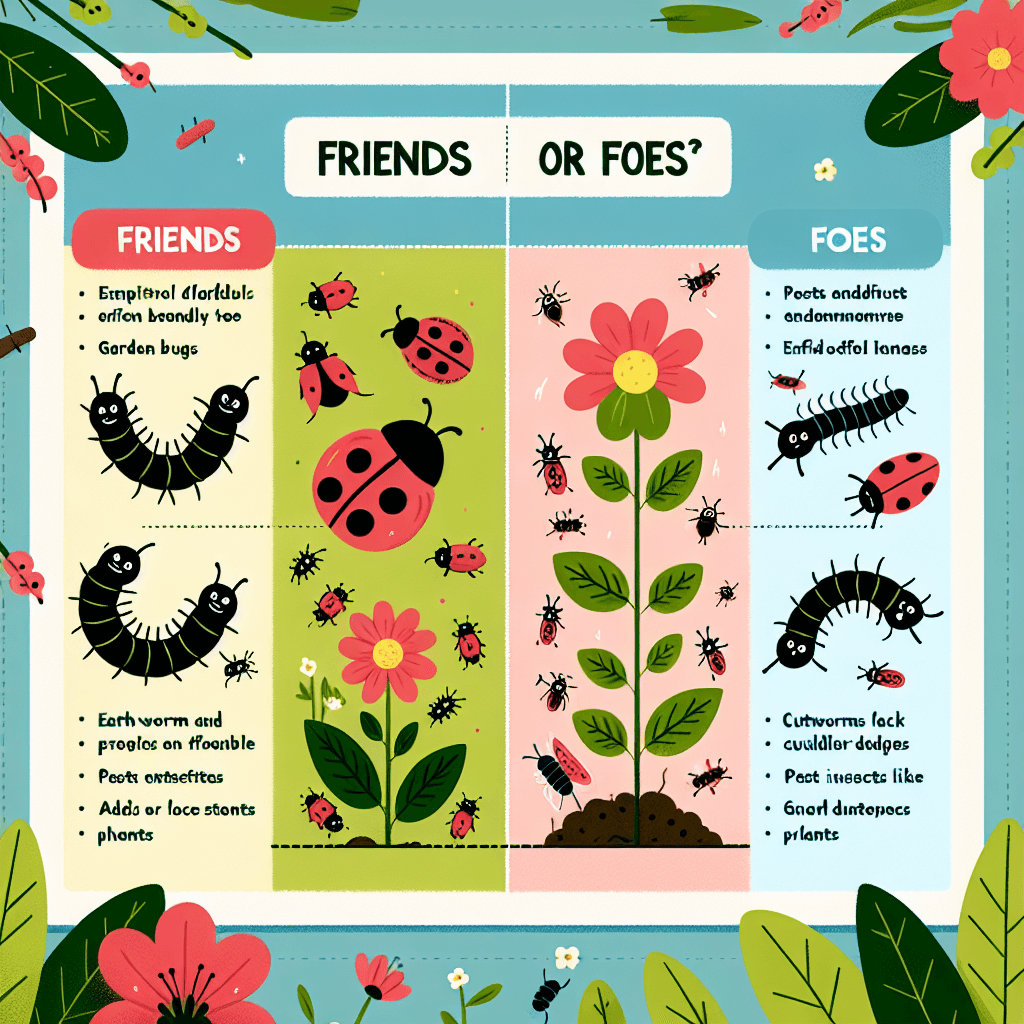
Garden Bugs: Friends or Foes?
Inquiry Framework
Question Framework
Driving Question
The overarching question that guides the entire project.How can we distinguish between beneficial and harmful insects in a garden, and how do their interactions with plants and environmental factors influence the health and sustainability of the ecosystem?Essential Questions
Supporting questions that break down major concepts.- What role do insects play in the ecosystem of a garden?
- How can the presence of certain insects affect plant growth and health?
- What methods can be used to identify beneficial and harmful insects in a garden setting?
- How do environmental factors influence the population and behavior of garden insects?
Standards & Learning Goals
Learning Goals
By the end of this project, students will be able to:- Identify and differentiate between beneficial and harmful insects in a garden setting.
- Analyze the impact of insect interactions on the overall health of the garden ecosystem.
- Evaluate environmental factors and their influence on the population dynamics of garden insects.
- Develop strategies for promoting beneficial insects and managing harmful ones in a sustainable manner.
NGSS - MS Life Sciences
Common Core Standards
Entry Events
Events that will be used to introduce the project to studentsBug Detective
Students find an unusual 'bug' kit on their desks containing magnifying glasses, specimen collection jars, and a mysterious journal entry about a bug invasion. The journal hints at a balance between helpful and harmful insects, sparking curiosity about ecosystem roles.Garden Ambush
A simulated 'emergency broadcast' announces an invasion of bugs in the school garden. Students must form rescue teams to investigate, identifying which bugs are threats and which safeguard the plant life, emphasizing the interconnectedness of ecosystems.Secret Life of Garden Bugs
Students receive anonymous letters from 'the bugs' detailing their own stories and roles in the garden environment. This narrative invites perspective-taking, encouraging them to empathize with the bugs’ ecological importance and the unseen battles in a garden.Bug MythBusters
Students walk into the classroom to find various 'bug myths' posted around the room, such as 'All bugs eat plants.' Their task is to investigate these statements, debunk myths, and uncover the truth about insect life cycles and their ecological roles.Portfolio Activities
Portfolio Activities
These activities progressively build towards your learning goals, with each submission contributing to the student's final portfolio.Bug Role Detective Diaries
Students become detective authors, creating diary entries from the perspective of their chosen garden insect. This activity helps students understand the role specific bugs play in garden ecosystems.Steps
Here is some basic scaffolding to help students complete the activity.Final Product
What students will submit as the final product of the activityA diary entry from the perspective of a garden insect, outlining its role in the ecosystem.Alignment
How this activity aligns with the learning objectives & standardsAligns with NGSS - MS Life Sciences by helping students construct arguments about insect roles and interactions. Supports Common Core Standards by using textual evidence in diary entries.Insect Influence Maps
Students will create visual maps illustrating the positive and negative impacts specific insects have on garden ecosystems. This activity helps visualize how various insects influence plant health and ecosystem stability.Steps
Here is some basic scaffolding to help students complete the activity.Final Product
What students will submit as the final product of the activityA visual map highlighting the relationships and impacts of an insect within the garden ecosystem.Alignment
How this activity aligns with the learning objectives & standardsFulfills NGSS - MS Life Sciences standards by constructing explanations of insect interactions. Also meets Common Core Standards by requiring research and visual organization of textual evidence.Simulated Bug Population Dynamics Tracker
In this simulation-based activity, students virtually track the population dynamics of garden insects using digital tools and data sets. This exercise allows them to understand the influence of environmental factors without setting up physical traps, aligning with a modern, data-driven approach to ecosystem study.Steps
Here is some basic scaffolding to help students complete the activity.Final Product
What students will submit as the final product of the activityA report that uses simulated data to analyze the correlation of insect population dynamics with provided environmental factors.Alignment
How this activity aligns with the learning objectives & standardsAligned with NGSS - MS Life Sciences standards by simulating the evaluation of environmental factors affecting insect populations. Supports Common Core Standards through collaboration and data analysis in a virtual setting.Garden Guardian Strategies
In groups, students devise sustainable garden management strategies to enhance beneficial insects while controlling harmful ones, cultivating skills in problem-solving and collaboration.Steps
Here is some basic scaffolding to help students complete the activity.Final Product
What students will submit as the final product of the activityA group presentation of sustainable garden management strategies involving insect control.Alignment
How this activity aligns with the learning objectives & standardsMeets NGSS - MS Life Sciences and Common Core Standards by fostering discussions and constructing arguments on managing ecosystem health.Rubric & Reflection
Portfolio Rubric
Grading criteria for assessing the overall project portfolioGarden Insect Ecosystem Exploration Rubric
Research and Understanding
Assessment of students' ability to research insects and their ecosystem roles, utilizing scientific texts and resources.Insect Research Quality
Measures the depth of research and understanding about the chosen insect's life cycle, diet, and ecological role.
Exemplary
4 PointsConducts thorough and comprehensive research. Demonstrates a sophisticated understanding of the insect's life cycle, diet, and ecological role, incorporating diverse and credible sources.
Proficient
3 PointsConducts thorough research. Demonstrates a comprehensive understanding of the insect's life cycle, diet, and ecological role, using credible sources.
Developing
2 PointsConducts basic research. Shows a partial understanding of the insect's life cycle, diet, and ecological role, with limited sources.
Beginning
1 PointsConducts minimal research. Displays limited or inaccurate understanding of the insect's life cycle, diet, and ecological role.
Evidence-Based Analysis
Assessment of student's ability to use textual evidence to support their analysis of insect roles and interactions in the ecosystem.
Exemplary
4 PointsUtilizes a wide range of textual evidence to create a compelling analysis of insect roles and interactions, demonstrating exceptional critical thinking.
Proficient
3 PointsUses sufficient textual evidence to support analysis of insect roles and interactions, demonstrating clear understanding.
Developing
2 PointsProvides limited textual evidence and basic analysis of insect roles and interactions, with emerging critical thinking skills.
Beginning
1 PointsStruggles to provide textual evidence for analysis, showing minimal critical thinking.
Creative Communication
Assessment of student's ability to creatively express their understanding and ideas through diary entries, visual maps, and presentations.Diary and Map Creativity
Measures how creatively students express the perspective of an insect and illustrate its ecological role through diary entries and maps.
Exemplary
4 PointsCreates highly imaginative and detailed diary entries and maps that vividly portray the insect's perspective and ecological role.
Proficient
3 PointsCreates imaginative and detailed diary entries and maps that effectively convey the insect's perspective and ecological role.
Developing
2 PointsCreates basic diary entries and maps that capture the insect's perspective with some detail and creativity.
Beginning
1 PointsCreates minimal diary entries and maps with limited detail and creativity, struggling to convey the insect's perspective.
Collaboration and Strategy Development
Assessment of student's ability to work collaboratively and develop strategies for sustainable garden management.Collaboration Effectiveness
Measures the student’s ability to collaborate with peers effectively in developing sustainable insect management strategies.
Exemplary
4 PointsDemonstrates leadership and exceptional collaboration skills, contributing valuable ideas and fostering a positive group dynamic.
Proficient
3 PointsWorks well within a group, participating actively and contributing useful ideas to the development of strategies.
Developing
2 PointsParticipates in group activities, offering some ideas and contributions to strategy development.
Beginning
1 PointsStruggles to participate effectively in group activities, offering minimal contributions or support.