
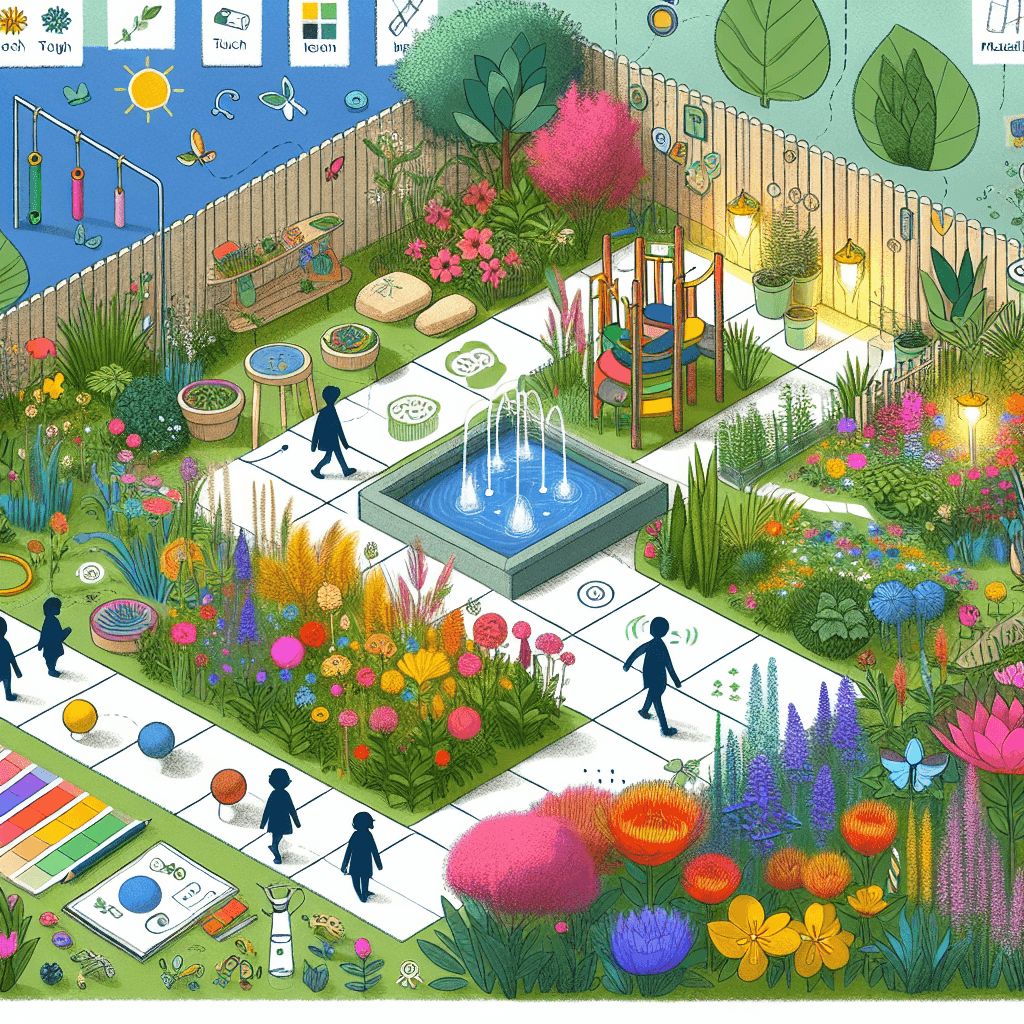
Garden Guardians: Design a Sensory Garden
Inquiry Framework
Question Framework
Driving Question
The overarching question that guides the entire project.How can we design a sustainable and accessible sensory garden that enhances the well-being and social interaction of adults with disabilities by stimulating their senses and fostering community?Essential Questions
Supporting questions that break down major concepts.- What features are important to include in a garden to make it accessible and enjoyable for adults with disabilities?
- How can a sensory garden improve the well-being and quality of life for people with disabilities?
- What types of plants and elements stimulate different senses in a garden environment?
- How can we ensure that our sensory garden is sustainable and environmentally friendly?
- What role do gardens play in community building and social interaction for individuals with disabilities?
Standards & Learning Goals
Learning Goals
By the end of this project, students will be able to:- Identify key features that make a garden accessible and enjoyable for adults with disabilities.
- Describe how a sensory garden can enhance the well-being and social interaction of individuals with disabilities.
- Select plants and garden elements that stimulate different senses and support environmental sustainability.
- Discuss the role of gardens in promoting community building and social interaction.
- Apply knowledge of perimeter and area to design an effective garden layout.
Next Generation Science Standards
Common Core Standards
Entry Events
Events that will be used to introduce the project to studentsMystery Seed Packet
Present each group with a sealed 'mystery seed packet' along with tools and soil. Challenge students to plant and nurture these unknown seeds, sparking discussions about the environmental needs of plants and encouraging speculation about the sensory benefits different plants might provide for the garden. This immediate hands-on activity connects directly to gardening and plants' sensory attributes.Sensory Blindfold Experience
Begin with a sensory activity where students wear blindfolds and experience a mini sensory garden set up in the classroom. Students use touch, smell, and hearing to explore, provoking curiosity about how a garden can appeal to different senses. This mimics the sensory experiences intended for the designed garden and ties into learning adaptive methods for understanding environments.The Garden Guardians Community Challenge
Launch a community design contest where students must submit their sensory garden designs to a local advisory board for consideration. Offer the premise that the best designs could be part of a real plan to enhance local community spaces, challenging students to think big and leverage their authentic interests in social impact through environmental science.Portfolio Activities
Portfolio Activities
These activities progressively build towards your learning goals, with each submission contributing to the student's final portfolio.Mystery Seed Exploration
In this activity, students explore the 'mystery seed packet' in their groups, planting and nurturing seeds while making predictions about the plants' sensory contributions and environmental needs.Steps
Here is some basic scaffolding to help students complete the activity.Final Product
What students will submit as the final product of the activityA plant observation journal documenting the growth process, environmental needs of the plants, and predictions regarding sensory attributes.Alignment
How this activity aligns with the learning objectives & standardsThis activity aligns with NGSS 4-ESS3-1 by engaging students in understanding the natural resources needed for plant growth and environmental impacts.Sensory Garden Design Workshop
Students participate in a sensory-focused workshop where they brainstorm and design a mini sensory garden model, emphasizing the inclusion of features that appeal to touch, smell, and hearing.Steps
Here is some basic scaffolding to help students complete the activity.Final Product
What students will submit as the final product of the activityA small-scale model or collage of a sensory garden, complete with labeled elements catering to various senses.Alignment
How this activity aligns with the learning objectives & standardsThis activity connects to NGSS 4-LS1-2 by allowing students to use models to explore how senses receive and process information, as well as CCSS.ELA-LITERACY.SL.4.1 for collaborative discussion and presentation.Calculate and Create
Students apply mathematical skills to calculate the area and perimeter of their garden designs, ensuring the space is maximized and effectively used for sensory features.Steps
Here is some basic scaffolding to help students complete the activity.Final Product
What students will submit as the final product of the activityA mathematically accurate garden layout design, with calculations clearly documented.Alignment
How this activity aligns with the learning objectives & standardsThis activity aligns with CCSS.Math.Content.4.MD.A.3, helping students apply mathematical concepts to real-world situations.Community Impact Presentation
Students develop and deliver a presentation to a mock community advisory board, advocating for their sensory garden design and its benefits for adults with disabilities.Steps
Here is some basic scaffolding to help students complete the activity.Final Product
What students will submit as the final product of the activityA well-organized persuasive presentation that communicates the design and social value of the sensory garden.Alignment
How this activity aligns with the learning objectives & standardsThis activity supports CCSS.ELA-LITERACY.SL.4.1 for engaging in discussions, as well as showcasing alignment with NGSS content standards through environmental and community considerations.Rubric & Reflection
Portfolio Rubric
Grading criteria for assessing the overall project portfolioSensory Garden Design Assessment Rubric
Environmental Understanding
Evaluates the ability to select environmentally friendly plants and understand natural resources.Plant Selection
Selection of plants based on sustainability and sensory stimulation.
Exemplary
4 PointsSelects a diverse range of plants that excellently balance sustainability and various sensory stimulations, clearly understanding their environmental impact.
Proficient
3 PointsSelects an appropriate range of sustainable plants that target various senses and describe their environmental benefits well.
Developing
2 PointsSelects plants that have some sustainability benefits and minor sensory attribution with limited explanation.
Beginning
1 PointsSelects plants with little attention to sustainability or sensory attributes; explanation is minimal or incorrect.
Environmental Impact Understanding
Understanding the impact of plant choices on the environment and resources.
Exemplary
4 PointsDemonstrates a thorough understanding of the environmental impact of plant choices, with significant insight into resource implications.
Proficient
3 PointsDemonstrates a good understanding of environmental impacts, discussing resource implications knowledgeably.
Developing
2 PointsShows basic understanding of environmental impacts with limited mention of resource implications.
Beginning
1 PointsShows little to no understanding of environmental impacts or resource implications.
Sensory Integration
Measures how well students integrate sensory elements into their garden design for the benefit of adults with disabilities.Sensory Feature Design
Quality of designs aimed at stimulating various senses for accessibility and enjoyment.
Exemplary
4 PointsDesign includes innovative sensory features that excellently cater to a broad range of senses, providing outstanding accessibility.
Proficient
3 PointsDesign effectively includes various sensory features that cater well to accessibility.
Developing
2 PointsDesign includes basic sensory features with limited accessibility focus.
Beginning
1 PointsDesign shows minimal attention to sensory features or accessibility.
Understanding of Sensory Processes
Comprehension of how sensory inputs are received and processed.
Exemplary
4 PointsExhibits excellent understanding with detailed explanations of sensory inputs and processes.
Proficient
3 PointsShows strong understanding with clear explanation of sensory inputs and processes.
Developing
2 PointsOffers basic understanding with some correct interpretation of sensory processes.
Beginning
1 PointsShows minimal understanding with incorrect interpretations of sensory processes.
Mathematical Application
Assesses the application of mathematical concepts in garden design, specifically area and perimeter calculations.Accuracy of Calculations
Precision in calculating area and perimeter for garden design.
Exemplary
4 PointsCalculations are highly precise with no errors and demonstrate a thorough understanding of measurement.
Proficient
3 PointsCalculations are mostly accurate with minor errors, showing a good understanding of measurement.
Developing
2 PointsCalculations show frequent errors but demonstrate basic measurement understanding.
Beginning
1 PointsCalculations are mostly incorrect and show little understanding of measurement.
Communication and Presentation
Evaluates the ability to effectively communicate and advocate for the sensory garden design.Clarity of Presentation
Clarity and organization of the sensory garden presentation.
Exemplary
4 PointsPresentation is exceptionally clear, well-organized, and compelling, with outstanding use of visuals.
Proficient
3 PointsPresentation is clear and organized with effective use of visuals and communication.
Developing
2 PointsPresentation is understandable with some organization but limited or ineffective visuals.
Beginning
1 PointsPresentation lacks clarity and organization, with poor or missing visuals.
Engagement in Discussion
Participation in collaborative discussions and responses to peer feedback.
Exemplary
4 PointsEngages deeply in discussions, responds insightfully to feedback, and refines ideas effectively.
Proficient
3 PointsEngages well in discussions, responds appropriately to feedback, and shows some refinement.
Developing
2 PointsEngages minimally in discussions with limited response to feedback.
Beginning
1 PointsStruggles to engage in discussions, offering little response to feedback.