
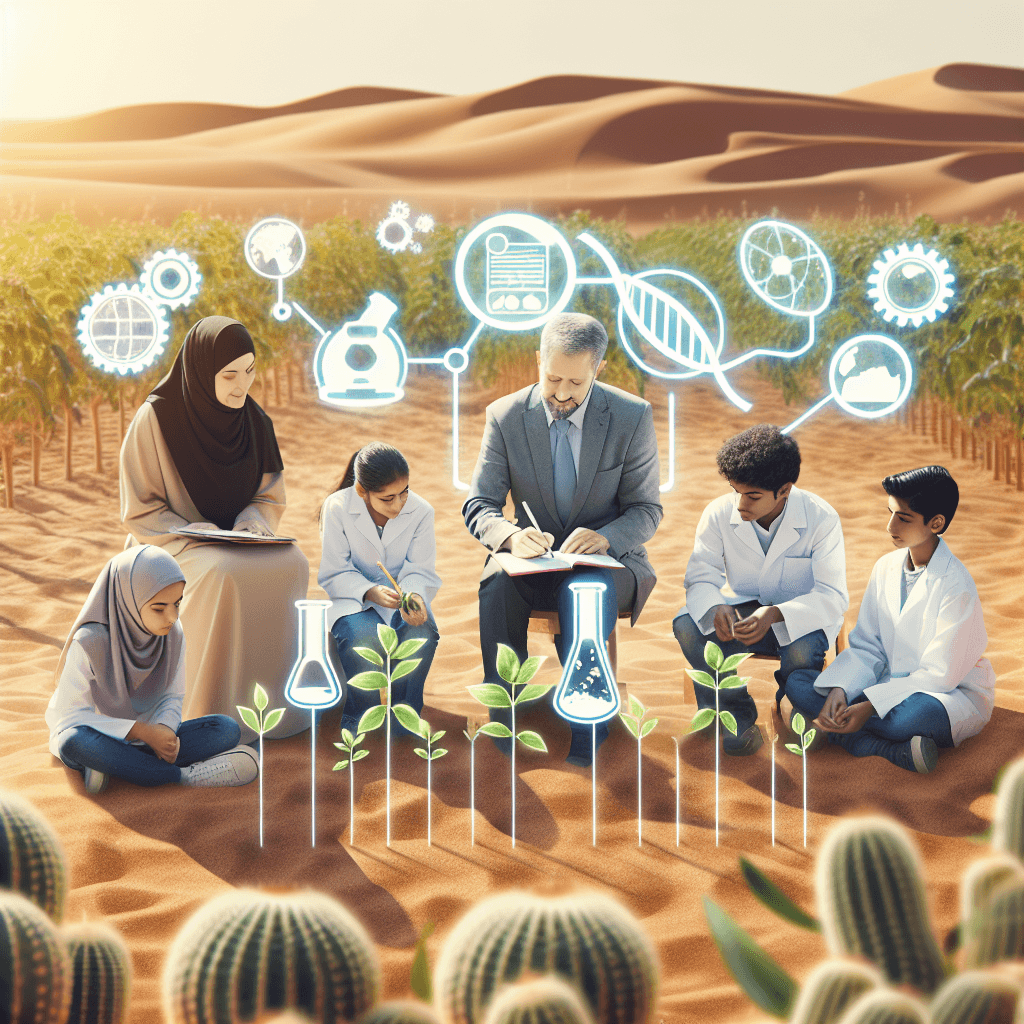
Genetic Architects: Designing Climate-Resilient Crops for the UAE
Inquiry Framework
Question Framework
Driving Question
The overarching question that guides the entire project.How can we, as members of the UAE Agricultural Genetics Innovation Team, design and scientifically justify a genetically optimized crop that uses the principles of inheritance and variation to thrive in the UAE's extreme environment?Essential Questions
Supporting questions that break down major concepts.- How do meiosis and genetic recombination ensure that no two plants are exactly alike, and why is this diversity crucial for survival?
- In what ways do dominant and recessive traits determine the physical characteristics of a crop designed for the UAE's climate?
- How can we use Punnett squares to mathematically predict which traits will appear in our engineered crops?
- What role do mutations play in the evolution of new plant traits, and are they always beneficial for food security?
- What specific physiological traits (like salt tolerance or heat resistance) are most vital for ensuring a sustainable food supply in the UAE?
- How does the scientific justification of a 'genetically improved crop' balance human needs with environmental sustainability?
Standards & Learning Goals
Learning Goals
By the end of this project, students will be able to:- Analyze and explain how meiosis, Mendelian inheritance, and mutations contribute to genetic variation and phenotypic diversity in plant populations.
- Apply mathematical models, such as Punnett squares, to calculate the probability of specific traits (e.g., drought resistance) appearing in crop offspring.
- Design a genetically improved crop model that addresses specific UAE environmental stressors including high temperature, salinity, and water scarcity.
- Justify the selection of specific genetic traits using evidence-based scientific reasoning and environmental data relevant to food security in the Middle East.
- Evaluate the role of biotechnology and genetic variation in ensuring sustainable food production systems for future populations.
Next Generation Science Standards (NGSS)
Entry Events
Events that will be used to introduce the project to studentsThe Survivor Plant 'Crime Scene' Investigation
Students arrive to find a 'Crime Scene' where several plants have 'died' under different conditions (heat, salt, drought), but one 'Survivor Plant' is thriving. They must use 'Genetic Decoder' cards (showing traits and inheritance patterns) to investigate the biological secrets that allowed the survivor to live while others perished.The 2071 Grocery Store Experience
Transform the classroom into a grocery store from the year 2071 where shelves are empty and a single, wilted tomato costs 500 AED. Students receive a 'transmission from the future' explaining that climate change has made traditional farming impossible, and they have been recruited to 're-code' the DNA of plants to save the food supply.Portfolio Activities
Portfolio Activities
These activities progressively build towards your learning goals, with each submission contributing to the student's final portfolio.The Variation Engine: Meiosis & Mutation Lab
Students dive into the 'engine room' of genetics to understand how their crop will achieve diversity. They will model the process of meiosis to see how independent assortment and crossing over create unique offspring. Additionally, they will 'simulated' a mutation event—introducing a rare genetic change that might provide a 'super-trait' (like a new protein that prevents heat denaturation) not found in the original population.Steps
Here is some basic scaffolding to help students complete the activity.Final Product
What students will submit as the final product of the activityAn annotated 'Variation Map' or digital animation showing how meiosis and a specific mutation resulted in a unique genetic profile for their new crop.Alignment
How this activity aligns with the learning objectives & standardsAligns with HS-LS3-2: Make and defend a claim that inheritable genetic variations result from new genetic combinations through meiosis and mutations. It focuses on the mechanisms that create the diversity needed for breeding programs.The Predictor’s Lab: Coding for Success
Now that students have identified their traits, they must predict the success of their 'Super Crop.' Using Mendelian principles, students will perform genetic crosses. If 'Salt Tolerance' is a recessive trait (s) and 'Salt Sensitive' is dominant (S), what are the odds of producing a salt-tolerant crop from two heterozygous parents? Students will use math to justify their breeding strategy.Steps
Here is some basic scaffolding to help students complete the activity.Final Product
What students will submit as the final product of the activityA 'Genetics Forecast Report' featuring at least three different Punnett square crosses and a statistical analysis of the likelihood of desired trait expression.Alignment
How this activity aligns with the learning objectives & standardsAligns with HS-LS3-3: Apply concepts of statistics and probability to explain the variation and distribution of expressed traits in a population. It uses Punnett squares to predict the success of the breeding program.The Innovation Blueprint: Securing the Future
In this final phase, students synthesize their research, variation models, and probability data into a final 'Innovation Blueprint.' They must present their genetically improved crop to the 'Ministry of Food Security.' This involves showing the plant's design and, more importantly, providing the scientific 'why' behind their genetic choices, proving it is a viable solution for the UAE's 2071 food goals.Steps
Here is some basic scaffolding to help students complete the activity.Final Product
What students will submit as the final product of the activityA final 'Innovation Package' (Presentation, Model, or Report) that includes the plant's physical design and a scientific defense of its genetic makeup.Alignment
How this activity aligns with the learning objectives & standardsAligns with HS-ETS1-2: Design a solution to a complex real-world problem. It also covers the 'Scientific Justification' requirement of the project by requiring evidence-based claims.Rubric & Reflection
Portfolio Rubric
Grading criteria for assessing the overall project portfolioUAE Agricultural Genetics Innovation Rubric
Scientific Understanding of Genetics
Focuses on the student's ability to model and calculate the biological processes of inheritance.Mechanisms of Variation
Demonstrates understanding of how meiosis (independent assortment, crossing over) and mutations create genetic diversity.
Exemplary
4 PointsModels show sophisticated understanding of meiosis, clearly illustrating crossing over and independent assortment. The identified mutation is scientifically plausible, innovative, and its transmission to future generations is explained with high precision.
Proficient
3 PointsModels accurately demonstrate the shuffling of chromosomes during meiosis. The identified mutation is relevant to the plant's survival, and the explanation of its inheritance is clear and scientifically sound.
Developing
2 PointsModels show basic chromosomal movement but may miss the nuances of variation (like crossing over). The mutation is identified but the explanation of its inheritance or beneficial nature is inconsistent.
Beginning
1 PointsMeiosis model is incomplete or contains significant errors. The mutation is either not identified or its role in genetic variation is misunderstood.
Genetic Prediction & Probability
Applies Mendelian genetics and probability to predict trait distribution in offspring.
Exemplary
4 PointsUses complex crosses (dihybrid) with 100% accuracy. Statistical analysis of seed requirements is flawless and integrated into a strategic breeding plan. Distinctly identifies dominant/recessive relationships.
Proficient
3 PointsMonohybrid and dihybrid crosses are performed accurately. Phenotypic and genotypic ratios are correctly calculated and used to forecast crop success. Clear assignment of alleles.
Developing
2 PointsPunnett squares are attempted but contain minor errors in calculation or allele assignment. Probability is calculated but not fully connected to the 'Super Crop' goals.
Beginning
1 PointsPunnett squares are incomplete or show fundamental misunderstandings of dominant/recessive traits. Probability calculations are missing or incorrect.
UAE Agricultural Application
Evaluates the practical application of genetic theory to solve regional agricultural challenges.Environmental Adaptation Design
Identifies and integrates specific traits to survive UAE's heat, salinity, and water scarcity.
Exemplary
4 PointsDesign features highly specialized traits that go beyond basics (e.g., specific protein adaptations for heat). The crop is a comprehensive solution for UAE food security, showing deep research into local environmental stressors.
Proficient
3 PointsDesign includes clear traits for drought resistance, salt tolerance, or heat resistance that are directly relevant to the UAE. The crop is realistically suited for the local climate.
Developing
2 PointsThe crop has generic 'survival' traits, but the connection to specific UAE environmental challenges (like specific soil salinity levels) is surface-level or inconsistent.
Beginning
1 PointsTraits are listed but do not clearly address UAE-specific challenges, or the design is not suitable for an extreme environment.
Analysis and Reasoning
Measures the student's ability to think critically and support claims with data.Evidence-Based Justification
Defends the crop design using scientific evidence, genetic data, and logic.
Exemplary
4 PointsJustification is a masterful synthesis of genetic data, environmental science, and sustainability. Addresses potential trade-offs and provides a compelling, evidence-based argument for the crop's long-term viability.
Proficient
3 PointsUses data from Punnett squares and meiosis models to justify the design. Reasoning is logical and explains why the specific genetic makeup is beneficial for the UAE.
Developing
2 PointsJustification is provided but relies more on general opinions than specific genetic data or lab results. Connections between traits and environment are basic.
Beginning
1 PointsJustification is missing, illogical, or lacks any scientific evidence to support the chosen traits.
Final Product & Communication
Assesses the student's ability to communicate complex scientific ideas effectively.Communication & Product Quality
The clarity, organization, and professional quality of the final presentation/report.
Exemplary
4 PointsProduct is of professional quality, highly engaging, and uses creative media to explain complex concepts. Communication is clear, and the student demonstrates leadership during Q&A.
Proficient
3 PointsProduct is well-organized, clear, and covers all project requirements. The explanation of the 'Innovation Blueprint' is easy to follow and scientifically accurate.
Developing
2 PointsProduct is complete but may be disorganized or lack clarity in some sections. Some required elements (like labeling or bibliography) may be missing.
Beginning
1 PointsProduct is incomplete, messy, or fails to communicate the basic ideas of the project. Significant support was needed to reach completion.