
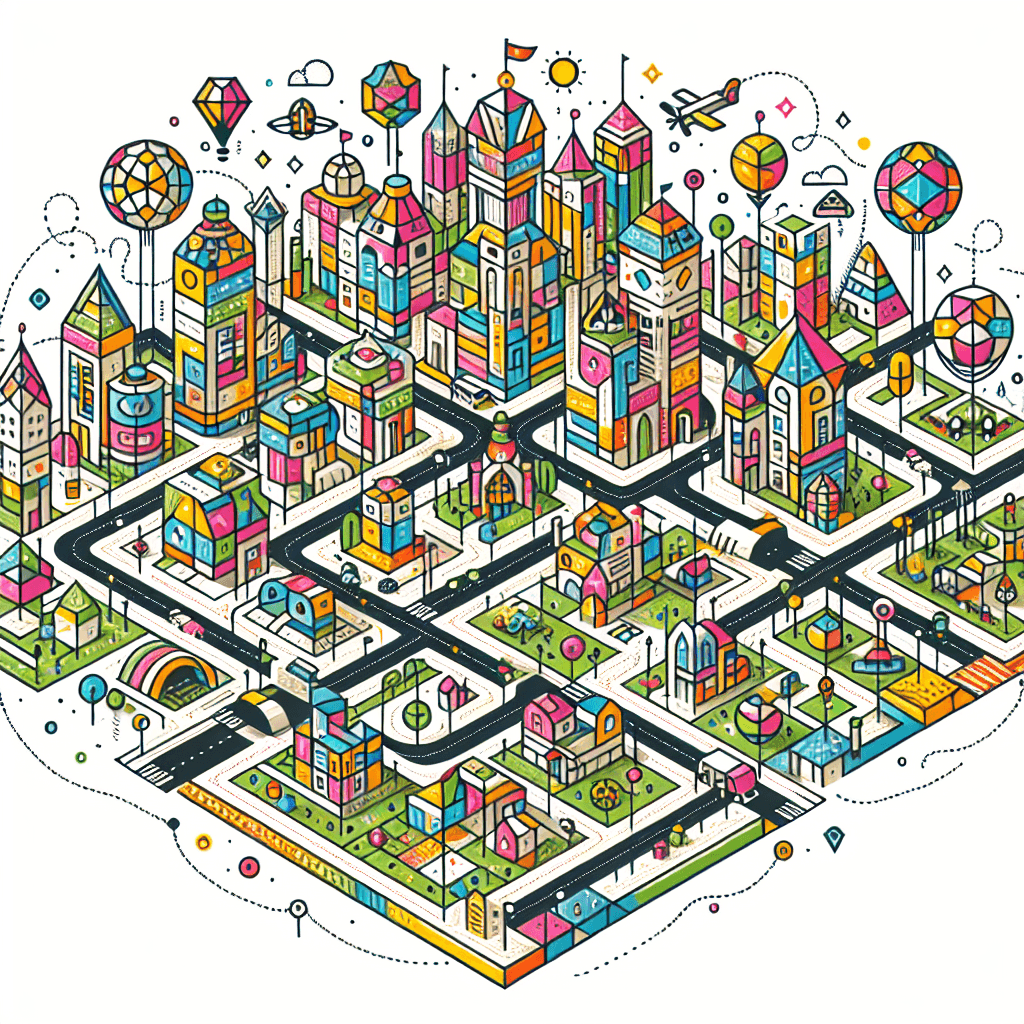
Geometry City: Design Your Dream City
Inquiry Framework
Question Framework
Driving Question
The overarching question that guides the entire project.How can we, as urban planners, design a sustainable and visually appealing city using geometric principles to optimize functionality and enhance the lives of its citizens?Essential Questions
Supporting questions that break down major concepts.- How can geometric shapes be used to design functional and aesthetically pleasing cities?
- What geometric principles (angles, lines, symmetry) are essential for city planning and design?
- How do different 2D and 3D shapes contribute to the overall structure and organization of a city?
- How can transformations (translations, reflections, rotations) and symmetry be used to create visually appealing and balanced city layouts?
- How can coordinates and the Cartesian plane be used to accurately map and plan the layout of a city?
Standards & Learning Goals
Learning Goals
By the end of this project, students will be able to:- Apply geometric principles to design a functional and aesthetically pleasing city.
- Utilize 2D and 3D shapes to create city structures and layouts.
- Incorporate transformations and symmetry to enhance city design.
- Use coordinates and the Cartesian plane to map and plan the city layout.
Teacher Provided
Entry Events
Events that will be used to introduce the project to students'Geometry in Disguise' Photo Challenge
Students receive cryptic photos of cityscapes, challenged to identify hidden geometric shapes and angles within the images. This sparks curiosity about the prevalence of geometry in urban design and encourages them to look at their own surroundings with a mathematical eye.Portfolio Activities
Portfolio Activities
These activities progressively build towards your learning goals, with each submission contributing to the student's final portfolio.Shape Surveyor's Starter Kit
Students will begin by identifying and classifying different types of lines and angles found in real-world cityscapes. This activity reinforces their understanding of fundamental geometric concepts.Steps
Here is some basic scaffolding to help students complete the activity.Final Product
What students will submit as the final product of the activityA visual presentation (e.g., poster, slideshow) showcasing labeled lines and angles in cityscapes with explanations.Alignment
How this activity aligns with the learning objectives & standardsAligns with standard 9.1 (Points, lines, and angles).2D Design Blueprint
Students will explore various 2D shapes and their properties, then apply this knowledge to create a blueprint for a city block, focusing on the functional use of each shape.Steps
Here is some basic scaffolding to help students complete the activity.Final Product
What students will submit as the final product of the activityA detailed blueprint of a city block using various 2D shapes, with labels and explanations of their properties and functions.Alignment
How this activity aligns with the learning objectives & standardsAligns with standard 9.2 (2D shapes).3D Cityscape Model
Students will extend their understanding of geometric shapes by creating 3D models of city buildings using prisms and pyramids, focusing on accurately representing faces, edges, and vertices.Steps
Here is some basic scaffolding to help students complete the activity.Final Product
What students will submit as the final product of the activity3D models of city buildings constructed from prisms and pyramids, with descriptions of their geometric properties.Alignment
How this activity aligns with the learning objectives & standardsAligns with standard 9.3 (3D figures).Transformation Station
Students will explore geometric transformations by applying translations, reflections, and rotations to building designs, and incorporating lines of symmetry to create balanced and visually appealing urban layouts.Steps
Here is some basic scaffolding to help students complete the activity.Final Product
What students will submit as the final product of the activityA city layout incorporating transformed building designs with identified lines of symmetry, and explanations of how transformations enhance visual appeal.Alignment
How this activity aligns with the learning objectives & standardsAligns with standard 9.4 (Transformation).Coordinate City Planner
Students will use coordinates and the Cartesian plane to plan and map the layout of their city, accurately plotting points and drawing shapes to represent buildings, roads, and other city features.Steps
Here is some basic scaffolding to help students complete the activity.Final Product
What students will submit as the final product of the activityA city map plotted on a Cartesian plane with labeled coordinates for buildings and landmarks, and an explanation of the mapping process.Alignment
How this activity aligns with the learning objectives & standardsAligns with standard 9.5 (Position and movement).Geometry City Construction Crew
Students will apply their knowledge of geometric construction to accurately create angles, circles, and parallel and perpendicular lines within their city designs, using tools like compasses, rulers, and protractors.Steps
Here is some basic scaffolding to help students complete the activity.Final Product
What students will submit as the final product of the activityA detailed city area plan with accurately constructed geometric elements (angles, circles, parallel lines, perpendicular lines), labeled measurements, and a construction process explanation.Alignment
How this activity aligns with the learning objectives & standardsAligns with standard 9.6 (Construction).Rubric & Reflection
Portfolio Rubric
Grading criteria for assessing the overall project portfolioGeometry City Portfolio Rubric
Geometric Knowledge and Application
Demonstrates understanding of geometric concepts (lines, angles, shapes, transformations) and their application in city design.Lines and Angles
Accurately identifies, classifies, and applies different types of lines and angles in the city design.
Exemplary
4 PointsDemonstrates a sophisticated understanding of lines and angles, accurately classifying and applying them creatively and effectively in the city design.
Proficient
3 PointsDemonstrates a thorough understanding of lines and angles, accurately classifying and applying them appropriately in the city design.
Developing
2 PointsShows an emerging understanding of lines and angles, with some inconsistencies in classification and application in the city design.
Beginning
1 PointsShows a limited understanding of lines and angles, struggling with classification and application in the city design.
2D and 3D Shapes
Effectively utilizes 2D and 3D shapes to create city structures, demonstrating an understanding of their properties and relationships.
Exemplary
4 PointsMasterfully utilizes a wide variety of 2D and 3D shapes to create innovative and functional city structures, showcasing a deep understanding of their properties.
Proficient
3 PointsEffectively utilizes 2D and 3D shapes to create well-designed city structures, demonstrating a good understanding of their properties.
Developing
2 PointsUses 2D and 3D shapes in the city design, but the application is inconsistent and understanding of properties is limited.
Beginning
1 PointsStruggles to utilize 2D and 3D shapes effectively in the city design, showing a minimal understanding of their properties.
Transformations and Symmetry
Skillfully applies transformations (translations, reflections, rotations) and incorporates symmetry to create balanced and visually appealing city layouts.
Exemplary
4 PointsExpertly applies transformations and symmetry to create a visually stunning and harmonious city layout, demonstrating a sophisticated understanding of these concepts.
Proficient
3 PointsSkillfully applies transformations and incorporates symmetry to create a balanced and visually appealing city layout.
Developing
2 PointsApplies transformations and incorporates symmetry in the city layout, but the application is inconsistent and the impact on visual appeal is limited.
Beginning
1 PointsStruggles to apply transformations and incorporate symmetry in the city layout, showing a minimal understanding of these concepts.
Construction and Mapping Skills
Demonstrates proficiency in geometric construction techniques and the use of coordinates and the Cartesian plane for city planning and mapping.Geometric Construction
Accurately constructs geometric figures (angles, circles, parallel/perpendicular lines) using tools like compasses, rulers, and protractors.
Exemplary
4 PointsDemonstrates masterful geometric construction skills, accurately creating complex figures with precision and attention to detail.
Proficient
3 PointsAccurately constructs geometric figures using appropriate tools and techniques.
Developing
2 PointsShows emerging skills in geometric construction, with some inaccuracies in the construction of figures.
Beginning
1 PointsStruggles with geometric construction, showing limited proficiency in using tools and creating accurate figures.
Coordinate Mapping
Effectively uses coordinates and the Cartesian plane to accurately map the city layout, demonstrating an understanding of spatial relationships.
Exemplary
4 PointsExpertly uses coordinates and the Cartesian plane to create a detailed and accurate map of the city layout, demonstrating a sophisticated understanding of spatial relationships and precise mapping skills.
Proficient
3 PointsEffectively uses coordinates and the Cartesian plane to accurately map the city layout.
Developing
2 PointsUses coordinates and the Cartesian plane to map the city layout, but the accuracy and detail are limited.
Beginning
1 PointsStruggles to use coordinates and the Cartesian plane to map the city layout, showing a minimal understanding of spatial relationships.
Design and Functionality
Creates a city design that is both aesthetically pleasing and functional, considering the needs of its citizens and the principles of urban planning.Aesthetic Appeal
Creates a visually appealing city layout that incorporates geometric principles to enhance its overall aesthetics.
Exemplary
4 PointsCreates a visually stunning and harmonious city layout that demonstrates exceptional creativity and a deep understanding of aesthetic principles.
Proficient
3 PointsCreates a visually appealing city layout that effectively incorporates geometric principles to enhance its aesthetics.
Developing
2 PointsCreates a city layout with some visual appeal, but the incorporation of geometric principles is limited.
Beginning
1 PointsCreates a city layout with limited visual appeal, showing minimal consideration of aesthetic principles.
Functional Design
Designs a city that is functional and meets the needs of its citizens, considering factors like transportation, housing, and public spaces.
Exemplary
4 PointsDesigns an exceptionally functional and sustainable city that comprehensively addresses the needs of its citizens and demonstrates a deep understanding of urban planning principles.
Proficient
3 PointsDesigns a functional city that meets the needs of its citizens, considering factors like transportation, housing, and public spaces.
Developing
2 PointsDesigns a city with some functional elements, but the consideration of citizen needs and urban planning principles is limited.
Beginning
1 PointsDesigns a city with limited functional elements, showing minimal consideration of citizen needs and urban planning principles.