
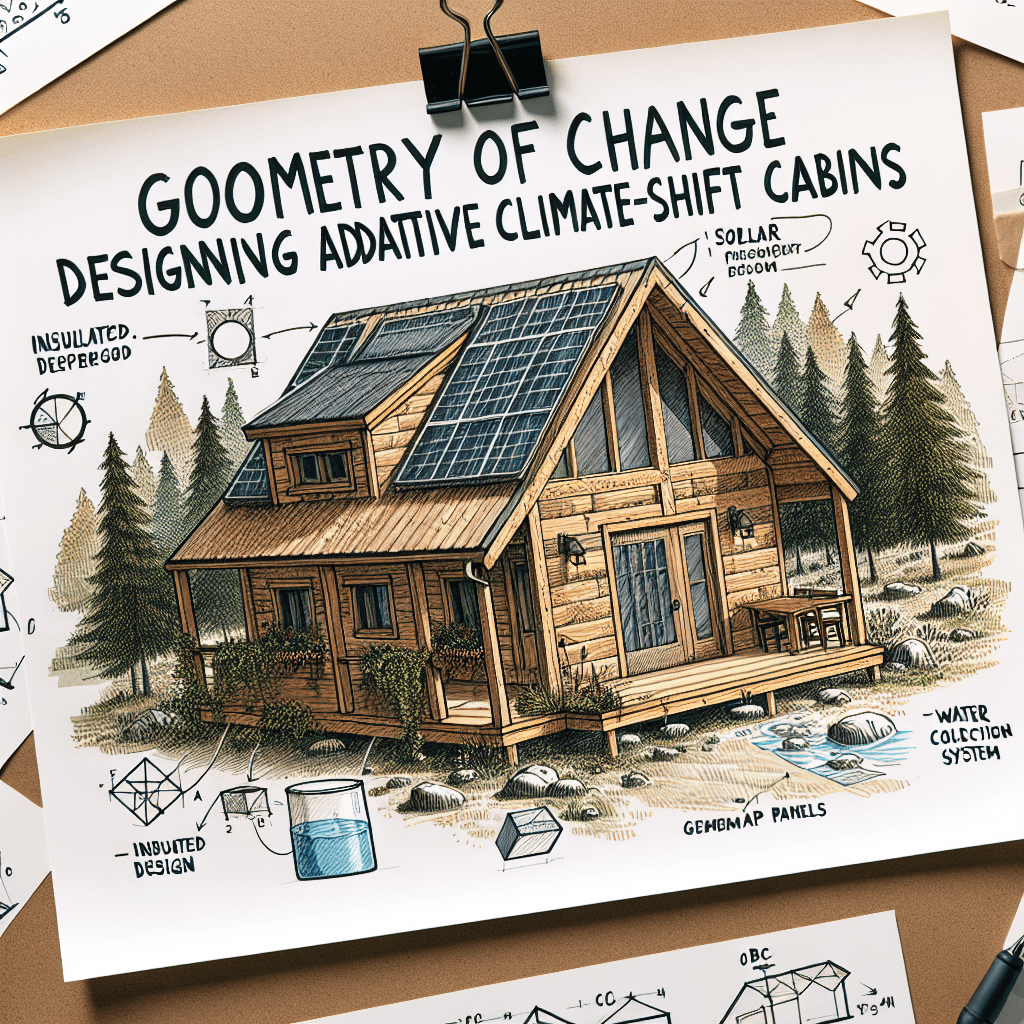
Geometry of Change: Designing Adaptive Climate-Shift Cabins
Inquiry Framework
Question Framework
Driving Question
The overarching question that guides the entire project.How can we design a geometric cabin that uses scale and ratio to adapt to shifting environmental footprints while maintaining the volume and surface area needed for sustainable living?Essential Questions
Supporting questions that break down major concepts.- How do changes in dimensions and area impact the functionality of a living space?
- How can we use scale factors and ratios to resize structures while maintaining their geometric proportions?
- In what ways does the volume of a space dictate its capacity to sustain life and resources?
- How do we modify our mathematical designs when environmental constraints (the footprint) suddenly change?
- What is the relationship between surface area and the materials needed for a climate-resilient cabin?
Standards & Learning Goals
Learning Goals
By the end of this project, students will be able to:- Calculate and analyze the surface area and volume of 3D geometric shapes to determine the resource needs and living capacity of a cabin design.
- Apply scale factors and proportional reasoning to resize architectural drawings and models while maintaining the structural integrity and proportions of the original design.
- Use nets and 2D representations of 3D figures to plan construction and estimate material costs for climate-resilient structures.
- Demonstrate mathematical adaptability by iterating on designs when faced with changing environmental constraints or footprint limitations.
- Communicate the mathematical reasoning behind design choices, specifically explaining the relationship between dimensions, area, and volume.
Common Core State Standards for Mathematics
Common Core State Standards for Mathematical Practice
P21 Framework for 21st Century Learning
Entry Events
Events that will be used to introduce the project to studentsThe Neighborhood Shrink-Ray Pitch
A local urban planner (or a video message) presents a simulated map of the students' own neighborhood showing projected land loss over the next 50 years. Students are 'hired' as junior designers to create 'Shift-Cabins' that must maintain a specific volume for living while their ground-level footprint is forced to decrease by 30% or more.Portfolio Activities
Portfolio Activities
These activities progressively build towards your learning goals, with each submission contributing to the student's final portfolio.Blueprinting the Sanctuary: Volume Foundations
In this introductory activity, students act as lead architects to design their initial 'Climate-Shift Cabin.' They must determine the essential living space required for a person to survive sustainably. Students will choose dimensions for a rectangular prism cabin that meets a specific volume requirement (e.g., 1,000 cubic feet), representing the 'air' and 'living capacity' needed.Steps
Here is some basic scaffolding to help students complete the activity.Final Product
What students will submit as the final product of the activityA 'Volume & Vision' Blueprint featuring a 3D sketch of the cabin, labeled dimensions (including fractional lengths), and the total volume calculation.Alignment
How this activity aligns with the learning objectives & standardsThis activity aligns with CCSS.MATH.CONTENT.6.G.A.2 by requiring students to determine the volume of a right rectangular prism (the cabin) and CCSS.MATH.PRACTICE.MP4 by modeling a real-world living space with mathematics.The Material Map: Unfolding the Design
Now that the volume is set, students must calculate the 'skin' of the building—the materials needed for walls, floors, and roofs to withstand climate shifts. Students will 'unfold' their 3D cabin into a 2D net to visualize the surface area. This helps students understand the relationship between 2D shapes and 3D structures.Steps
Here is some basic scaffolding to help students complete the activity.Final Product
What students will submit as the final product of the activityA 'Material Map' (a precise geometric net) drawn to scale on grid paper, including a table that lists the area of each individual face and the total surface area.Alignment
How this activity aligns with the learning objectives & standardsThis activity aligns with CCSS.MATH.CONTENT.6.G.A.4, as students represent their 3D cabin as a 2D net and use that net to calculate the total surface area (materials needed).The Great Footprint Shrink: Ratios in Action
The 'Urban Planner' has issued a warning: due to environmental shifts, the cabin's ground-level footprint must be reduced by 30%. Students must use scale factors and ratios to resize their cabin's base while attempting to keep the living volume as high as possible. This introduces the challenge of 'Ratio vs. Reality.'Steps
Here is some basic scaffolding to help students complete the activity.Final Product
What students will submit as the final product of the activityA 'Scaling Impact Report' comparing the original footprint area to the new, reduced footprint area using ratios and percentages.Alignment
How this activity aligns with the learning objectives & standardsThis activity aligns with CCSS.MATH.CONTENT.6.RP.A.3, as students use ratio and rate reasoning (scale factors) to solve the real-world problem of a shrinking land footprint.The Pivot Protocol: Engineering Adaptability
Students must now reconcile the conflict: the footprint has shrunk, but the human inside still needs the original volume to survive. Students must 'pivot' their design—perhaps by building taller (increasing the height) or changing the shape—to maintain volume within the new footprint constraints. This demonstrates their ability to be 'adaptable learners.'Steps
Here is some basic scaffolding to help students complete the activity.Final Product
What students will submit as the final product of the activityThe 'Resilient Redesign'—a side-by-side comparison of the original cabin and the new, taller/adapted cabin, including updated volume and surface area calculations.Alignment
How this activity aligns with the learning objectives & standardsThis activity aligns with P21.LSS.1.1 (Adaptability) and CCSS.MATH.PRACTICE.MP4, as students must iterate on their design based on new, ambiguous environmental constraints.The Resilience Portfolio: Pitching the Shift
In the final phase, students compile their journey from the original design to the climate-adapted version. They will present their 'Shift-Cabin' to the 'Urban Planner' (the class), explaining the ratios used, the volume maintained, and how their design is the most efficient use of space and materials for a changing planet.Steps
Here is some basic scaffolding to help students complete the activity.Final Product
What students will submit as the final product of the activityThe 'Climate-Shift Portfolio,' a digital or physical presentation containing the original blueprint, the scaled net, the adaptation calculations, and a final persuasive pitch.Alignment
How this activity aligns with the learning objectives & standardsThis activity synthesizes all previous standards (6.G.A.2, 6.G.A.4, 6.RP.A.3) and focuses on the learning goal of communicating mathematical reasoning behind design choices.Rubric & Reflection
Portfolio Rubric
Grading criteria for assessing the overall project portfolioThe Climate-Shift Cabin: Resilience & Geometry Rubric
Geometric Analysis & Modeling
Assessment of the student's ability to apply 6th-grade geometry standards to create and analyze 3D structures.Volume Modeling & Capacity
Students calculate the volume of a right rectangular prism with fractional edge lengths and demonstrate the concept of volume through unit cube packing.
Exemplary
4 PointsCalculates volume with absolute precision using fractional edge lengths; provides a sophisticated visual representation of 'packing' that proves the formula V=lwh; accurately interprets volume as 'living capacity.'
Proficient
3 PointsCalculates volume correctly with fractional edge lengths; includes a clear drawing or explanation of unit cube packing to verify the calculation.
Developing
2 PointsCalculates volume but contains minor errors in fractional arithmetic; unit cube packing is attempted but may not clearly verify the formula.
Beginning
1 PointsVolume calculations are missing or contain significant errors; little to no evidence of unit cube packing or understanding of fractional edges.
Surface Area & Net Construction
Students represent 3D figures as 2D nets and calculate total surface area by identifying and summing the areas of individual faces.
Exemplary
4 PointsCreates a precise, professional-grade 2D net; accurately identifies all polygons; surface area calculation is flawless; provides a deep justification for how surface area relates to material costs/insulation.
Proficient
3 PointsCreates an accurate 2D net with all faces labeled; calculates total surface area correctly; provides a basic justification for material costs.
Developing
2 PointsNet is mostly accurate but may have minor proportional errors; surface area calculation has minor errors; justification for materials is vague.
Beginning
1 PointsNet is incomplete or incorrect; surface area calculations are missing or inaccurate; no connection made to material costs.
Ratio and Scale Application
Assessment of the student's ability to use ratio and rate reasoning to solve real-world design constraints.Proportional Reasoning & Scaling
Students apply scale factors and ratios to resize the cabin's footprint while maintaining proportional relationships.
Exemplary
4 PointsApplies scale factors and 30% reduction with 100% accuracy; uses sophisticated equivalent ratio tables to show how proportions were maintained; explains the mathematical impact of scaling on the overall design.
Proficient
3 PointsCorrectly applies a scale factor to reduce the footprint; creates an accurate table of equivalent ratios to demonstrate the change in dimensions.
Developing
2 PointsAttempts to reduce the footprint but makes minor errors in percentage or scale factor application; ratio tables are incomplete or contain errors.
Beginning
1 PointsFails to apply scale factors or ratios correctly; dimensions are changed without a mathematical basis; ratio tables are missing.
Engineering Adaptability
Assessment of the student's growth mindset and ability to pivot designs based on the 'Adaptable Learner' framework.Mathematical Iteration & Adaptability
Students modify their designs in response to changing environmental constraints (shrinking footprint) while striving to maintain living volume.
Exemplary
4 PointsInnovative redesign that maximizes volume despite constraints; clearly articulates the trade-offs made between height, footprint, and stability; shows high resilience in the face of 'ambiguous' design shifts.
Proficient
3 PointsSuccessfully modifies the cabin design to fit the new footprint while maintaining or justifying a new volume; shows clear evidence of iteration.
Developing
2 PointsRedesign is attempted but the cabin does not fully fit new constraints or the volume is significantly lost without clear mathematical justification.
Beginning
1 PointsDesign remains static or ignores the footprint constraints; shows resistance to the 'shift' or fails to iterate.
Communication & Synthesis
Assessment of the student's ability to communicate mathematical thinking and organize evidence of learning.Synthesis & Communication
Students synthesize their work into a portfolio and present a logical argument for their design choices.
Exemplary
4 PointsPortfolio is professionally organized and visually compelling; 'Designer’s Statement' provides a sophisticated analysis of the relationship between dimensions, area, and volume; presentation is persuasive and handles Q&A expertly.
Proficient
3 PointsPortfolio is organized and complete; explains the reasoning behind design choices clearly; presentation is coherent and uses mathematical vocabulary correctly.
Developing
2 PointsPortfolio is missing key components or is disorganized; explanation of design choices is basic or relies on non-mathematical reasoning.
Beginning
1 PointsPortfolio is incomplete; presentation lacks clarity or fails to demonstrate the mathematical journey from original to adapted design.