
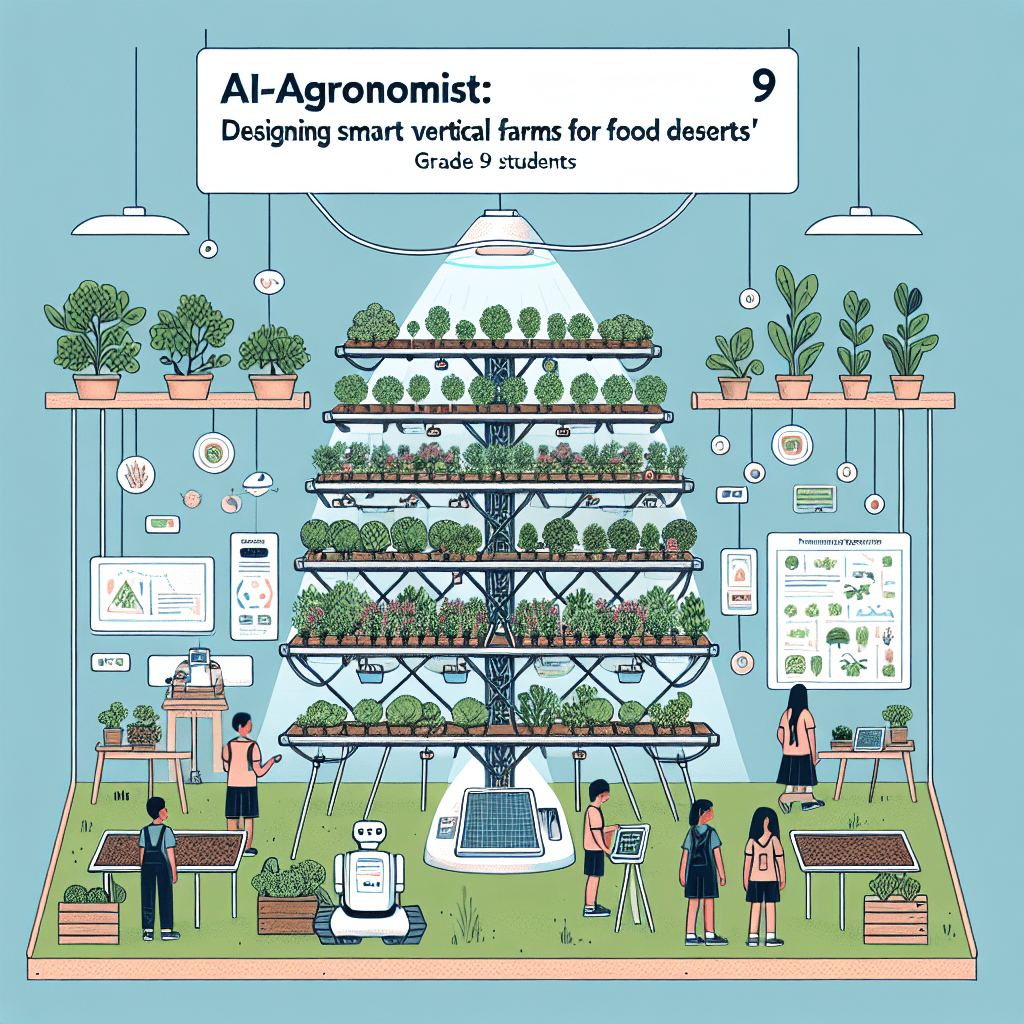
Grade 9: AI-Agronomist: Designing Smart Vertical Farms for Food Deserts
Inquiry Framework
Question Framework
Driving Question
The overarching question that guides the entire project.How can we design and advocate for an ethically-integrated, AI-monitored vertical farm that utilizes physics and data to transform food deserts into sustainable hubs for Zero Hunger?Essential Questions
Supporting questions that break down major concepts.- How can the principles of physics—such as light intensity, fluid dynamics, and thermodynamics—be mathematically modeled to optimize the efficiency of a vertical farming system?
- In what ways can we integrate AI and sensor technology to create an autonomous farming system, and what are the ethical implications of relying on algorithms for food security?
- How do socio-economic factors contribute to the existence of food deserts, and to what extent can localized, tech-driven urban farming achieve the goals of SDG 2: Zero Hunger?
- How can we use persuasive communication and visual design to advocate for the implementation of micro-farms in urban communities while respecting local culture and aesthetics?
- What are the environmental and health benefits of hyper-local food production compared to global supply chains, and how does this reflect our responsibility toward sustainable stewardship?
- How does the intersection of AI ethics and resource management challenge our traditional understanding of labor, equity, and the right to food?
Standards & Learning Goals
Learning Goals
By the end of this project, students will be able to:- Apply principles of physics (optics, fluid dynamics, and thermodynamics) to design and model an efficient vertical farming structure that maximizes crop yield.
- Develop a conceptual or technical framework for an AI-monitored sensor system to manage resources (water, light, nutrients) autonomously while identifying potential algorithmic biases.
- Analyze the socio-economic causes of food deserts and evaluate the effectiveness of localized urban farming in meeting UN SDG 2 (Zero Hunger) targets.
- Critically evaluate the ethical implications of AI in food production, focusing on data privacy, labor replacement, and equity in food access.
- Synthesize research and technical data into a persuasive advocacy campaign that uses multi-modal communication (visual and written) to engage local community stakeholders.
- Utilize mathematical modeling to predict harvest outcomes and resource consumption based on sensor data and environmental variables.
IB MYP Sciences
IB MYP Mathematics
UN Sustainable Development Goals
IB MYP Design
IB MYP Individuals and Societies
ISTE Standards for Students
IB MYP Language and Literature
Entry Events
Events that will be used to introduce the project to studentsThe 15-Minute Desert Dash
Students are given a real-world map of a local neighborhood designated as a 'food desert' and a 15-minute challenge to find a fresh, affordable vegetable using only public transit data. This leads to a 'Product Reveal' where students discover a prototype AI-monitored micro-farm that is currently failing due to incorrect physics parameters, prompting the need for their intervention.Portfolio Activities
Portfolio Activities
These activities progressively build towards your learning goals, with each submission contributing to the student's final portfolio.The Food Desert Detective Agency
In this foundational activity, students act as urban sociologists to investigate the root causes of food insecurity in their specific local context. They will analyze the 'Food Desert' map from the entry event, research local demographics, and interview (or simulate interviews with) community members to understand the barriers to accessing fresh produce. This activity sets the stage by identifying the 'client' and the specific needs the AI-Agronomist must solve.Steps
Here is some basic scaffolding to help students complete the activity.Final Product
What students will submit as the final product of the activityA 'Community Needs & Access Report' featuring a demographic map, a summary of socio-economic barriers, and a defined 'User Profile' for the residents of the food desert.Alignment
How this activity aligns with the learning objectives & standardsAligns with IB MYP Individuals and Societies (Knowing and understanding) and UN SDG 2 (Zero Hunger). It specifically addresses the inquiry into socio-economic factors that create food deserts.The Photon & Flow Blueprint
Students transition from sociologists to engineers. Using the constraints of an urban environment (limited space and light), students must design the physical structure of their vertical farm. They will apply physics principles to determine the Inverse Square Law of light for LED placement and use fluid dynamics to plan an efficient hydroponic or aeroponic irrigation system. Mathematical modeling will be used to calculate the volume of the structure and the potential crop yield per square meter.Steps
Here is some basic scaffolding to help students complete the activity.Final Product
What students will submit as the final product of the activityA Technical Design Blueprint that includes scaled 3D sketches, light intensity calculations, and a mathematical model of resource consumption (water/electricity).Alignment
How this activity aligns with the learning objectives & standardsAligns with IB MYP Sciences (Reflecting on the impacts of science) and IB MYP Mathematics (Applying mathematics in real-life contexts). It focuses on the physics of light (optics) and fluid dynamics.The Algorithmic Agronomist
Now that the physical structure is designed, students must build its 'brain.' Students will design a sensor-based monitoring system (moisture, pH, light, temperature) and develop the logic for an AI that manages these resources. Crucially, they will also engage in a 'Bias Audit' where they investigate how an algorithm optimized solely for 'yield' might overlook community needs, such as crop diversity or cultural relevance, and how data privacy is maintained in a community-integrated tech system.Steps
Here is some basic scaffolding to help students complete the activity.Final Product
What students will submit as the final product of the activityAn AI System Architecture Map (flowchart) and an 'AI Ethics & Equity Manifesto' outlining how the system remains transparent and fair.Alignment
How this activity aligns with the learning objectives & standardsAligns with ISTE 1.1.d (Technology Operations) and ISTE 1.5.b (Computational Thinker), as well as the MYP Design 'Inquiring and Analyzing' objective. It addresses the ethical implications of AI.The Harvest Hub Pitch
In the final activity, students become advocates. They must combine their socio-economic research, their physics-based designs, and their AI logic into a compelling proposal for local government or community stakeholders. The goal is to move from a technical design to a community-wide movement for Zero Hunger. Students will create a multi-modal campaign that includes data visualization, a persuasive pitch, and an aesthetic vision of the farm in the community.Steps
Here is some basic scaffolding to help students complete the activity.Final Product
What students will submit as the final product of the activityA Multi-modal Advocacy Portfolio, including a 2-minute 'Pitch Video' and a digital brochure for community stakeholders.Alignment
How this activity aligns with the learning objectives & standardsAligns with IB MYP Language and Literature (Producing text) and MYP Design (Justifying the solution). It synthesizes all previous learning into a persuasive advocacy campaign.Rubric & Reflection
Portfolio Rubric
Grading criteria for assessing the overall project portfolioThe AI-Agronomist: Urban Micro-Farm Rubric
Socio-Economic & Urban Analysis (MYP I&S / SDG 2)
Focuses on the investigation of food insecurity, socio-economic factors, and the identification of community needs within food deserts.Socio-Economic Inquiry & Community Profiling
Evaluating the ability to analyze the socio-economic causes of food deserts and the development of community-centered user profiles to justify urban farming solutions.
Exemplary
4 PointsDemonstrates a sophisticated understanding of complex socio-economic factors (zoning, history, income). User personas are deeply nuanced and derived from extensive data. Analysis shows exceptional insight into the systemic nature of food insecurity.
Proficient
3 PointsDemonstrates a thorough understanding of localized socio-economic barriers. User personas are clear and supported by demographic data. Analysis effectively justifies the need for an urban farm solution.
Developing
2 PointsShows emerging understanding of food deserts but may rely on generalizations. User personas are basic and partially connected to research. Socio-economic analysis is present but lacks depth or specific data.
Beginning
1 PointsInitial understanding of food deserts with significant gaps in research. User personas are incomplete or stereotypical. Fails to provide a clear justification for the localized solution.
Physics & Mathematical Engineering (MYP Science/Math)
Focuses on the engineering of the vertical farm using physics principles and mathematical calculations to optimize production.Scientific Modeling & Engineering Design
Assessing the application of the Inverse Square Law for lighting, fluid dynamics for irrigation, and mathematical modeling for resource consumption and yield prediction.
Exemplary
4 PointsTechnical blueprints are professionally scaled and precise. Physics principles (optics/fluids) are applied innovatively to maximize efficiency. Mathematical models show advanced integration of variables and predictive accuracy.
Proficient
3 PointsTechnical blueprints are clearly drawn to scale. Correct application of Inverse Square Law and fluid dynamics is evident. Mathematical models effectively predict resource needs and crop yields.
Developing
2 PointsBlueprints are mostly to scale but contain minor errors. Basic application of physics principles is present but may be inconsistent. Mathematical modeling shows partial integration of environmental variables.
Beginning
1 PointsBlueprints are unscaled or lack detail. Struggles to apply physics principles to the farm design. Mathematical modeling is incomplete or contains significant errors in logic.
Technology & AI Ethics (ISTE / MYP Design)
Focuses on the technical design of the AI system and the critical ethical evaluation of technology in agriculture.Computational Logic & Ethical Frameworks
Evaluating the design of the AI sensor system, logic flowcharts, and the critical analysis of algorithmic bias and ethical data management.
Exemplary
4 PointsAI architecture is highly sophisticated, featuring complex IF/THEN logic. The Ethics Manifesto shows exceptional critical thinking regarding algorithmic bias, labor equity, and data transparency. Leadership is shown in defining 'Ethical AI.'
Proficient
3 PointsAI architecture is logical and clearly mapped with appropriate sensor integration. The Ethics Manifesto provides a thorough analysis of bias and outlines clear rules for transparency and equity.
Developing
2 PointsAI architecture is functional but basic. The discussion of AI ethics or bias is emerging but may miss key implications regarding labor or community sovereignty. Manifesto provides limited guidelines.
Beginning
1 PointsLogic flowchart is incomplete or dysfunctional. Shows minimal understanding of AI ethics or the potential for algorithmic bias. Manifesto is missing or lacks specific ethical considerations.
Communication & Advocacy (MYP Lang & Lit / Design)
Focuses on the communication of the final solution, visual design, and the ability to advocate for sustainable change.Synthesis & Multi-modal Advocacy
Assessing the ability to synthesize technical data into a persuasive multi-modal campaign that engages community stakeholders and addresses concerns.
Exemplary
4 PointsSynthesizes complex data into a masterful, persuasive narrative. Visual branding is professional and culturally resonant. Pitch video is exceptionally compelling, anticipating and answering all stakeholder concerns.
Proficient
3 PointsEffectively synthesizes research and data into a clear argument. Visual design is appropriate and engaging. Pitch script uses persuasive vocabulary and structure to address community needs.
Developing
2 PointsAttempts to synthesize data but the connection between research and the final pitch is weak. Visual design is present but may not reflect community aesthetics. Advocacy materials are basic in structure.
Beginning
1 PointsMinimal synthesis of technical data. Communication is unclear or lacks a persuasive focus. Advocacy materials are incomplete or fail to address the target audience/stakeholders.