
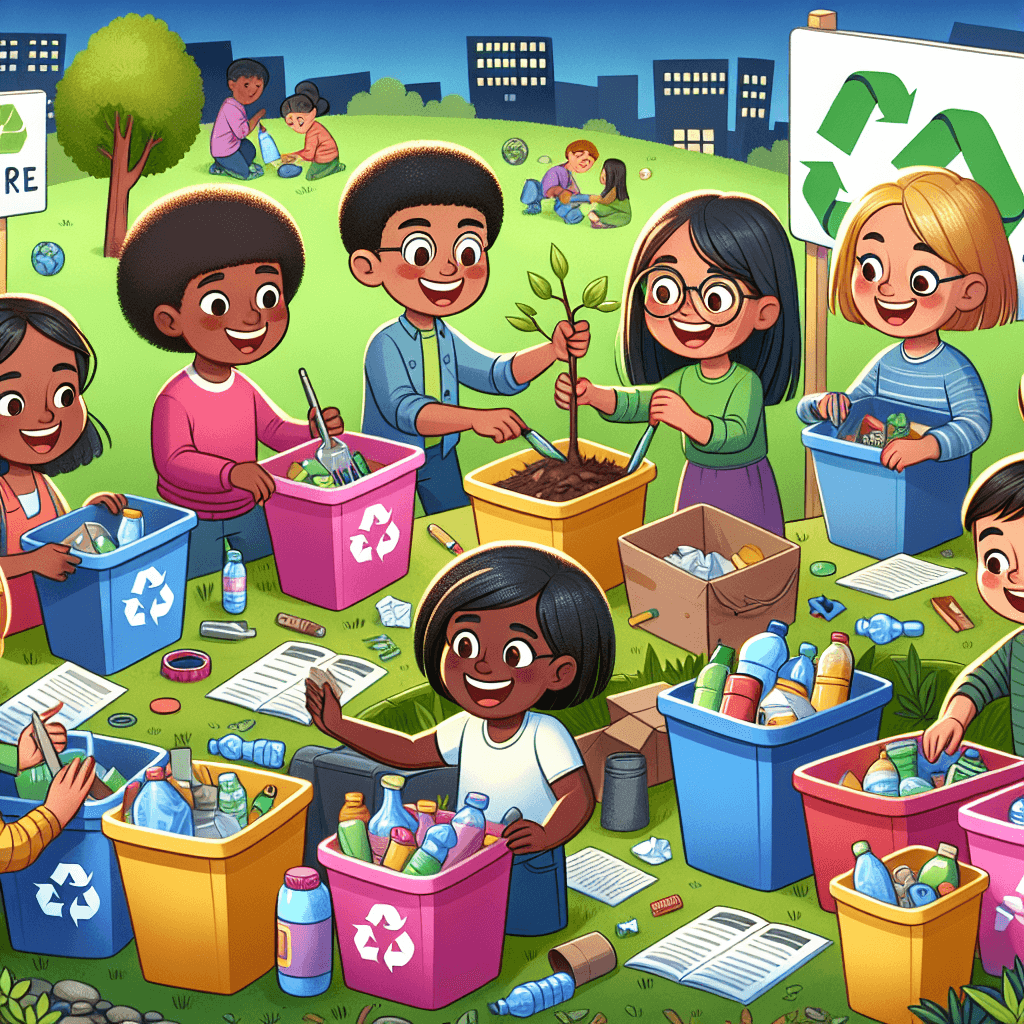
Green Pledge: Student-led Recycling Revolution
Inquiry Framework
Question Framework
Driving Question
The overarching question that guides the entire project.How can we design and implement a sustainable recycling program at our school that effectively engages the entire school community, improves current practices, and demonstrates clear environmental benefits?Essential Questions
Supporting questions that break down major concepts.- What are the current recycling practices at our school and how effective are they?
- How can we improve the sorting and collection of waste materials at our school?
- What strategies can be used to encourage students and staff to participate in recycling efforts?
- How can data help us understand and improve recycling practices?
- In what ways does recycling benefit the environment and our community?
- What are some creative solutions we can propose to enhance recycling at school?
- How can collaboration within our school community lead to more effective recycling initiatives?
- What challenges do we face in implementing a school-wide recycling plan, and how can we overcome them?
Standards & Learning Goals
Learning Goals
By the end of this project, students will be able to:- Students will be able to analyze current recycling practices at their school and identify areas for improvement.
- Students will develop research and data collection skills related to environmental science by gathering information on recycling.
- Students will apply creative problem-solving skills to design sustainable solutions for waste management at school.
- Students will collaborate with peers and the school community to promote environmental responsibility.
- Students will communicate their findings and proposals effectively through written and oral presentations.
- Students will understand the importance of civic responsibility in contributing to environmental sustainability.
Common Core Standards for English Language Arts
Common Core Standards for Mathematics
Next Generation Science Standards
College, Career, and Civic Life (C3) Framework for Social Studies State Standards
Entry Events
Events that will be used to introduce the project to studentsRescue Mission: Trash Sorters in Space!
Students receive a fictional emergency broadcast from a space station overwhelmed by floating paper and plastic debris. The mission: devise a plan to recycle and manage waste materials to ensure the safety and functionality of the station. This concept hooks students with the allure of space while directly tying into their real-world Green Pledge campaign.Meet the Eco-Innovators
Invite local environmental activists and experts to share their personal stories of championing recycling initiatives. Through interaction, students gain inspiration and insights that will help shape their own campaign strategies. This event bridges real-world environmental efforts with students' project goals, encouraging them to see the potential impact of their efforts.Portfolio Activities
Portfolio Activities
These activities progressively build towards your learning goals, with each submission contributing to the student's final portfolio.Trash Sorters ADV Training
Students embark on a deep dive into the intricacies of efficient waste sorting techniques for both paper and plastic. This core exercise will help them build a solid foundation for the rest of the project.Steps
Here is some basic scaffolding to help students complete the activity.Final Product
What students will submit as the final product of the activityStudents demonstrate accurate sorting skills and understand the importance of proper waste management.Alignment
How this activity aligns with the learning objectives & standardsAligns with NGSS.5-ESS3-1 by promoting understanding of how waste sorting is an essential part of protecting Earth's resources.Data Sleuths: The Recycling Detective Agency
Students take on the role of recycling detectives, tasked with investigating and analyzing the current state of school recycling practices. They collect data and create visual representations to analyze effectiveness.Steps
Here is some basic scaffolding to help students complete the activity.Final Product
What students will submit as the final product of the activityA line plot that visualizes the waste collection data, providing insight into current recycling practices.Alignment
How this activity aligns with the learning objectives & standardsMeets CCSS.MATH.CONTENT.5.MD.B.2 by collecting and visually displaying data in a line plot to analyze fractions of a unit.Campaign Speechwriters' Workshop
Students craft persuasive speeches to champion their recycling improvement plans. This task hones their ability to present structured and compelling arguments to peers and faculty.Steps
Here is some basic scaffolding to help students complete the activity.Final Product
What students will submit as the final product of the activityA polished speech ready to present, demonstrating reasoned opinion and supporting information.Alignment
How this activity aligns with the learning objectives & standardsAligned with CCSS.ELA-LITERACY.W.5.1 by fostering skills in writing structured opinion pieces with supportive arguments.Eco-Activist Presenters
The final culmination involves students presenting their proposals to the school community in a formal session, encouraging action towards recycling goals.Steps
Here is some basic scaffolding to help students complete the activity.Final Product
What students will submit as the final product of the activityA formal presentation delivered to the school community, aiming to implement the recycling proposals.Alignment
How this activity aligns with the learning objectives & standardsSupports CCSS.ELA-LITERACY.SL.5.4 by providing students opportunities to report on topics clearly and logically, using facts and descriptive details.The Green Brainstorm Lab
In a creative collaboration session, students brainstorm innovative solutions to improve recycling at school, using their data as a foundation for ideas.Steps
Here is some basic scaffolding to help students complete the activity.Final Product
What students will submit as the final product of the activityAn idea board filled with creative solutions and prioritized plans for improving recycling practices.Alignment
How this activity aligns with the learning objectives & standardsSupports NGSS.5-ESS3-1 by leveraging scientific understanding in proposing enhanced recycling strategies.Rubric & Reflection
Portfolio Rubric
Grading criteria for assessing the overall project portfolioGreen Pledge Campaign Assessment Rubric
Research and Data Analysis
Evaluation of students' ability to investigate and analyze recycling practices through data collection and interpretation.Data Collection
Effectiveness in collecting and organizing data on school recycling practices.
Exemplary
4 PointsCollects extensive, accurate data with attention to detail, using appropriate methods.
Proficient
3 PointsCollects accurate data using appropriate methods; minor errors in detail.
Developing
2 PointsCollects data but lacks accuracy or thoroughness; incomplete methods.
Beginning
1 PointsStruggles to collect data; methods are incomplete or inappropriate.
Data Analysis
Ability to interpret data using mathematical tools, and to draw informed conclusions.
Exemplary
4 PointsAnalyzes data insightfully to identify trends; uses mathematical tools expertly.
Proficient
3 PointsAnalyzes data to identify trends; uses mathematical tools appropriately.
Developing
2 PointsAttempts to analyze data but may miss key trends; limited use of tools.
Beginning
1 PointsStruggles to analyze data; tools are rarely or incorrectly applied.
Problem-Solving and Innovation
Assessment of students' creativity in proposing solutions to enhance recycling practices.Creativity and Innovation
Quality and originality of proposed recycling solutions.
Exemplary
4 PointsProposes highly original, feasible solutions that reflect creativity and extensive thought.
Proficient
3 PointsProposes feasible and somewhat original solutions with creative elements.
Developing
2 PointsProposes solutions that are feasible but lack originality or thoroughness.
Beginning
1 PointsStruggles to propose feasible solutions; limited creativity and originality.
Communication and Presentation
Evaluation of students' ability to effectively convey their ideas through speeches and presentations.Speech Writing
Effectiveness in writing structured, persuasive opinion pieces.
Exemplary
4 PointsCrafts logically structured speeches with compelling arguments and clear evidence.
Proficient
3 PointsCrafts structured speeches with clear arguments and supportive evidence.
Developing
2 PointsWrites speeches with basic structure but limited clarity or evidence.
Beginning
1 PointsStruggles to write coherent speeches; lacks structure and evidence.
Oral Presentation
Effectiveness in presenting ideas clearly and engagingly to an audience.
Exemplary
4 PointsDelivers presentations with clarity, confidence, and engagement, using persuasive techniques.
Proficient
3 PointsDelivers clear and confident presentations with appropriate engagement.
Developing
2 PointsPresentation is unclear or lacks engagement; struggles with confidence.
Beginning
1 PointsStruggles with clarity and confidence in presentation; minimal engagement.
Collaboration and Civic Responsibility
Assessment of students' teamwork skills and understanding of civic responsibility in recycling efforts.Collaboration
Ability to work effectively with peers and contribute to group projects.
Exemplary
4 PointsExhibits leadership in group settings, promoting inclusive and effective collaboration.
Proficient
3 PointsWorks well with peers, contributing effectively to group goals.
Developing
2 PointsParticipates in group work but inconsistent in contribution and communication.
Beginning
1 PointsStruggles to work with peers; requires assistance to contribute to group goals.
Civic Understanding
Understanding of civic responsibilities and how individual actions impact the community.
Exemplary
4 PointsDemonstrates a strong understanding of civic duties and clearly sees the impact of individual actions.
Proficient
3 PointsUnderstands civic duties and recognizes the impact of actions on the community.
Developing
2 PointsShows limited understanding of civic responsibilities; sees limited impact of actions.
Beginning
1 PointsMinimal understanding of civic responsibilities and impact of actions.