
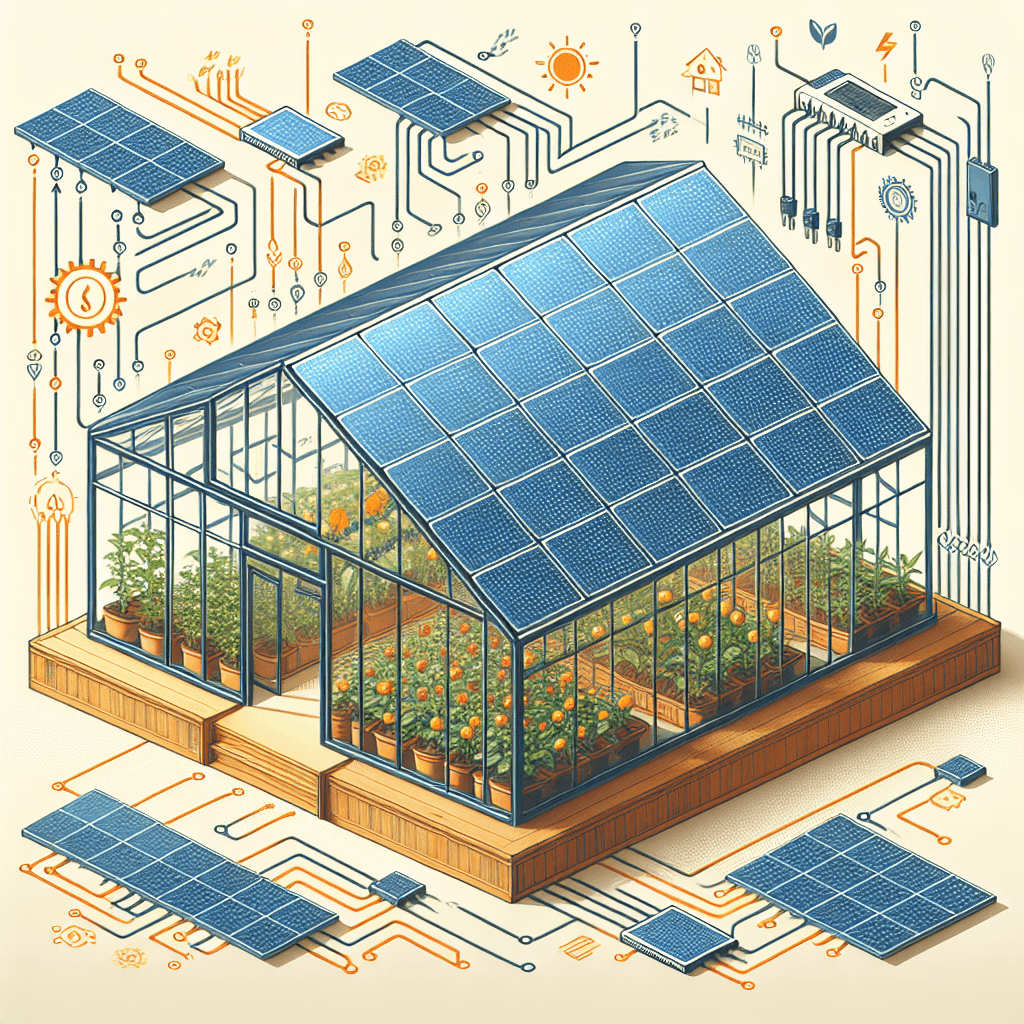
Grid-Wise Greenhouses: Optimizing Circuits for Energy Efficiency
Inquiry Framework
Question Framework
Driving Question
The overarching question that guides the entire project.How can we apply the principles of current electricity to engineer an automated greenhouse system that optimizes plant care while minimizing energy waste?Essential Questions
Supporting questions that break down major concepts.- How can we use Ohm’s Law to design a circuit that responds to changes in its environment?
- In what ways can we manipulate resistance to automate the delivery of water and light to a plant?
- How do series and parallel circuit configurations affect the overall energy efficiency of an automated greenhouse?
- How can mathematical models of power (P = IV) help us minimize energy waste in a real-world system?
- How does the physics of electricity allow us to build sustainable solutions for food production?
Standards & Learning Goals
Learning Goals
By the end of this project, students will be able to:- Students will apply Ohm’s Law (V = IR) to design and construct a functional circuit that responds to changes in environmental resistance (e.g., soil moisture).
- Students will analyze the differences between series and parallel circuit configurations to determine the most energy-efficient setup for a greenhouse system.
- Students will use mathematical models of power (P = IV and P = I²R) to calculate and minimize energy waste within their automated system.
- Students will engineer a prototype that utilizes sensors and actuators (LEDs, motors/pumps) to demonstrate an automated feedback loop for plant care.
- Students will evaluate the trade-offs between system complexity, cost, and energy sustainability in a real-world agricultural context.
Next Generation Science Standards (NGSS)
Common Core State Standards for Mathematics
Entry Events
Events that will be used to introduce the project to studentsRed Planet Rationing: The 5% Survival Challenge
Students receive a 'distress signal' from a simulated Mars colony where energy reserves have dropped to 5%. They are presented with a failing, 'always-on' greenhouse circuit and must calculate the exact moment the colony will run out of power unless they can implement dynamic, sensor-based current control.The Cost of Constancy: The 'Breathing' Circuit Mystery
Students walk into a dark room where two 'smart' power meters are projected on the wall; one shows a steady, expensive drain, while the other fluctuates wildly but stays low. They must use multimeters to investigate a 'mystery circuit' that seems to 'breathe' with the needs of a plant, sparking an inquiry into how resistance and voltage can be automated to save costs.Portfolio Activities
Portfolio Activities
These activities progressively build towards your learning goals, with each submission contributing to the student's final portfolio.The Resistance Resolver: Mapping Soil Conductivity
Before building the full system, students must understand how soil moisture acts as a variable resistor. In this activity, students will use multimeters to measure the resistance of soil at various saturation levels and use Ohm’s Law to determine the necessary voltage to trigger a hypothetical pump.Steps
Here is some basic scaffolding to help students complete the activity.Final Product
What students will submit as the final product of the activityA 'Soil Conductivity Profile' containing a data table of moisture vs. resistance and a set of solved Ohm's Law equations determining the target current for the system.Alignment
How this activity aligns with the learning objectives & standardsThis activity aligns with HS-ETS1-2 (breaking down a complex problem) and HSA-CED.A.4 (rearranging formulas like V=IR). Students begin by quantifying the 'environmental resistance' of the soil, a key component of their greenhouse solution.Circuit Architects: Parallel vs. Series Showdown
Students design the layout for the two main greenhouse subsystems: the LED array (light) and the water delivery (pump). They must decide which components should be in series and which in parallel to ensure that if one LED fails, the pump still functions, and to optimize the voltage distribution from their power source.Steps
Here is some basic scaffolding to help students complete the activity.Final Product
What students will submit as the final product of the activityA technical circuit schematic (blueprint) labeled with intended current and voltage drops for each branch, accompanied by a 'Design Justification' paragraph.Alignment
How this activity aligns with the learning objectives & standardsThis activity aligns with HS-PS3-3 (designing and building a device) and focuses on the learning goal regarding series vs. parallel configurations. It requires students to make engineering choices based on electrical constraints.The Wattage Watchdog: Power Modeling & Waste Reduction
Students will now calculate the 'Energy Footprint' of their proposed greenhouse. By measuring current (I) and voltage (V) across different components, they will calculate power consumption and identify where energy is being 'wasted' as heat (thermal energy) in resistors versus being used for light or mechanical work.Steps
Here is some basic scaffolding to help students complete the activity.Final Product
What students will submit as the final product of the activityAn 'Energy Efficiency Audit' spreadsheet that models the power consumption (in Watts) of the system over a simulated 24-hour cycle.Alignment
How this activity aligns with the learning objectives & standardsThis activity aligns with HS-PS3-1 (creating a computational model of energy flow) and the learning goal of using P=IV to minimize energy waste.The Grid-Wise Governor: The Final Feedback Loop
In the final phase, students integrate their soil sensor and LED system into a single dynamic 'Grid-Wise' prototype. The circuit must automatically dim the LEDs when ambient light is high and activate the pump only when soil resistance crosses a specific threshold, demonstrating a functional feedback loop.Steps
Here is some basic scaffolding to help students complete the activity.Final Product
What students will submit as the final product of the activityA fully functional, automated greenhouse circuit prototype mounted on a display board, including a performance log showing the system 'reacting' to environmental changes.Alignment
How this activity aligns with the learning objectives & standardsThis activity is the culmination of HS-PS3-3 and HS-ETS1-2, where students refine their device to meet the specific constraint of 'minimizing energy waste' while maintaining plant health.Rubric & Reflection
Portfolio Rubric
Grading criteria for assessing the overall project portfolioGrid-Wise Greenhouses: Electrical Engineering & Sustainability Rubric
Scientific Application & Circuitry
Evaluates the student's ability to apply fundamental physics principles to the design of the greenhouse circuit.Soil Conductivity Analysis (Ohm's Law)
Ability to quantify soil resistance and apply Ohm’s Law (V=IR) to determine necessary circuit parameters for automation.
Exemplary
4 PointsPrecisely measures resistance across multiple moisture levels; calculates voltage/current with 100% accuracy; demonstrates sophisticated understanding of soil as a variable resistor by predicting saturation thresholds.
Proficient
3 PointsAccurately measures resistance for dry, damp, and saturated soil; applies Ohm’s Law correctly to find target current; demonstrates clear understanding of the relationship between moisture and conductivity.
Developing
2 PointsMeasures resistance but with minor inconsistencies; calculates Ohm’s Law with occasional errors; shows emerging understanding of how moisture affects the circuit.
Beginning
1 PointsMeasurements are incomplete or inaccurate; struggles to apply Ohm’s Law to the data; provides insufficient evidence of soil conductivity mapping.
Circuit Architecture & Design Logic
Efficiency and logic in designing circuit layouts (series vs. parallel) to meet component requirements and ensure system reliability.
Exemplary
4 PointsDevelops a sophisticated schematic that optimizes voltage distribution; provides an innovative justification for parallel branching that maximizes both energy efficiency and system redundancy.
Proficient
3 PointsDesigns a functional schematic with labeled current and voltage drops; correctly chooses between series and parallel for specific components; explains the logic behind the choice.
Developing
2 PointsDrafts a basic schematic but fails to label all voltage drops; circuit logic is functional but may have inefficient energy distribution or single points of failure.
Beginning
1 PointsSchematic is incomplete or contains fundamental errors in circuit logic; lacks a clear justification for component arrangement.
Computational Modeling & Efficiency
Focuses on the computational modeling of energy and the mathematical precision of the system design.Energy Footprint & Waste Reduction
Proficiency in using P=IV and P=I²R to model energy flow and identify areas of thermal energy waste.
Exemplary
4 PointsModels power usage with high precision; identifies subtle areas of energy waste; proposes an innovative modification that reduces waste by significantly more than the 10% target.
Proficient
3 PointsAccurately calculates P=IV for active components and P=I²R for resistors; creates a logical 24-hour energy audit; proposes a viable 10% waste reduction strategy.
Developing
2 PointsCalculates power with minor errors; creates a partial energy audit; proposed waste reduction strategy is vague or mathematically unsupported.
Beginning
1 PointsStruggles to apply power formulas; audit is incomplete or shows fundamental misunderstandings of energy conservation.
Mathematical Modeling (HSA-CED.A.4)
Ability to rearrange and manipulate electrical formulas to solve for unknown variables in complex system constraints.
Exemplary
4 PointsEffortlessly rearranges formulas (V=IR, P=IV, P=I²R) to solve for any variable; uses mathematical models to predict system behavior under extreme environmental conditions.
Proficient
3 PointsCorrectly rearranges formulas to solve for resistance or current as required by the project; calculations are accurate and clearly documented.
Developing
2 PointsAttempts to rearrange formulas but requires support; calculations are inconsistent or missing clear steps.
Beginning
1 PointsUnable to manipulate formulas for target variables; calculations are largely incorrect or absent.
Engineering & Prototyping
Assesses the physical construction, functionality, and iterative improvement of the greenhouse prototype.Automated System Functionality
Effectiveness of the automated feedback loop (LDR and moisture sensors) in reacting to environmental changes to save energy.
Exemplary
4 PointsPrototype is highly responsive and perfectly calibrated; demonstrates a seamless feedback loop that maximizes plant care while minimizing power; shows exceptional craftsmanship.
Proficient
3 PointsPrototype functions as intended; LDR and soil sensors correctly trigger the LED and pump; system demonstrates a clear, automated response to environmental changes.
Developing
2 PointsPrototype is partially functional; sensors trigger responses inconsistently or require manual intervention; feedback loop is incomplete.
Beginning
1 PointsPrototype fails to respond to environmental triggers; circuit is non-functional or does not incorporate sensors.
Iterative Engineering & Optimization
The process of testing, refining, and optimizing the circuit based on data and performance constraints.
Exemplary
4 PointsProvides detailed documentation of multiple iterations; uses potentiometers to find the absolute 'Goldilocks zone'; demonstrates advanced troubleshooting skills and system optimization.
Proficient
3 PointsConducts a structured stress test; identifies performance gaps and makes successful adjustments to resistor values or component placement.
Developing
2 PointsIdentifies some issues during testing but adjustments are superficial or do not fully resolve the efficiency problems.
Beginning
1 PointsMinimal evidence of testing or refinement; prototype is presented without verification of its performance under stress.
Communication & Inquiry Synthesis
Evaluates how well students communicate their findings and relate their technical work back to the larger driving question.Synthesis & The 'Mars Survival' Pitch
Ability to synthesize project data into a compelling narrative that addresses the 'Mars Survival' challenge and energy sustainability.
Exemplary
4 PointsPresentation is highly persuasive and grounded in rigorous data; makes profound connections between electrical physics and global sustainability/space exploration.
Proficient
3 PointsClearly explains how the circuit saves energy using specific data from the efficiency audit; addresses the 'Mars colony' constraints logically and effectively.
Developing
2 PointsPresentation covers the basic project requirements but lacks strong data integration; connection to the 'Mars' scenario is weak.
Beginning
1 PointsPresentation is disorganized and lacks supporting evidence; fails to explain the system's impact on energy conservation.