
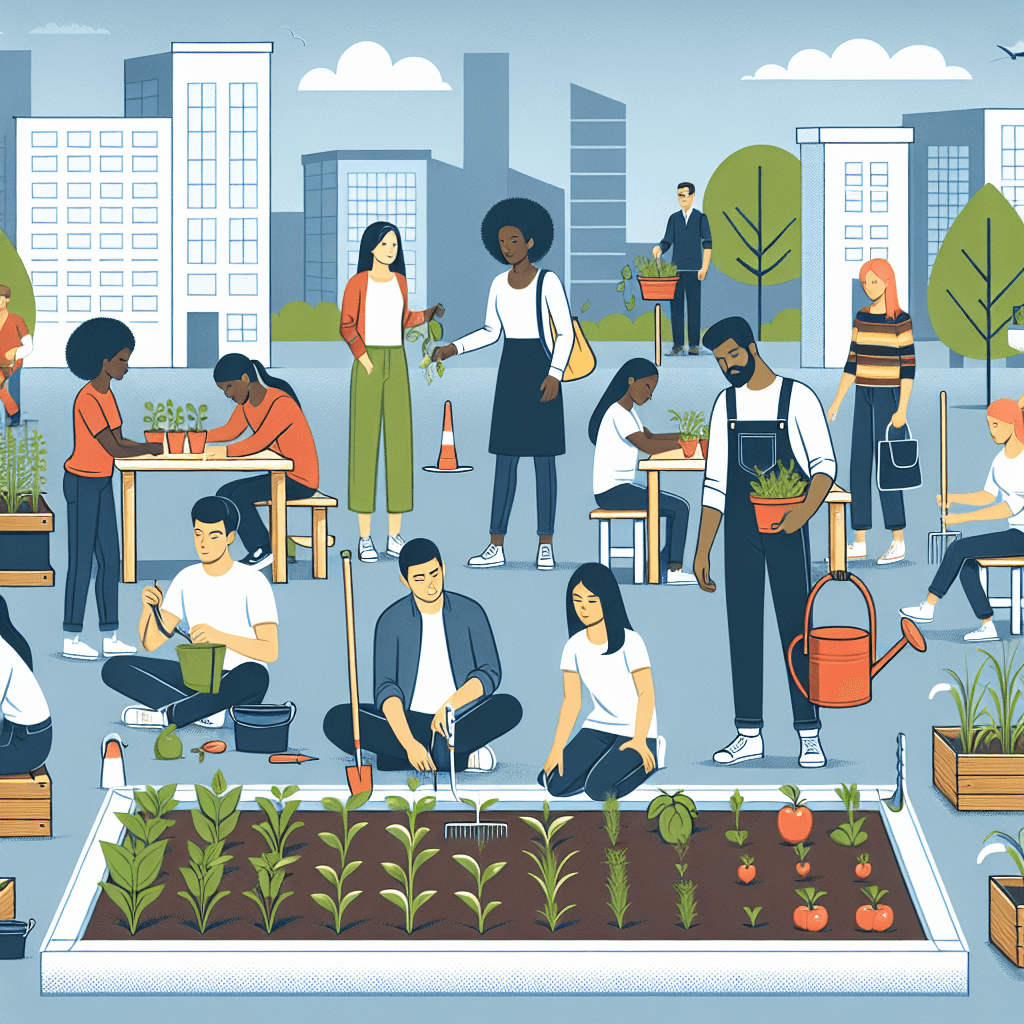
Growing Solutions: Small-Scale Agriculture for Food Security
Inquiry Framework
Question Framework
Driving Question
The overarching question that guides the entire project.How can we design and implement innovative agricultural systems like hydroponics, aquaponics, and raised garden beds to improve local food security while understanding and mitigating their environmental impacts?Essential Questions
Supporting questions that break down major concepts.- How do hydroponics, aquaponics, and raised garden bed systems work to support plant growth?
- What are the scientific principles behind plant growth in different agricultural systems?
- How can mathematical models be used to predict the growth rates and yields of plants in these systems?
- In what ways can small-scale gardens contribute to local food security?
- What are the environmental impacts of different agricultural practices, and how can they be measured or mitigated?
- How does one construct an effective argument in writing about the importance of innovative agricultural practices for food security?
- What are the benefits and challenges of maintaining a hydroponic, aquaponic, or raised garden bed system?
Standards & Learning Goals
Learning Goals
By the end of this project, students will be able to:- Understand the principles and functioning of hydroponics, aquaponics, and raised garden bed systems for plant growth.
- Develop and refine agricultural systems to reduce environmental impact and enhance biodiversity.
- Use mathematical models to predict plant growth and optimize yield in various agriculture systems.
- Analyze the contribution of small-scale gardens to local and global food security.
- Evaluate the environmental impact of agriculture and propose mitigation strategies.
- Construct discipline-specific arguments in writing about the role of innovative agriculture in food security.
- Effectively communicate research findings on agricultural systems and their societal benefits.
Next Generation Science Standards
Common Core English Language Arts Standards
Common Core Mathematics Standards
Entry Events
Events that will be used to introduce the project to studentsThe Food Security Challenge
Kick-off the project with a simulation where students find themselves in a scenario where their community faces a food shortage crisis. Challenge them to devise a plan utilizing hydroponics, aquaponics, and raised garden bed systems to ensure food security. This event connects to real-world crisis management and the application of agricultural sciences.Portfolio Activities
Portfolio Activities
These activities progressively build towards your learning goals, with each submission contributing to the student's final portfolio.Garden Blueprint Designers
Students will sketch initial designs for hydroponics, aquaponics, and raised garden beds to prepare for the building phase. This activity encourages creativity while stressing the importance of thoughtful planning for sustainable systems.Steps
Here is some basic scaffolding to help students complete the activity.Final Product
What students will submit as the final product of the activityDetailed blueprints for each type of system considering space, resources, and local environmental conditions.Alignment
How this activity aligns with the learning objectives & standardsAligns with HS-LS2-7 by designing solutions to reduce environmental impacts.System Construction Specialists
Students will construct their designed hydroponic, aquaponic, and raised garden bed systems. This hands-on activity helps students understand the practical aspects of system creation and implementation.Steps
Here is some basic scaffolding to help students complete the activity.Final Product
What students will submit as the final product of the activityThree functioning agricultural systems: hydroponic, aquaponic, and raised garden bed.Alignment
How this activity aligns with the learning objectives & standardsAligns with NGSS HS-ESS3-3 by simulating management of resources for sustainability.Growth Data Analysts
Students will collect and analyze data on plant growth across the three systems, developing skills in data-driven decision-making.Steps
Here is some basic scaffolding to help students complete the activity.Final Product
What students will submit as the final product of the activityA comprehensive data report showing analysis and interpretation of growth metrics across systems.Alignment
How this activity aligns with the learning objectives & standardsAligns with CCSS.MATH.CONTENT.HSF.IF.B.4 by interpreting key features of graphs related to plant growth.Sustainability Panel
Students will evaluate the environmental impact of their systems and suggest improvements, demonstrating understanding of sustainability principles.Steps
Here is some basic scaffolding to help students complete the activity.Final Product
What students will submit as the final product of the activityA panel presentation discussing the sustainability of each system with proposed improvements.Alignment
How this activity aligns with the learning objectives & standardsAligns with HS-LS2-7 by refining solutions to reduce environmental impacts.Math Models Masters
Students create mathematical models to predict plant growth and system yields, integrating math with real-world applications to optimize farming outputs.Steps
Here is some basic scaffolding to help students complete the activity.Final Product
What students will submit as the final product of the activityMathematical models and graphs predicting plant growth and yield rates.Alignment
How this activity aligns with the learning objectives & standardsAligns with CCSS.MATH.CONTENT.HSA.CED.A.2 by creating and solving equations to represent plant growth.Compelling Communicators
Focusing on writing skills, students draft essays explaining the importance of innovative agricultural systems for food security, conveying their point of view with strong arguments.Steps
Here is some basic scaffolding to help students complete the activity.Final Product
What students will submit as the final product of the activityA well-structured essay arguing the importance of agricultural systems in food security.Alignment
How this activity aligns with the learning objectives & standardsAligns with CCSS.ELA-LITERACY.WHST.11-12.1 by constructing discipline-specific arguments in writing.Public Presenters
Students practice presentation skills by conveying research findings on agricultural systems' impact on food security, honing public speaking skills.Steps
Here is some basic scaffolding to help students complete the activity.Final Product
What students will submit as the final product of the activityAn engaging presentation clearly articulating the research findings and the impact of agriculture systems on food security.Alignment
How this activity aligns with the learning objectives & standardsAligns with CCSS.ELA-LITERACY.SL.11-12.4 focusing on effective communication and presentation skills.Rubric & Reflection
Portfolio Rubric
Grading criteria for assessing the overall project portfolioInnovative Agriculture Systems Assessment Rubric
Design and Development Skills
Assesses student's ability to design and build effective agricultural systems with considerations for environmental impacts and sustainability.Design Complexity and Innovation
Measures the creativity and practicality of system designs, including considerations for space, resources, and environmental conditions.
Exemplary
4 PointsDesigns are highly innovative, practical, and consider all variables such as space, resources, and environment, with excellent details and logical solutions to potential challenges.
Proficient
3 PointsDesigns are thoughtful and practical, considering most variables and showing sensible solutions to potential challenges.
Developing
2 PointsDesigns are basic, considering only some variables, and show limited creativity or foresight into challenges.
Beginning
1 PointsDesigns lack creativity, practical considerations, and fail to address significant variables or challenges.
System Construction and Functionality
Evaluates the ability to construct and operate systems effectively in alignment with initial designs.
Exemplary
4 PointsAll systems are constructed with high precision, fully functional, align perfectly with designs, and demonstrate problem-solving during construction.
Proficient
3 PointsSystems are mostly functional and align well with designs, with successful problem-solving of most construction challenges.
Developing
2 PointsSystems are partially functional and align only somewhat with the designs, exhibiting limited problem-solving during construction.
Beginning
1 PointsSystems are non-functional or poorly constructed, showing minimal alignment with initial designs and lacking problem-solving.
Scientific and Mathematical Analysis
Measures the use of scientific principles and mathematical modeling to assess growth outcomes and optimize system performance.Data Collection and Analysis
Assesses the accuracy and thoroughness of data collection, analysis, and interpretation related to plant growth and yields.
Exemplary
4 PointsData collection is comprehensive and accurate, with insightful analysis using advanced tools to interpret growth patterns and yields.
Proficient
3 PointsData collection is thorough, analysis is accurate, and interpretation of growth patterns and yields is clear.
Developing
2 PointsData collection is incomplete, and analysis uses basic tools, offering partial interpretation of growth patterns and yields.
Beginning
1 PointsData collection is minimal, with inadequate analysis and unclear or incomplete interpretation of growth data.
Mathematical Modeling and Predictions
Evaluates the use of mathematical models to create predictions and optimize system performance.
Exemplary
4 PointsMathematical models are advanced, accurately predicting growth and yield, and show innovative optimization strategies.
Proficient
3 PointsMathematical models predict growth and yield accurately and demonstrate sound optimization strategies.
Developing
2 PointsMathematical models provide basic predictions of growth and yield with limited optimization strategies.
Beginning
1 PointsMathematical models are inaccurate or incomplete, offering poor predictions and no optimization strategies.
Environmental and Sustainability Understanding
Evaluates students' ability to assess and propose improvements for environmental sustainability of the systems created.Environmental Impact Evaluation
Measures the understanding of environmental impact and sustainability strategies for the systems developed.
Exemplary
4 PointsDemonstrates comprehensive understanding and evaluation of environmental impact, offering advanced and actionable sustainability improvements.
Proficient
3 PointsShows thorough understanding and evaluation, proposing sensible sustainability improvements.
Developing
2 PointsShows basic understanding and evaluation with limited sustainability improvement proposals.
Beginning
1 PointsDemonstrates minimal understanding and evaluation with inappropriate or no improvement proposals.
Communication and Argumentation
Assesses the student's ability to effectively communicate their findings and construct well-supported arguments regarding agricultural systems.Written Communication and Argumentation
Measures the clarity, coherence, and persuasiveness of written arguments related to the significance of agricultural systems in food security.
Exemplary
4 PointsWriting presents compelling, well-structured arguments with strong evidence and clarity on the significance of agricultural systems in food security.
Proficient
3 PointsWriting is clear, structured, with sound arguments and adequate evidence of the significance of agricultural systems.
Developing
2 PointsWriting is basic, with unclear structure and weak arguments that lack supporting evidence.
Beginning
1 PointsWriting is poorly constructed with limited arguments and insufficient or irrelevant evidence.
Oral Presentation Skills
Evaluates the effectiveness of presentations in conveying research findings and engaging the audience.
Exemplary
4 PointsPresents information with exceptional clarity, engagement, and depth of content, effectively responding to audience feedback.
Proficient
3 PointsPresents clearly and engages the audience, with adequately supported content.
Developing
2 PointsPresents with limited clarity or engagement, not fully supporting content or addressing audience feedback.
Beginning
1 PointsPresents with poor clarity, engagement, and content support, and cannot adequately address feedback.