
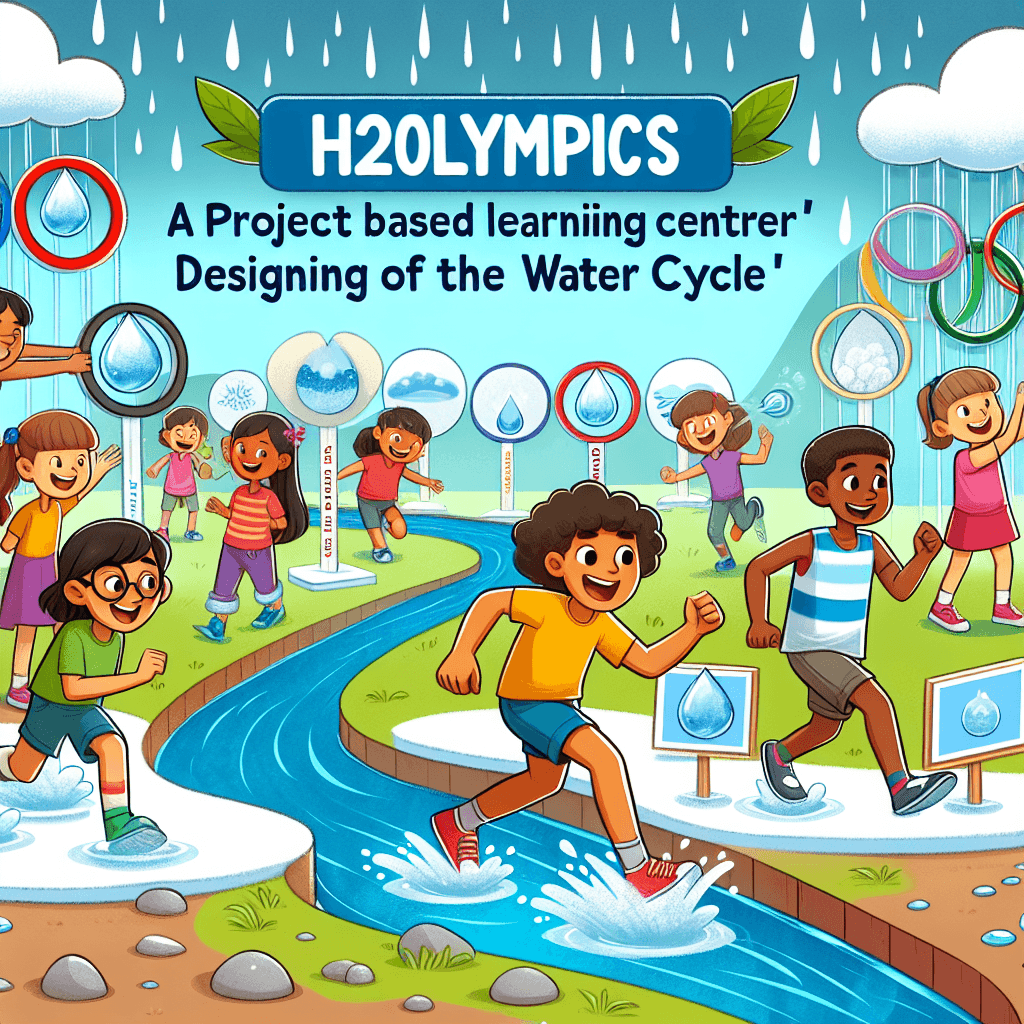
H2Olympics: Design Water Cycle Sport Events
Inquiry Framework
Question Framework
Driving Question
The overarching question that guides the entire project.How can we design a series of water-based sports that creatively demonstrate the different phases of the water cycle?Essential Questions
Supporting questions that break down major concepts.- How does water change its state during the water cycle?
- What are the different phases of the water cycle?
- How can the phases of the water cycle be represented in a sports event?
Standards & Learning Goals
Learning Goals
By the end of this project, students will be able to:- Students will understand and be able to explain the various phases of the water cycle including evaporation, condensation, precipitation, and collection.
- Students will design and create a model or representation of a sport that demonstrates one or more phases of the water cycle.
- Students will collaborate with peers to brainstorm, prototype, and present their water-based sports.
- Students will apply scientific concepts related to energy and states of matter in the context of their sports designs.
Next Generation Science Standards
Entry Events
Events that will be used to introduce the project to studentsWater Detective: The Missing Molecule
Students arrive to find a cryptic message from a 'Water Molecule' claiming to have gone missing. As detectives, their mission is to trace its journey through different water cycle phases, connecting each phase to a potential new sport. This adventure immerses students in the water cycle, sparking curiosity about each transformation.Portfolio Activities
Portfolio Activities
These activities progressively build towards your learning goals, with each submission contributing to the student's final portfolio.Concept Design: Sport Phase Mapping
Once students understand the water cycle, they'll brainstorm how to illustrate its phases through sports. They'll map out initial ideas for a sport linked to each water cycle phase.Steps
Here is some basic scaffolding to help students complete the activity.Final Product
What students will submit as the final product of the activityA proposal document outlining the concept of a water-based sport representing a water cycle phase.Alignment
How this activity aligns with the learning objectives & standardsSupports MS-ESS2-4 by connecting water cycle understanding with creative application.Sport Prototype & Particle Motion Model
Students move from conceptualizing to prototyping their water-based sports. They'll also construct a model demonstrating particle motion as water changes state for their assigned phase.Steps
Here is some basic scaffolding to help students complete the activity.Final Product
What students will submit as the final product of the activityA physical prototype of the sport along with a model illustrating particle motion related to the water cycle phase.Alignment
How this activity aligns with the learning objectives & standardsAligns with MS-ESS2-4 and MS-PS1-4, integrating energy, state changes, and water cycle knowledge.The H2Olympics Showcase
Culminating the project with a showcase event gives students a platform to present their sports and models. This event will engage peers, teachers, and possibly parents to demonstrate applied learning.Steps
Here is some basic scaffolding to help students complete the activity.Final Product
What students will submit as the final product of the activityA live event showcasing water-based sports connected to the water cycle, highlighting student innovation and scientific understanding.Alignment
How this activity aligns with the learning objectives & standardsComprehensively covers standards MS-ESS2-4 and MS-PS1-4, demonstrating mastery in scientific modeling and communication.Rubric & Reflection
Portfolio Rubric
Grading criteria for assessing the overall project portfolioH2Olympics Sports Design Rubric
Scientific Understanding
Assessing students' comprehension of the water cycle phases and particle motion.Understanding of Phases
The student's ability to describe and apply knowledge of water cycle phases.
Exemplary
4 PointsShows comprehensive understanding and innovative application of all water cycle phases related to the sport design.
Proficient
3 PointsDemonstrates thorough understanding and appropriate application of water cycle phases in the sport design.
Developing
2 PointsShows basic understanding of water cycle phases with some inconsistencies in application.
Beginning
1 PointsShows initial understanding with difficulty applying water cycle phases to the sport design.
Particle Motion Model
The accuracy and clarity of the model demonstrating water state changes and particle movement.
Exemplary
4 PointsPresents a highly accurate and clear model with exceptional detail in particle motion representation.
Proficient
3 PointsDevelops an accurate model with clear representation of particle motion.
Developing
2 PointsModel shows emerging accuracy with some clarity in particle motion representation.
Beginning
1 PointsModel lacks accuracy and clarity in illustrating particle motion.
Creativity and Innovation
Evaluating the originality and creativity of the sport design, including the integration of scientific concepts.Originality of Sport Design
The creativity and uniqueness of the sport concept.
Exemplary
4 PointsDesigns an exceptionally original sport that creatively represents water cycle phases.
Proficient
3 PointsDevelops a unique sport design that appropriately represents water cycle phases.
Developing
2 PointsCreates a sport design with some originality and representation of water cycle phases.
Beginning
1 PointsSport design lacks originality and fails to represent water cycle phases effectively.
Integration of Scientific Concepts
The effectiveness of integrating scientific principles into the sport design and implementation.
Exemplary
4 PointsExceptionally integrates scientific principles in a highly effective and engaging manner.
Proficient
3 PointsEffectively integrates scientific principles into sport design.
Developing
2 PointsAttempts integration of scientific principles with varying effectiveness.
Beginning
1 PointsMinimal integration of scientific concepts, lacking effectiveness.
Collaboration and Presentation
Focuses on teamwork dynamics and the ability to communicate ideas effectively during the showcase.Teamwork and Collaboration
Ability to work well with peers and contribute to group tasks.
Exemplary
4 PointsDemonstrates leadership and exceptional collaboration, contributing significantly to group work.
Proficient
3 PointsShows effective collaboration and contributes well to group efforts.
Developing
2 PointsParticipates in collaboration with some contribution to group tasks.
Beginning
1 PointsRequires support to collaborate and contributes minimally to group work.
Presentation and Communication Skills
Clarity and engagement in presenting the sport design and scientific concepts during the showcase.
Exemplary
4 PointsDelivers a highly engaging and clear presentation with outstanding communication of ideas.
Proficient
3 PointsProvides clear and engaging presentation with good communication of ideas.
Developing
2 PointsPresents with basic clarity and engagement of ideas.
Beginning
1 PointsStruggles to present ideas clearly and engage the audience.