
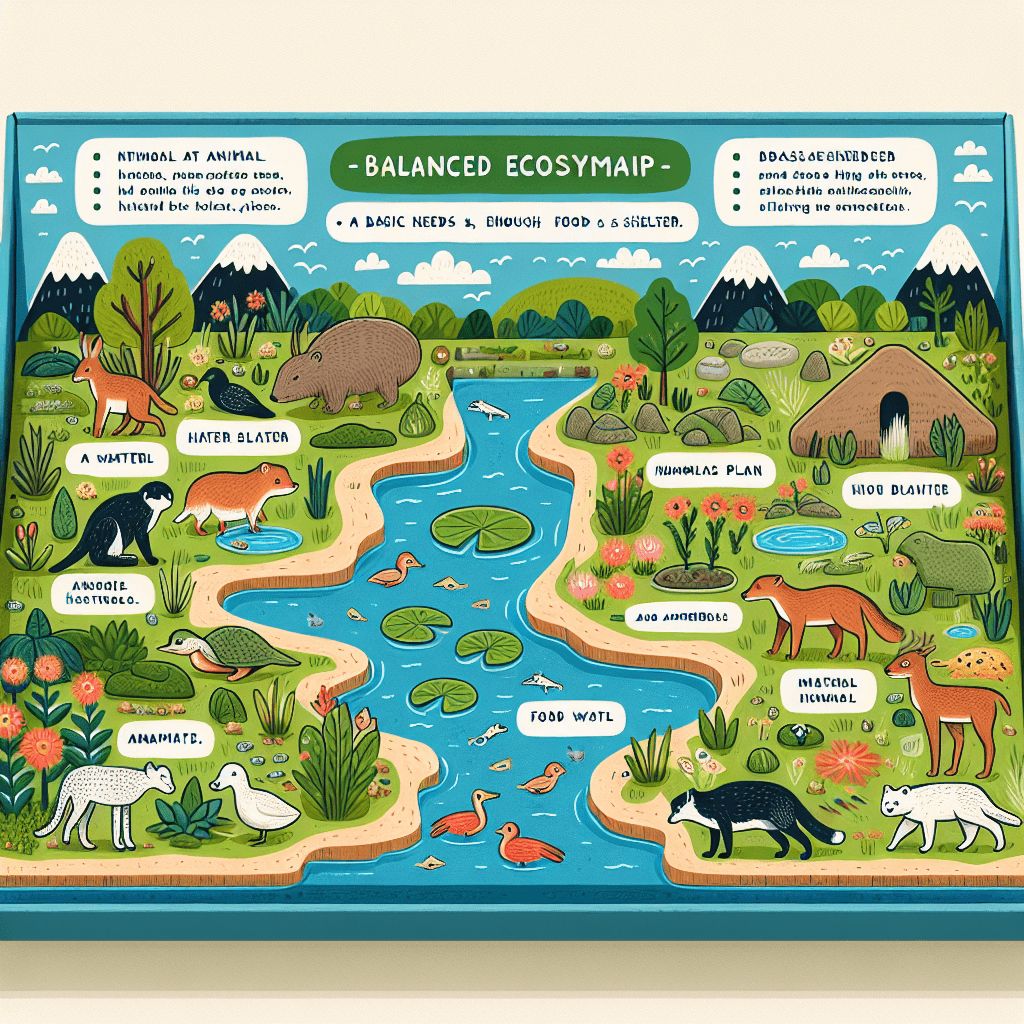
Habitat Diorama Challenge: Meeting Basic Needs
Inquiry Framework
Question Framework
Driving Question
The overarching question that guides the entire project.What makes a good home for plants and animals, and how can we show it in a model?Essential Questions
Supporting questions that break down major concepts.- How do I know if something is alive or not?
- How do animals and plants use their parts to live and grow?
- How are baby animals and plants like their parents? How are they different?
Standards & Learning Goals
Learning Goals
By the end of this project, students will be able to:- Students will be able to construct a diorama representing a specific habitat.
- Students will be able to identify and describe the basic needs (shelter, food, water) of plants and animals within that habitat.
- Students will be able to differentiate between living and non-living components of a habitat.
- Students will be able to explain how the habitat meets the needs of the living things within it.
- Students will discover patterns that help them classify things as living or nonliving.
- Students will make observations about how plants and animals use their parts to get what they need to live and grow.
- Students will make observations about how plants and animals are alike and different from their parents.
Teacher Provided
Entry Events
Events that will be used to introduce the project to studentsHabitat Rescue Mission
A local park ranger (played by the teacher or a guest) arrives with a plea: “Animals are losing their homes because their habitats are changing!” Students become Habitat Rescuers. Their mission: build dioramas to create safe and comfortable homes for the animals, making sure each home meets the animals’ needs.Portfolio Activities
Portfolio Activities
These activities progressively build towards your learning goals, with each submission contributing to the student's final portfolio.Living or Non-Living Detective
Students will explore the classroom and outdoor environment to identify and classify items as either living or non-living. This activity introduces the concept of distinguishing between organisms and inanimate objects based on observable characteristics.Steps
Here is some basic scaffolding to help students complete the activity.Final Product
What students will submit as the final product of the activityA completed worksheet or notebook page with labeled drawings or names of living and non-living items, along with brief explanations for each classification.Alignment
How this activity aligns with the learning objectives & standardsK.LS1.2 - Recognize differences between living organisms and non-living materials and sort them into groups by observable physical attributes.Habitat Diorama Construction Zone
Students will build their habitat dioramas based on the design blueprint. They will use a variety of materials to create a representation of their chosen habitat, ensuring that the diorama includes both living and non-living components and clearly demonstrates how the habitat meets the needs of its inhabitants.Steps
Here is some basic scaffolding to help students complete the activity.Final Product
What students will submit as the final product of the activityA completed diorama showcasing a specific habitat, with plants, animals, and non-living elements accurately represented and labeled. The diorama should clearly show how the habitat meets the needs of the living things within it.Alignment
How this activity aligns with the learning objectives & standardsK.LS1.1 - Use information from observations to identify the differences between plants and animals and how they live and grow. K.ESS3.1 - Use a model to represent the way the environment meets the basic needs (shelter, food, water) of living thingsHabitat Presentation & Expert Panel
Students will present their completed dioramas to the class, acting as 'Habitat Experts'. They will describe their habitat, identify the plants and animals that live there, explain how the habitat meets the needs of its inhabitants, and answer questions from their peers and the teacher.Steps
Here is some basic scaffolding to help students complete the activity.Final Product
What students will submit as the final product of the activityA presentation of their diorama, demonstrating their understanding of the habitat, its inhabitants, and how it meets their needs. This includes answering questions from the class.Alignment
How this activity aligns with the learning objectives & standardsK.LS1.1 - Use information from observations to identify the differences between plants and animals and how they live and grow. K.ESS3.1 - Use a model to represent the way the environment meets the basic needs (shelter, food, water) of living thingsHabitat Explorers: Plant and Animal Needs
Students will investigate a chosen habitat (e.g., forest, ocean, desert) to identify the plants and animals that live there. They will then explore and document what those plants and animals need to survive in their habitat, focusing on food, water, and shelter.Steps
Here is some basic scaffolding to help students complete the activity.Final Product
What students will submit as the final product of the activityA graphic organizer for their chosen habitat, listing plants and animals and detailing their needs for food, water, and shelter, and how the habitat provides these.Alignment
How this activity aligns with the learning objectives & standardsK.LS1.1 - Use information from observations to identify the differences between plants and animals and how they live and grow. K.ESS3.1 - Use a model to represent the way the environment meets the basic needs (shelter, food, water) of living thingsDiorama Design Blueprint
Students will create a detailed plan for their habitat diorama, including a sketch of the layout, a list of materials needed, and descriptions of how the diorama will showcase the needs of the plants and animals within the habitat.Steps
Here is some basic scaffolding to help students complete the activity.Final Product
What students will submit as the final product of the activityA blueprint including a sketch of the diorama, a list of materials, and a paragraph describing how the diorama will meet the needs of the living things in the habitat.Alignment
How this activity aligns with the learning objectives & standardsK.ESS3.1 - Use a model to represent the way the environment meets the basic needs (shelter, food, water) of living things. This activity sets the stage for the diorama creation.Rubric & Reflection
Portfolio Rubric
Grading criteria for assessing the overall project portfolioHabitat Diorama Portfolio Rubric
Habitat Knowledge & Accuracy
Demonstrates understanding of the chosen habitat and the needs of its inhabitants (plants and animals).Habitat Representation
Accuracy and detail in representing the chosen habitat within the diorama.
Exemplary
4 PointsDiorama accurately and thoroughly represents the chosen habitat with specific details that reflect deep understanding. Shows evidence of research beyond basic requirements.
Proficient
3 PointsDiorama accurately represents the chosen habitat with appropriate details. Demonstrates a solid understanding of the habitat's key features.
Developing
2 PointsDiorama represents the chosen habitat, but some details are missing or inaccurate. Shows a basic understanding of the habitat.
Beginning
1 PointsDiorama does not accurately represent the chosen habitat, and many details are missing or incorrect. Shows limited understanding of the habitat.
Needs of Living Things
Accurate identification and representation of the basic needs (food, water, shelter) of the plants and animals in the habitat.
Exemplary
4 PointsClearly and comprehensively identifies and represents the specific needs of multiple plants and animals in the habitat, demonstrating a deep understanding of their interdependence. Explains how the habitat provides these needs in detail.
Proficient
3 PointsAccurately identifies and represents the basic needs of the plants and animals in the habitat. Explains how the habitat provides these needs effectively.
Developing
2 PointsIdentifies some of the basic needs of the plants and animals in the habitat, but the representation may be incomplete or unclear. Explanation of how the habitat meets these needs is limited.
Beginning
1 PointsStruggles to identify and represent the basic needs of the plants and animals in the habitat. Shows limited understanding of their needs and how the habitat provides for them.
Diorama Construction & Design
Quality of diorama construction, attention to detail, and effective use of materials.Craftsmanship & Neatness
Overall quality of construction and neatness of the diorama.
Exemplary
4 PointsDiorama is exceptionally well-constructed, neat, and visually appealing. Attention to detail is evident throughout, and materials are used creatively and effectively.
Proficient
3 PointsDiorama is well-constructed and neat, with attention to detail. Materials are used appropriately and effectively.
Developing
2 PointsDiorama construction is adequate, but some areas may be messy or lack detail. Materials are used with some effectiveness.
Beginning
1 PointsDiorama construction is poor, messy, and lacks attention to detail. Materials are used ineffectively.
Use of Materials
Effective and appropriate use of materials to represent habitat elements.
Exemplary
4 PointsMaterials are used in innovative and effective ways to create realistic and engaging representations of habitat elements. Demonstrates resourcefulness and creativity.
Proficient
3 PointsMaterials are used effectively to represent habitat elements. Choices are appropriate and contribute to the overall quality of the diorama.
Developing
2 PointsMaterials are used, but their effectiveness in representing habitat elements is limited. Some choices may be inappropriate or distracting.
Beginning
1 PointsMaterials are used ineffectively and do not contribute to a clear representation of habitat elements. Choices may be random or poorly considered.
Presentation & Communication
Clarity and accuracy in presenting the diorama and explaining the habitat and its inhabitants.Clarity of Explanation
Clear and understandable explanation of the habitat, its plants and animals, and their needs.
Exemplary
4 PointsPresents a clear, detailed, and engaging explanation of the habitat, its plants and animals, and their needs, using precise language and demonstrating a deep understanding of the concepts. Answers questions thoughtfully and thoroughly.
Proficient
3 PointsPresents a clear and understandable explanation of the habitat, its plants and animals, and their needs. Answers questions accurately and effectively.
Developing
2 PointsExplanation of the habitat, its plants and animals, and their needs is somewhat unclear or incomplete. Struggles to answer questions effectively.
Beginning
1 PointsUnable to clearly explain the habitat, its plants and animals, or their needs. Struggles to answer questions.
Knowledge of Living vs. Non-Living
Correct identification and explanation of living and non-living components within the habitat.
Exemplary
4 PointsClearly and accurately identifies and explains the difference between living and non-living components in the habitat, providing examples and explaining their roles in the ecosystem. Shows understanding of complex interactions.
Proficient
3 PointsAccurately identifies and explains the difference between living and non-living components in the habitat.
Developing
2 PointsIdentifies some living and non-living components, but the explanation may be unclear or incomplete. Shows some confusion between the two.
Beginning
1 PointsStruggles to identify living and non-living components in the habitat and cannot explain the difference between them.