
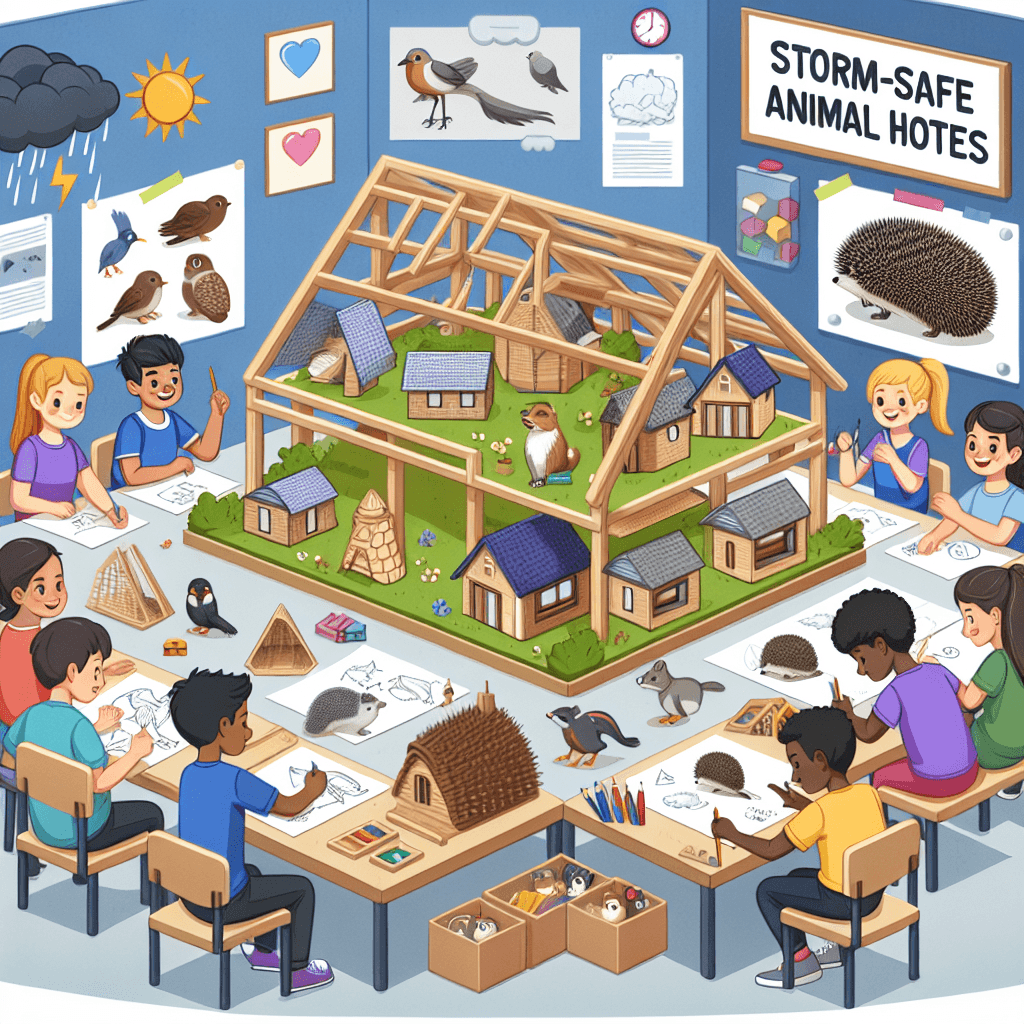
Habitat Heroes: Designing Storm-Safe Animal Hotels
Inquiry Framework
Question Framework
Driving Question
The overarching question that guides the entire project.How can we, as animal experts, design and create a "Storm-Shelter Sanctuary" to keep Oklahoma wildlife safe and comfortable when extreme weather strikes?Essential Questions
Supporting questions that break down major concepts.- What do Oklahoma animals need from their habitats to survive and be healthy?
- How does Oklahoma's extreme weather (like tornadoes, floods, or ice storms) change an animal's natural home?
- How can we use measurement and geometry to design a sanctuary that fits our animal's specific size and needs?
- What materials and design features will keep our sanctuary's climate stable and safe during a storm?
- How can we use our research and writing to explain to our community why these animals need our help?
Standards & Learning Goals
Learning Goals
By the end of this project, students will be able to:- Identify and describe the specific basic needs of Oklahoma wildlife and how different habitats meet those needs.
- Analyze the impact of Oklahoma's extreme weather patterns (tornadoes, floods, ice storms) on animal habitats and survival.
- Apply engineering design principles to create a prototype 'Storm-Shelter Sanctuary' that provides protection and climate control.
- Use standard and non-standard units of measurement and geometric shapes to design and build a scale model of the sanctuary.
- Conduct research on a specific Oklahoma animal and write an informational text to explain their findings and design solutions.
- Communicate ideas effectively through a final presentation to the community about animal safety and environmental stewardship.
Oklahoma Academic Standards for Science (OAS-S)
Oklahoma Academic Standards for English Language Arts (OAS-ELA)
Oklahoma Academic Standards for Mathematics (OAS-M)
Oklahoma Academic Standards for Social Studies (OAS-SS)
Entry Events
Events that will be used to introduce the project to studentsThe Wildlife Emergency Broadcast
Students enter a classroom transformed into the 'Oklahoma Wildlife Emergency Command Center' to find a 'Breaking News' broadcast featuring a local meteorologist and a wildlife vet. The duo explains that recent extreme weather has left local animals like the Box Turtle and Scissor-tailed Flycatcher without safe habitats, and they are officially commissioning the students as 'Sanctuary Architects' to design climate-controlled solutions.The Critter Concierge Challenge
A 'Critter Concierge' (the teacher in character) visits the class to report that while their human hotel is doing great, displaced animals are trying to check in to escape the Oklahoma heat and wind. The Concierge presents a formal 'Design Contract' asking students to create a specialized luxury wing that includes 'smart' temperature controls and species-specific amenities for these unusual guests.The Mystery of the Muddy Suitcase
Students discover a mud-splattered 'Animal Evacuation Suitcase' in the center of the room containing a single damp feather, a map of Oklahoma, and a handwritten 'Wish List' for a dream home. Students must work as detectives to identify which local animal the items belong to and why their current habitat failed them during the last big storm.Portfolio Activities
Portfolio Activities
These activities progressively build towards your learning goals, with each submission contributing to the student's final portfolio.The Oklahoma Animal Dossier: Researching Our Guests
To kick off their role as 'Sanctuary Architects,' students will choose a specific Oklahoma animal (like a Box Turtle, Scissor-tailed Flycatcher, or American Bison) and conduct a deep-dive investigation into its habitat needs. This activity helps students understand the 'guest' they are building for before they begin the design process.Steps
Here is some basic scaffolding to help students complete the activity.Final Product
What students will submit as the final product of the activityAn 'Animal Dossier' profile page including a drawing of the animal, a list of its three essential habitat needs, and two questions the student answered through research.Alignment
How this activity aligns with the learning objectives & standardsThis activity aligns with Science standard 2-LS4-1 by having students compare habitats and biodiversity. It also aligns with ELA standard 2.6.R.1 as students generate research questions and find specific facts about their chosen Oklahoma animal.The Weather Warning Blueprints: Planning for Protection
Before building, architects must understand the 'threats' their building will face. In this activity, students analyze how specific Oklahoma weather events (tornadoes, floods, or ice storms) destroy natural habitats. They will then create a 'Protection Plan' that outlines specific features their sanctuary needs to keep their animal safe from these elements.Steps
Here is some basic scaffolding to help students complete the activity.Final Product
What students will submit as the final product of the activityA 'Weather-Proof Blueprint'—a labeled drawing of their proposed sanctuary highlighting at least three safety features (e.g., 'thick walls for wind,' 'raised floor for floods').Alignment
How this activity aligns with the learning objectives & standardsThis activity aligns with Social Studies standard 2.3.1.B, as students describe how Oklahoma's extreme weather affects living things. It also supports Science standard K-2-ETS1-1 by defining the problem (weather damage) that needs a designed solution.The Sanctuary Construction Zone: Geometry and Measurement at Work
Now, students move into the 'Construction Zone.' Using their blueprints, students will use recycled materials to build a 3-D prototype of their sanctuary. They must use specific geometric shapes for stability and ensure the sanctuary is the correct size for their animal by using rulers to measure their 'guest' (a small toy or paper cutout of their animal).Steps
Here is some basic scaffolding to help students complete the activity.Final Product
What students will submit as the final product of the activityA 3-D prototype of the Storm-Shelter Sanctuary built to scale for their specific animal.Alignment
How this activity aligns with the learning objectives & standardsThis activity aligns with Math standards 2.M.1.1 (measuring length with tools) and 2.GM.1.1 (identifying and using 2-D and 3-D shapes). It also meets Science standard K-2-ETS1-1 as students develop a physical tool to solve a problem.The Critter Concierge Guidebook: Explaining the Design
Every luxury hotel needs a guide for its guests! Students will write an informational 'Hotel Guidebook' that explains how the sanctuary works. This piece of writing will describe the animal's needs and explain how the sanctuary's design features solve the problems caused by Oklahoma weather.Steps
Here is some basic scaffolding to help students complete the activity.Final Product
What students will submit as the final product of the activityA multi-sentence informational 'Guidebook' or brochure that introduces the animal and explains the sanctuary's features.Alignment
How this activity aligns with the learning objectives & standardsThis activity aligns with ELA standard 2.3.W.1, as students write an informational text with a main idea, supporting details, and transition words.The Grand Opening Showcase: Saving Oklahoma Wildlife
In the final stage, students prepare their 'Grand Opening' pitch. They will assemble their Dossier, Blueprint, and Guidebook into a presentation portfolio. Students will then lead a tour of their 3-D prototype, explaining to 'investors' (classmates and visitors) how their sanctuary protects Oklahoma's wildlife.Steps
Here is some basic scaffolding to help students complete the activity.Final Product
What students will submit as the final product of the activityA completed project portfolio and an oral presentation given to the 'Wildlife Emergency Command Center.'Alignment
How this activity aligns with the learning objectives & standardsThis activity synthesizes all project standards, focusing on the ELA goal of communicating research and the Science goal of sharing engineering solutions.Rubric & Reflection
Portfolio Rubric
Grading criteria for assessing the overall project portfolioStorm-Shelter Sanctuary Mastery Rubric
Scientific Inquiry & Habitat Knowledge
Focuses on the student's ability to gather and analyze information about Oklahoma wildlife and their specific needs for survival.Research & Habitat Identification
How well the student investigates and understands the relationship between an Oklahoma animal and its habitat needs.
Exemplary
4 PointsExceeds expectations by asking deep, investigative questions and identifying specific Oklahoma-based habitat nuances (e.g., specific diet or nesting habits). The dossier is comprehensive and highly detailed.
Proficient
3 PointsSuccessfully identifies three essential habitat needs and answers two research questions accurately. The dossier is complete and focused on a specific Oklahoma species.
Developing
2 PointsIdentifies some habitat needs but may miss specific details or fail to answer research questions clearly. The connection to Oklahoma wildlife is emerging.
Beginning
1 PointsProvides minimal information about an animal; research is incomplete or inaccurate. Struggling to define basic habitat needs.
Engineering & Weather Adaptation
Evaluates the student's application of the engineering design process to solve environmental challenges.Engineering Design & Problem Solving
The ability to design a prototype that addresses a specific problem caused by Oklahoma extreme weather (tornadoes, floods, ice).
Exemplary
4 PointsBlueprint features innovative and sophisticated safety solutions. Student clearly explains the logic behind materials chosen to combat specific weather threats.
Proficient
3 PointsBlueprint includes three labeled safety features that directly address a chosen weather event (e.g., raised floor for floods). Plan is logical and actionable.
Developing
2 PointsBlueprint shows 1-2 safety features, but they may not clearly solve the problem of the chosen weather event. Labels are partial or missing.
Beginning
1 PointsBlueprint lacks specific safety features or does not address weather-related habitat destruction. Concept is unclear.
Mathematical Application
Measures the application of mathematical skills in a real-world engineering context.Measurement & Geometric Construction
Accuracy in measuring the 'guest' and the sanctuary, and the purposeful use of 3-D geometric shapes in construction.
Exemplary
4 PointsMeasurements are precise and consistent. Student explains why specific 3-D shapes were chosen for structural strength (e.g., 'the cylinder is stronger for wind').
Proficient
3 PointsUses a ruler correctly to measure the guest and the sanctuary in inches or centimeters. Correctly identifies and uses at least two 3-D shapes (cube, cylinder, etc.).
Developing
2 PointsMeasurements are attempted but contain errors. Uses shapes in construction but cannot identify them or their purpose correctly.
Beginning
1 PointsMinimal evidence of measurement tools used. Construction lacks clear geometric structure or scale for the animal.
Communication & Literacy
Assesses the student's ability to explain their design and research through structured writing.Informational Writing Quality
The ability to communicate technical information clearly using a main idea, supporting details, and transition words.
Exemplary
4 PointsWriting is highly organized with a strong main idea, 4+ supporting details, and sophisticated transitions. Grammar and punctuation are polished.
Proficient
3 PointsWrites a clear main idea and three detail sentences using transition words (First, Next, Finally). Text is legible and mostly free of errors.
Developing
2 PointsIncludes a main idea but lacks sufficient details or fails to use transition words. Several errors in punctuation or capitalization.
Beginning
1 PointsWriting is incomplete or disjointed. Lacks a clear main idea and supporting details about the sanctuary's features.
Synthesis & Showcase
Evaluates the final assembly of work and the oral communication of the project's goals.Portfolio Synthesis & Presentation
The quality of the final portfolio and the student's ability to explain their work to an audience.
Exemplary
4 PointsDelivers a compelling, confident presentation that connects the project to environmental stewardship. Portfolio is expertly organized and reflective.
Proficient
3 PointsPresents a complete portfolio and clearly explains the most important safety feature of the sanctuary during the 'tour.' Demonstrates pride in work.
Developing
2 PointsPortfolio is mostly complete but the presentation is hesitant or misses key explanations of the design's purpose.
Beginning
1 PointsPortfolio is missing components and the student is unable to explain how the sanctuary protects the animal.