
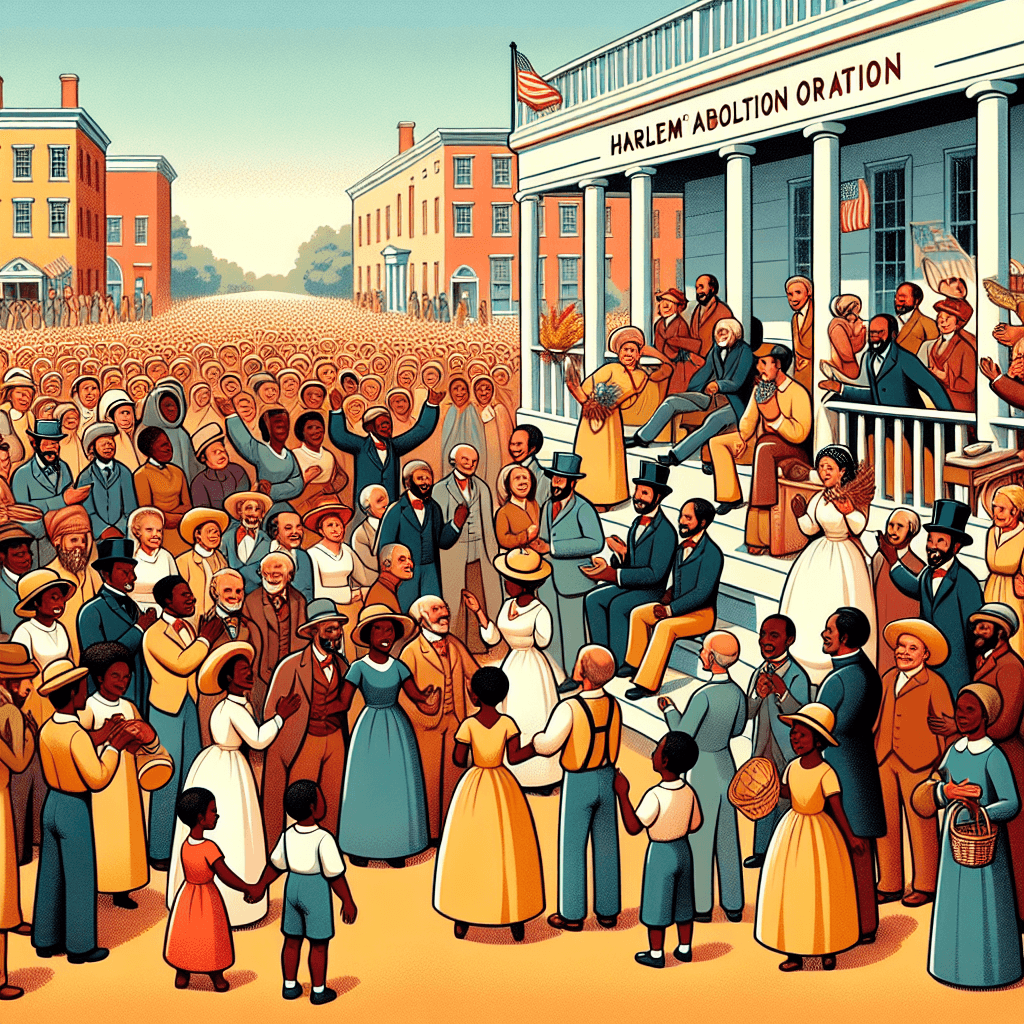
Harlem's 1813 Abolition Oration: A Community Celebration
Inquiry Framework
Question Framework
Driving Question
The overarching question that guides the entire project.How can we, as 6th-grade historians in Harlem, design a commemoration that connects the spirit of the 1813 abolition commemoration to our community today, fostering critical thinking and civic engagement?Essential Questions
Supporting questions that break down major concepts.- How does understanding historical speeches help us connect to the past and present?
- In what ways can we commemorate historical events to honor the struggles and triumphs of communities?
- How does the study of historical texts and events promote critical thinking, empathy, and civic engagement in our community?
Standards & Learning Goals
Learning Goals
By the end of this project, students will be able to:- Analyze a primary source speech about the abolition of the slave trade.
- Identify and interpret imagery and rhetorical strategies in historical texts.
- Connect historical events to community celebrations and civic identity.
- Practice reading comprehension, critical thinking, and creative writing
Common Core Standards
Entry Events
Events that will be used to introduce the project to studentsHarlem 1813 Immersion
Students walk into a room transformed into a bustling Harlem street scene from 1813, complete with market stalls (props) and costumed figures (teachers/older students). They overhear snippets of conversations about the upcoming commemoration of the abolition of the slave trade and are handed a 'news pamphlet' detailing the event. This immerses them in the historical context and sparks curiosity about the upcoming celebration and its significance.Echoes of Celebration
Begin with a modern-day audio recording of a Harlem community celebration (e.g., Juneteenth, a block party). Without revealing the event, ask students to describe the sounds, feelings, and purpose they infer from the recording. Then, connect this to the idea of historical celebrations like the 1813 commemoration, prompting them to consider why communities gather to celebrate important milestones, bridging the past and present.Mystery of the Artifacts
Present students with a 'mystery artifact box' containing items related to the abolition movement and early 19th-century Harlem (e.g., a replica abolitionist medal, a piece of sheet music with a freedom song, a map of early Harlem). Students examine the objects and brainstorm what event these items might be connected to and what they reveal about the lives and beliefs of people at the time. This fosters inquiry and critical thinking about historical evidence.Harlem Then and Now: A Visual Connection
Show students a series of images: a contemporary photo of Harlem, a historical map of Harlem in 1813, and a portrait of George Lawrence. Ask them to make connections between the images: What do they notice? What questions do they have? How might these images relate to each other and to the abolition of the slave trade? This visual thinking activity encourages observation and hypothesis-building.Voices of Harlem: A Town Hall Debate
Stage a mock 'town hall debate' where students take on the roles of different Harlem residents in 1813 (e.g., a formerly enslaved person, a merchant, a church leader) discussing the meaning and importance of the abolition of the slave trade. This participatory activity allows students to explore diverse perspectives, empathize with historical actors, and grapple with the complexities of the time.Portfolio Activities
Portfolio Activities
These activities progressively build towards your learning goals, with each submission contributing to the student's final portfolio.Vocabulary Voyage
Students will create a glossary of key vocabulary from George Lawrence’s oration. This activity helps students understand the language used in the speech, which is crucial for accurate analysis.Steps
Here is some basic scaffolding to help students complete the activity.Final Product
What students will submit as the final product of the activityA personal glossary with definitions and example sentences using words from the speech.Alignment
How this activity aligns with the learning objectives & standardsAligns with Learning Goal: Analyze a primary source speech about the abolition of the slave trade; Standards: 6.2 rw (Determine a central idea of a text and how it is conveyed through particular details; provide a summary of the text distinct from personal opinions or judgments.)Rhetorical Road Map
Students will identify and analyze examples of imagery and rhetorical devices in Lawrence’s speech. They will explain how these elements contribute to the speech’s overall message and impact.Steps
Here is some basic scaffolding to help students complete the activity.Final Product
What students will submit as the final product of the activityA chart or graphic organizer that identifies specific examples of imagery and rhetorical devices, explains their meaning, and discusses their effect on the audience.Alignment
How this activity aligns with the learning objectives & standardsAligns with Learning Goal: Identify and interpret imagery and rhetorical strategies in historical texts; Standards: 6.2 rw (Determine a central idea of a text and how it is conveyed through particular details; provide a summary of the text distinct from personal opinions or judgments.)Celebration Crossroads
Students will research and compare historical celebrations of the abolition of the slave trade with modern-day community celebrations in Harlem. They will analyze how these celebrations reflect community values and civic identity.Steps
Here is some basic scaffolding to help students complete the activity.Final Product
What students will submit as the final product of the activityA presentation (oral, written, or multimedia) that compares and contrasts historical and modern celebrations, highlighting their significance for the Harlem community.Alignment
How this activity aligns with the learning objectives & standardsAligns with Learning Goal: Connect historical events to community celebrations and civic identity; Standards: 6.2 rw (Determine a central idea of a text and how it is conveyed through particular details; provide a summary of the text distinct from personal opinions or judgments.)Echoes of Eloquence
Students will write a creative piece (poem, song, short story, or play excerpt) inspired by Lawrence’s speech and the historical context of the 1813 commemoration. This activity encourages students to engage with the material on a personal level, demonstrating their understanding through creative expression.Steps
Here is some basic scaffolding to help students complete the activity.Final Product
What students will submit as the final product of the activityA creative writing piece that reflects the themes, emotions, and historical context of Lawrence’s speech.Alignment
How this activity aligns with the learning objectives & standardsAligns with Learning Goals: Analyze a primary source speech; Practice reading comprehension, critical thinking, and creative writing; Standards: 6.2 rw (Determine a central idea of a text and how it is conveyed through particular details; provide a summary of the text distinct from personal opinions or judgments.)Rubric & Reflection
Portfolio Rubric
Grading criteria for assessing the overall project portfolio6th Grade Abolition Commemoration Portfolio Rubric
Vocabulary Mastery
Assesses students' ability to extract, define, and apply key vocabulary from the primary source speech.Vocabulary Accuracy
Accuracy and completeness of vocabulary definitions.
Exemplary
4 PointsDefinitions are entirely accurate, comprehensive, and demonstrate a deep understanding of the words' meanings in the context of the speech.
Proficient
3 PointsDefinitions are mostly accurate and show a good understanding of the words' meanings in the context of the speech.
Developing
2 PointsDefinitions are partially accurate but show a limited understanding of the words' meanings in the context of the speech.
Beginning
1 PointsDefinitions are inaccurate or incomplete and show little to no understanding of the words' meanings in the context of the speech.
Contextual Application
Effectiveness of sentences in demonstrating the meaning of vocabulary words in the context of the speech.
Exemplary
4 PointsSentences are exceptionally clear, insightful, and demonstrate a sophisticated understanding of how the vocabulary words are used in Lawrence's speech.
Proficient
3 PointsSentences are clear, relevant, and demonstrate a solid understanding of how the vocabulary words are used in Lawrence's speech.
Developing
2 PointsSentences are somewhat relevant but demonstrate a basic understanding of how the vocabulary words are used in Lawrence's speech.
Beginning
1 PointsSentences are unclear, irrelevant, or do not demonstrate an understanding of how the vocabulary words are used in Lawrence's speech.
Textual Engagement
Depth of exploration and selection of vocabulary words, indicating critical engagement with the text.
Exemplary
4 PointsThe vocabulary selection is exceptionally insightful, demonstrating a deep and nuanced engagement with the text and a sophisticated understanding of its complexities.
Proficient
3 PointsThe vocabulary selection is thorough and relevant, demonstrating a strong engagement with the text and a clear understanding of its key concepts.
Developing
2 PointsThe vocabulary selection is adequate but may miss some key terms or demonstrate a superficial engagement with the text.
Beginning
1 PointsThe vocabulary selection is minimal and demonstrates little engagement with the text or understanding of its key concepts.
Rhetorical Analysis
Evaluates students' ability to identify and analyze imagery and rhetorical devices in the primary source speech, explaining their impact.Identification Skills
Identification of imagery and rhetorical devices in the text.
Exemplary
4 PointsIdentifies a wide range of imagery and rhetorical devices with exceptional accuracy and insight.
Proficient
3 PointsIdentifies multiple examples of imagery and rhetorical devices with accuracy.
Developing
2 PointsIdentifies some examples of imagery and rhetorical devices, but may have inaccuracies.
Beginning
1 PointsStruggles to identify imagery and rhetorical devices in the text.
Analytical Explanation
Explanation of the literal meaning and intended effect of imagery and rhetorical devices.
Exemplary
4 PointsProvides a nuanced and insightful explanation of both the literal meaning and intended effect of the identified elements, demonstrating a sophisticated understanding of their function in the speech.
Proficient
3 PointsClearly explains the literal meaning and intended effect of the identified elements, demonstrating a solid understanding of their function in the speech.
Developing
2 PointsProvides a basic explanation of the literal meaning and/or intended effect of the identified elements, but may lack depth or clarity.
Beginning
1 PointsStruggles to explain the literal meaning or intended effect of the identified elements.
Synthesis and Interpretation
Discussion of how imagery and rhetorical devices contribute to the speech’s overall message and persuasive power.
Exemplary
4 PointsOffers a comprehensive and compelling discussion of how the identified elements powerfully contribute to the speech’s overall message and persuasive power, demonstrating a mastery of rhetorical analysis.
Proficient
3 PointsEffectively discusses how the identified elements contribute to the speech’s overall message and persuasive power.
Developing
2 PointsAttempts to discuss how the identified elements contribute to the speech’s overall message and persuasive power, but the explanation may be superficial or incomplete.
Beginning
1 PointsFails to discuss how the identified elements contribute to the speech’s overall message and persuasive power.
Celebration Significance
Assesses students' ability to connect historical events to community celebrations and civic identity, analyzing their significance.Research Depth
Depth of research into historical and modern celebrations in Harlem.
Exemplary
4 PointsDemonstrates extensive research, providing a rich and detailed account of both historical and modern celebrations in Harlem, uncovering nuanced connections and insights.
Proficient
3 PointsDemonstrates thorough research, providing a detailed account of both historical and modern celebrations in Harlem.
Developing
2 PointsDemonstrates some research, but the account of historical and modern celebrations in Harlem may lack detail or depth.
Beginning
1 PointsDemonstrates minimal research and provides little information about historical and modern celebrations in Harlem.
Comparative Analysis
Clarity and insightfulness of the comparison and contrast between historical and modern celebrations.
Exemplary
4 PointsPresents a highly insightful and nuanced comparison and contrast, revealing profound connections and distinctions between historical and modern celebrations, demonstrating a sophisticated understanding of cultural continuity and change.
Proficient
3 PointsPresents a clear and insightful comparison and contrast between historical and modern celebrations.
Developing
2 PointsPresents a basic comparison and contrast between historical and modern celebrations, but the analysis may lack depth or clarity.
Beginning
1 PointsFails to present a clear comparison and contrast between historical and modern celebrations.
Socio-Political Context
Analysis of how celebrations reflect community values, civic identity, and the ongoing struggle for social justice.
Exemplary
4 PointsProvides a comprehensive and profound analysis of how celebrations reflect community values, civic identity, and the ongoing struggle for social justice, demonstrating a nuanced understanding of the socio-political context.
Proficient
3 PointsProvides a thorough analysis of how celebrations reflect community values, civic identity, and the ongoing struggle for social justice.
Developing
2 PointsAttempts to analyze how celebrations reflect community values, civic identity, and the ongoing struggle for social justice, but the analysis may be superficial or incomplete.
Beginning
1 PointsFails to analyze how celebrations reflect community values, civic identity, and the ongoing struggle for social justice.
Creative Synthesis
Evaluates students' creative writing skills, assessing their ability to synthesize historical information and express it through a chosen format.Creative Expression
Creativity and originality of the chosen format and content.
Exemplary
4 PointsThe creative piece demonstrates exceptional originality, innovation, and artistic skill, going far beyond the assignment requirements to create a truly unique and memorable work.
Proficient
3 PointsThe creative piece demonstrates creativity and originality, effectively using the chosen format to express ideas and emotions.
Developing
2 PointsThe creative piece shows some creativity, but may rely on clichés or lack originality in its approach.
Beginning
1 PointsThe creative piece lacks creativity and originality, demonstrating little effort to engage with the material in a personal or imaginative way.
Thematic Reflection
Reflection of themes, emotions, and historical context from Lawrence’s speech in the creative piece.
Exemplary
4 PointsThe creative piece masterfully captures the themes, emotions, and historical context of Lawrence’s speech, demonstrating a profound and nuanced understanding of the source material and its relevance to contemporary issues.
Proficient
3 PointsThe creative piece effectively reflects the themes, emotions, and historical context of Lawrence’s speech.
Developing
2 PointsThe creative piece attempts to reflect the themes, emotions, and historical context of Lawrence’s speech, but may lack depth or accuracy.
Beginning
1 PointsThe creative piece fails to reflect the themes, emotions, or historical context of Lawrence’s speech.
Writing Quality
Clarity, coherence, and emotional impact of the writing.
Exemplary
4 PointsThe writing is exceptionally clear, coherent, and emotionally impactful, demonstrating a mastery of language and an ability to connect with the audience on a deep and meaningful level.
Proficient
3 PointsThe writing is clear, coherent, and has a noticeable emotional impact on the reader.
Developing
2 PointsThe writing is somewhat clear and coherent, but the emotional impact may be limited.
Beginning
1 PointsThe writing is unclear, incoherent, and lacks emotional impact.