
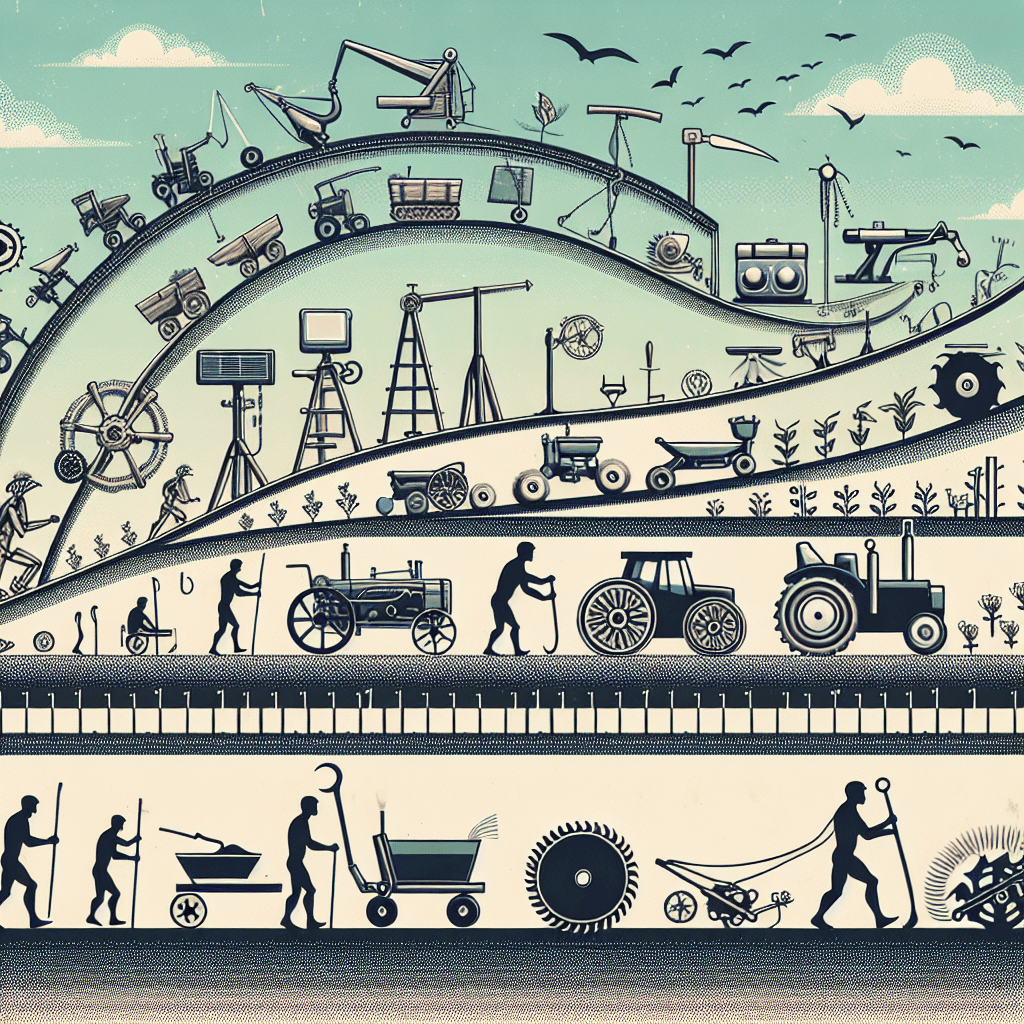
Harvesting History: Curating the Evolution of Farming Technology
Inquiry Framework
Question Framework
Driving Question
The overarching question that guides the entire project.How can we, as museum curators, design a compelling exhibit that uses science, data, and storytelling to show how farming innovations have transformed survival and life in Texas and the United States?Essential Questions
Supporting questions that break down major concepts.- How do innovations in farming technology change the way humans interact with the land and use natural resources?
- In what ways did historical farming inventions, like the steel plow or the tractor, lead to social and economic shifts in Texas and the United States?
- How can we use mathematical data and scale to represent the growth and efficiency of agriculture over time?
- How do we use scientific principles of forces, motion, and energy to explain how agricultural machinery works?
- How can we use research and persuasive writing to curate an exhibit that tells a compelling story of survival or change?
- What are the environmental trade-offs of using advanced technology in farming compared to traditional methods?
Standards & Learning Goals
Learning Goals
By the end of this project, students will be able to:- Analyze and document how specific farming innovations (e.g., the steel plow, mechanical reaper, or tractor) shifted the economic and social landscape of Texas and the United States.
- Design and construct scale models or diagrams of agricultural machinery, explaining the scientific principles of forces, motion, and energy that allow them to function.
- Collect, interpret, and represent agricultural data using graphs and scale to demonstrate changes in crop yields and farming efficiency over time.
- Conduct multi-source research to curate a museum exhibit narrative that uses persuasive writing to communicate the theme of 'Innovation, Survival, or Change.'
- Evaluate the environmental trade-offs of agricultural technology by comparing traditional farming methods with modern industrial practices.
TEKS Social Studies Grade 5
TEKS Science Grade 5
TEKS Mathematics Grade 5
TEKS ELAR Grade 5
Entry Events
Events that will be used to introduce the project to studentsThe Dust Bowl Mystery Box
Students enter a classroom transformed into a 'crime scene' from 1935, featuring a dusty, abandoned dinner table and a cryptic letter from a farmer whose crops have failed. They must examine a box of 'useless' rusted gear parts and old blueprints to figure out what went wrong and how a single technological innovation could have saved the family farm.Portfolio Activities
Portfolio Activities
These activities progressively build towards your learning goals, with each submission contributing to the student's final portfolio.The Innovation Time-Traveler’s Dossier
To start their journey as curators, students must investigate the 'who' and 'what' behind major farming shifts. They will choose one specific innovation (e.g., the steel plow, the mechanical reaper, or the tractor) and research the entrepreneur who created it. This activity focuses on understanding the economic necessity that drove the invention and how it began to change the American landscape.Steps
Here is some basic scaffolding to help students complete the activity.Final Product
What students will submit as the final product of the activityAn 'Innovation Dossier' featuring a biographical sketch of the inventor, a technical drawing of the invention, and a 'Problem vs. Solution' chart.Alignment
How this activity aligns with the learning objectives & standardsTEKS Social Studies 113.16.b.23.AB: Students identify the role of entrepreneurs and how technological innovations (like the steel plow or reaper) advanced the economic development of the U.S. and Texas.Gears of Growth: The Physics of Farming
Now that students know *what* was invented, they must explain *how* it works to museum visitors. Using the rusted gears from the Mystery Box as inspiration, students will explore the physics of farming. They will create a working model or a detailed interactive diagram that demonstrates how simple machines (levers, pulleys, wheels, and axles) within farming tech use force and motion to process land or crops.Steps
Here is some basic scaffolding to help students complete the activity.Final Product
What students will submit as the final product of the activityA 'Mechanics in Motion' display board or a small-scale recycled material model demonstrating the forces (push/pull) used in their chosen innovation.Alignment
How this activity aligns with the learning objectives & standardsTEKS Science 112.7.b.7.D: Students design an investigation or create a model that tests or demonstrates the effect of force on an object. This aligns with understanding the mechanical physics of agricultural machinery.The Great Harvest Data Lab
Curators use data to tell a story of scale. In this activity, students will analyze historical data sets comparing 'Before Innovation' (hand labor) to 'After Innovation' (machine labor). They will look at crop yields, the time it took to harvest an acre, and the environmental impact (like soil erosion during the Dust Bowl). They will also use geographic tools to map out how much more land could be farmed using this new technology.Steps
Here is some basic scaffolding to help students complete the activity.Final Product
What students will submit as the final product of the activityA 'Change by the Numbers' Infographic that includes a comparative bar graph and a 'Modified Map' showing land use changes.Alignment
How this activity aligns with the learning objectives & standardsTEKS Math 111.7.b.9.C & Social Studies 113.16.b.9.B: Students solve problems using data (yields/efficiency) and describe the environmental consequences of human modification of the land.The Curator’s Manifesto
Every museum exhibit needs a powerful narrative. Students will now choose a 'lens' for their exhibit: was farming technology a story of pure Innovation, a desperate struggle for Survival, or a radical Change? They will write a persuasive 'Curator’s Manifesto' to convince visitors of their perspective, using the evidence gathered in the previous three activities.Steps
Here is some basic scaffolding to help students complete the activity.Final Product
What students will submit as the final product of the activityA three-paragraph Persuasive Exhibit Introduction (The Manifesto) that will be recorded as an audio guide or displayed at the entrance of their exhibit.Alignment
How this activity aligns with the learning objectives & standardsTEKS ELAR 110.7.b.12.C: Students compose a multi-paragraph argumentative text using an organizational structure and a declaration of belief regarding their exhibit theme.The Living History Gallery: Innovation, Survival, & Change
In this final capstone activity, students assemble all their previous work into a cohesive physical or digital museum gallery. They must design the layout of their 'wing' of the museum, ensuring that the flow of information leads the visitor through the story of farming technology. They will participate in a Gallery Walk, acting as docents to answer questions about their research, data, and models.Steps
Here is some basic scaffolding to help students complete the activity.Final Product
What students will submit as the final product of the activityThe 'Innovation & Survival Pop-up Exhibit'—a complete curated station featuring the Dossier, the Model, the Infographic, and the Manifesto.Alignment
How this activity aligns with the learning objectives & standardsTEKS Social Studies 113.16.b.6.A & Science 112.7.b.3.A: Students apply geographic tools (grid systems/scales) to layout their exhibit and use scientific reasoning to critique the impact of technology.Rubric & Reflection
Portfolio Rubric
Grading criteria for assessing the overall project portfolioFarming Technology Museum Curator Rubric
History and Science Integration
Assesses the student's ability to research historical context and apply scientific principles to farming innovations.Historical Context & Entrepreneurship
The ability to identify the role of entrepreneurs and explain how technological innovations in farming drove economic development in the United States and Texas.
Exemplary
4 PointsProvides a sophisticated analysis of the entrepreneur's motivations and a detailed, multi-faceted explanation of the innovation's impact on the national and local economy. Drawing is expertly labeled and technically precise.
Proficient
3 PointsClearly identifies the entrepreneur and provides a thorough explanation of how the innovation advanced the U.S. economy. Technical drawing includes all required labels and is accurate.
Developing
2 PointsIdentifies the entrepreneur and innovation but provides an inconsistent or superficial explanation of the economic impact. Drawing is missing labels or lacks technical detail.
Beginning
1 PointsStruggles to identify the entrepreneur or innovation correctly. Explanation of economic growth is incomplete or missing. Drawing is absent or unclear.
Scientific Principles & Mechanical Modeling
The accuracy of explaining physical forces (friction, gravity, applied force) and simple machines within the context of agricultural technology through modeling.
Exemplary
4 PointsModel and description show advanced understanding of forces and motion. Force tests are expertly conducted with clear data, and the 'How it Works' plaque uses precise scientific terminology to explain complex mechanical interactions.
Proficient
3 PointsSuccessfully builds a working model and identifies simple machines. Correctly applies terms like friction and force in the museum plaque. Force test results are documented clearly.
Developing
2 PointsConstructs a basic model but struggles to clearly demonstrate mechanical motion. Scientific terminology is used inconsistently or with minor inaccuracies in the plaque.
Beginning
1 PointsModel is incomplete or does not demonstrate motion. Shows limited understanding of simple machines or the physical forces required for the machine to function.
Mathematics and Geography Application
Evaluates mathematical data processing and the understanding of human-environment interaction.Data Literacy & Environmental Impact
The ability to collect, organize, and interpret agricultural data into visual formats while analyzing the environmental consequences of land modification.
Exemplary
4 PointsData representation is exceptionally clear and used to draw sophisticated conclusions about efficiency. Map work uses scale perfectly, and the trade-off reflection shows deep critical thinking regarding ecological consequences.
Proficient
3 PointsConstructs accurate graphs/infographics and correctly interprets data trends. Map uses scale appropriately to show land change, and environmental trade-offs are clearly described with evidence.
Developing
2 PointsGraphs are mostly accurate but may have minor labeling errors. Map work shows basic land use changes but lacks precise scale. Reflection on environmental impact is surface-level.
Beginning
1 PointsData representation is incorrect or incomplete. Map lacks required geographic tools (scale/legend). Reflection fails to identify meaningful environmental consequences of agricultural technology.
Literacy and Communication
Measures the student's ability to communicate a chosen theme through evidence-based persuasive writing.Argumentative Writing & Thematic Curation
The ability to compose a persuasive museum narrative using an organizational structure, a clear declaration of belief, and evidence from multiple disciplines.
Exemplary
4 PointsCrafts a compelling, high-quality manifesto with a sophisticated thesis. Seamlessly integrates historical, scientific, and mathematical evidence. Persuasive language is powerful and highly effective for the target audience.
Proficient
3 PointsWrites a clear multi-paragraph text with a distinct declaration of belief. Includes relevant evidence from previous activities and uses persuasive techniques effectively to support the chosen theme.
Developing
2 PointsThe manifesto has an emerging organizational structure but the thesis may be weak. Evidence is mentioned but not fully integrated or explained. Persuasive language is used inconsistently.
Beginning
1 PointsText is disorganized or lacks a clear declaration of belief. Fails to provide evidence from previous work. Writing lacks persuasive intent and structure.
Curation and Presentation Capstone
Assesses the final assembly of the portfolio and the student's ability to present their findings as a curator.Exhibition Design & Synthesis
The ability to design a functional museum layout using scale and effectively communicate findings through a professional 'Docent Talk' during the gallery walk.
Exemplary
4 PointsExhibit layout is professional, utilizing an expert-level grid system and scale. The docent talk is engaging, exhibits leadership, and provides a masterfully synthesized summary of the driving question. Peer feedback is insightful and constructive.
Proficient
3 PointsDesigns a functional exhibit layout using a grid system and scale. Delivers a clear, informative docent talk that summarizes the project effectively. Actively participates in the gallery walk and provides useful peer feedback.
Developing
2 PointsExhibit layout is attempted but lacks precision in scale or organization. Docent talk is brief or misses key information from the driving question. Participation in the gallery walk is passive.
Beginning
1 PointsExhibit is disorganized and lacks a clear layout or scale. Docent talk is incomplete or indicates a lack of preparation. Peer feedback is missing or non-substantive.