
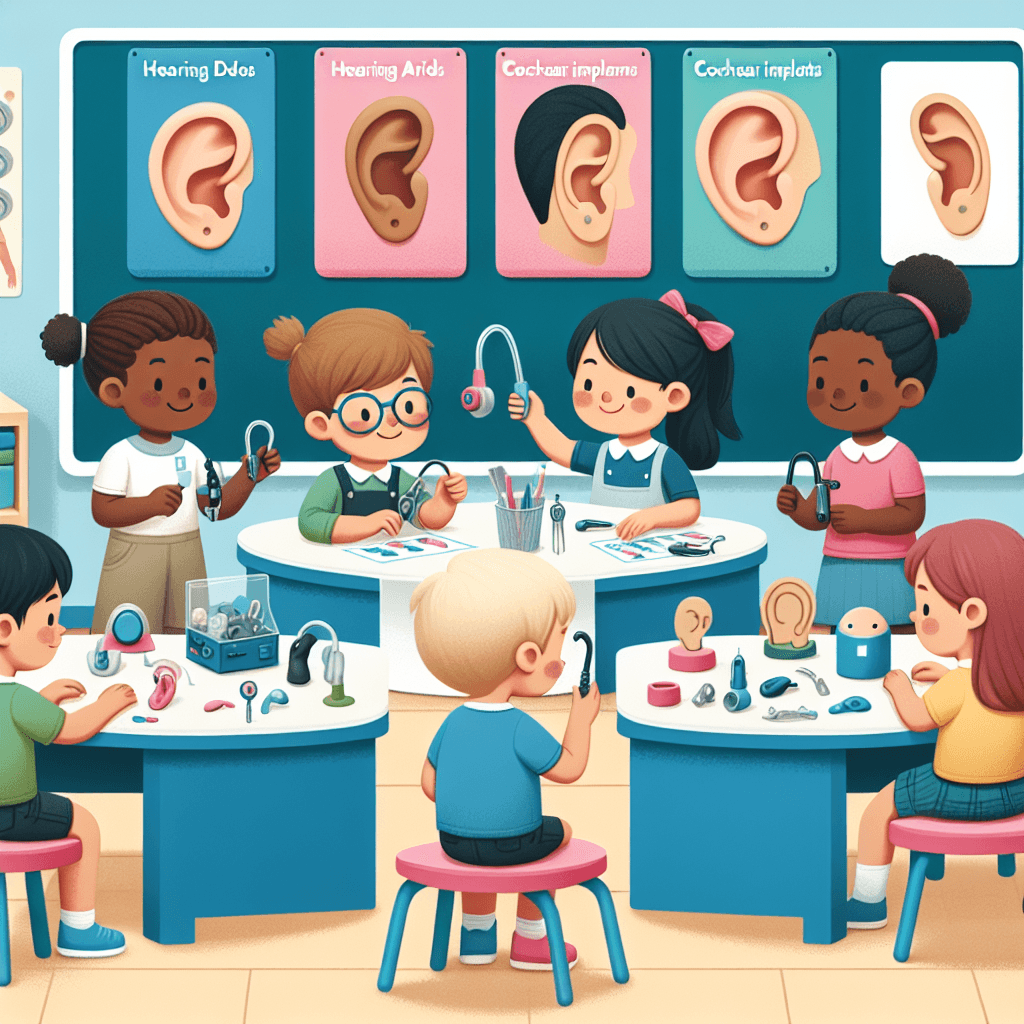
Hearing Device Care and Mastery for 2nd Graders
Inquiry Framework
Question Framework
Driving Question
The overarching question that guides the entire project.How can we, as young audiologists, ensure our hearing aids and cochlear implants are functioning optimally and are well-maintained every day?Essential Questions
Supporting questions that break down major concepts.- How do hearing aids and cochlear implants help us hear better?
- What are the different parts of hearing aids and cochlear implants, and how do they work?
- Why is it important to clean and care for our hearing devices regularly?
- How can we troubleshoot common problems with our hearing aids and cochlear implants?
- What steps should we take to ensure our hearing devices are working properly every day?
Standards & Learning Goals
Learning Goals
By the end of this project, students will be able to:- Students will identify and describe the function of different parts of hearing aids and cochlear implants.
- Students will explain the importance of regular cleaning and maintenance of hearing aids and cochlear implants.
- Students will demonstrate how to maintain and troubleshoot basic issues with their hearing devices.
- Students will develop a daily checklist for ensuring their hearing devices are functioning optimally.
Florida State Standards for Special Skills for the Deaf and Hard of Hearing
Entry Events
Events that will be used to introduce the project to studentsMystery of the Missing Sound
Create a detective-themed activity where students must solve the 'mystery' of a malfunctioning hearing device. They will be given scenarios, often based on real-life issues with hearing aids/cochlear implants, to diagnose and fix the problems.Portfolio Activities
Portfolio Activities
These activities progressively build towards your learning goals, with each submission contributing to the student's final portfolio.Sound Sleuths: Device Detective
Students embark on a journey as detectives to understand common issues related to hearing aids and cochlear implants. Solving scenarios will help them understand the importance of proper device functioning.Steps
Here is some basic scaffolding to help students complete the activity.Final Product
What students will submit as the final product of the activityA list of common hearing device issues and their possible solutions discovered during the activity.Alignment
How this activity aligns with the learning objectives & standardsAligns with FL-DHH-SS-2 by identifying components and understanding their function.Device Dissection
In this activity, students will learn about the different parts of their hearing devices by visually and physically exploring them, helping to solidify their understanding of how each part contributes to the device's function.Steps
Here is some basic scaffolding to help students complete the activity.Final Product
What students will submit as the final product of the activityLabeled diagrams and models of hearing devices created by students.Alignment
How this activity aligns with the learning objectives & standardsAligns with FL-DHH-SS-2 by identifying components and functions of hearing aids and cochlear implants.Clean & Care: Hands-on Hygiene
This activity focuses on teaching students how to properly clean their hearing aids and cochlear implants, emphasizing the importance of maintaining hygiene for optimal device performance.Steps
Here is some basic scaffolding to help students complete the activity.Final Product
What students will submit as the final product of the activityA step-by-step guide created by students on how to clean their hearing devices.Alignment
How this activity aligns with the learning objectives & standardsSupports FL-DHH-SS-1 by teaching the essential practices of care and maintenance.Troubleshooting Treasure Hunt
Students participate in a treasure hunt-like activity where they troubleshoot simulated issues with hearing devices, promoting problem-solving skills and device knowledge.Steps
Here is some basic scaffolding to help students complete the activity.Final Product
What students will submit as the final product of the activityA troubleshooting journal documenting issues and solutions from each station.Alignment
How this activity aligns with the learning objectives & standardsReinforces FL-DHH-SS-1 by encouraging troubleshooting and maintenance skills.Daily Device Check: Routine Mastery
Students develop their own daily checklist for maintaining and ensuring the proper function of their hearing devices, fostering independence and confidence.Steps
Here is some basic scaffolding to help students complete the activity.Final Product
What students will submit as the final product of the activityA personalized daily checklist for maintaining hearing devices created by each student.Alignment
How this activity aligns with the learning objectives & standardsAligns with FL-DHH-SS-1 by promoting daily maintenance practices.Rubric & Reflection
Portfolio Rubric
Grading criteria for assessing the overall project portfolioHearing Device Maintenance and Understanding Rubric
Device Component Identification and Function
Assesses the student's ability to accurately identify and describe the components and functions of hearing aids and cochlear implants.Identification of Device Components
Evaluates the student's ability to identify different parts of hearing aids and cochlear implants accurately.
Exemplary
4 PointsCorrectly identifies all major and minor components of both hearing aids and cochlear implants on multiple representations.
Proficient
3 PointsCorrectly identifies all major components and most minor components of hearing devices on most representations.
Developing
2 PointsIdentifies major components with some errors or omissions; struggles with minor components.
Beginning
1 PointsStruggles to identify major components correctly; minor components largely missed.
Function Explanation
Assesses the student's ability to explain the function of identified parts of hearing devices.
Exemplary
4 PointsAccurately explains the function of all identified components with detailed, context-appropriate descriptions.
Proficient
3 PointsAccurately explains the function of most identified components with general but correct descriptions.
Developing
2 PointsProvides basic explanations for some identified components; lacks detail and accuracy in others.
Beginning
1 PointsStruggles to explain component functions; provides incorrect or vague descriptions.
Device Maintenance and Hygiene
Evaluates the student's ability to maintain their hearing aids and cochlear implants through proper cleaning and hygiene practices.Cleaning Techniques
Measures student's ability to demonstrate and articulate proper cleaning methods for hearing devices.
Exemplary
4 PointsDemonstrates flawless cleaning techniques and explains their benefits contextually with full understanding.
Proficient
3 PointsDemonstrates effective cleaning techniques with minor errors; understands basic benefits.
Developing
2 PointsDemonstrates basic cleaning techniques with noticeable errors; limited understanding of benefits.
Beginning
1 PointsStruggles significantly with cleaning techniques; unclear on benefits relating to practice.
Troubleshooting and Problem Solving
Focuses on the student's ability to identify and solve common issues with hearing devices.Troubleshooting Effectiveness
Assesses the student's competency in identifying device issues and proposing effective solutions.
Exemplary
4 PointsEffectively identifies all presented issues with comprehensive solutions backed by reasoning.
Proficient
3 PointsIdentifies most issues with appropriate solutions; occasional minor reasoning gaps.
Developing
2 PointsIdentifies some issues but struggles with proposing complete or accurate solutions.
Beginning
1 PointsStruggles to identify issues accurately and provides incorrect or vague solutions.
Routine Maintenance
Evaluates the student's ability to develop and adhere to a routine maintenance checklist for device upkeep.Checklist Quality
Assesses the completeness and practicality of the student's daily maintenance checklist for hearing devices.
Exemplary
4 PointsCreates a thorough and practical checklist, demonstrating foresight and complete understanding of routine needs.
Proficient
3 PointsCreates a useful checklist covering most routine needs; minor improvements needed for practicality.
Developing
2 PointsCreates a checklist with gaps in necessary steps; understanding of routine needs is basic.
Beginning
1 PointsCreates an incomplete checklist; lacks understanding of essential routine maintenance practices.