
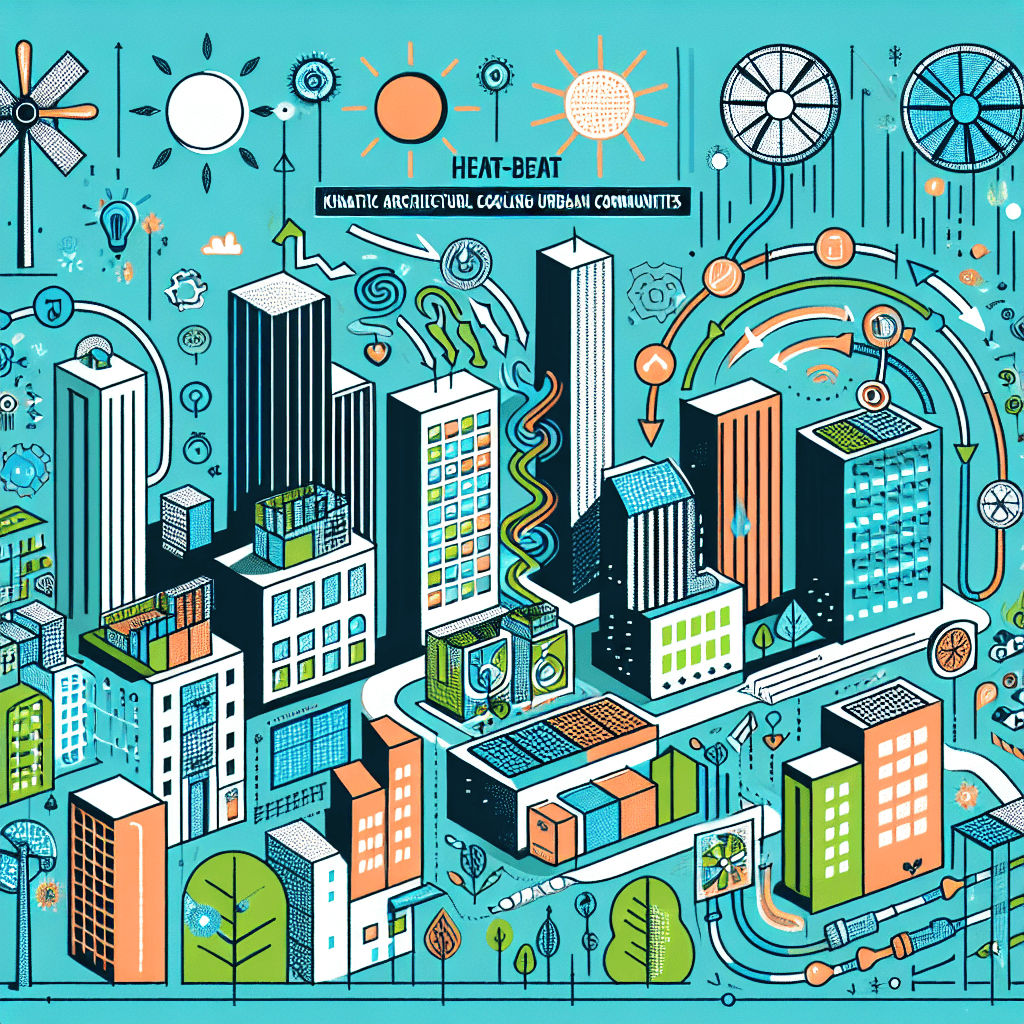
Heat-Beat: Kinetic Architectural Cooling for Urban Communities
Inquiry Framework
Question Framework
Driving Question
The overarching question that guides the entire project.How can we, as collaborative engineering teams, design kinetic architectural systems that mitigate heat vulnerability in local low-income housing by balancing thermodynamic efficiency with urban equity?Essential Questions
Supporting questions that break down major concepts.- How do the principles of thermodynamics (conduction, convection, and radiation) dictate the formation and intensity of the Urban Heat Island effect in our local community?
- How can kinetic mechanisms—such as dynamic facades or responsive shading—be used to manipulate airflow and solar gain to reduce a building's thermal load?
- In what ways do historical urban planning and socioeconomic factors influence the 'heat vulnerability' of low-income housing projects?
- How do we evaluate the efficiency and sustainability of a cooling system beyond just temperature reduction (e.g., energy cost, material lifecycle, maintenance)?
- How does the synergy of diverse technical roles and shared decision-making within a team lead to more innovative and viable engineering solutions?
Standards & Learning Goals
Learning Goals
By the end of this project, students will be able to:- Students will apply the laws of thermodynamics to design a kinetic architectural system that effectively reduces heat gain and promotes passive cooling.
- Students will analyze the socioeconomic factors and historical urban planning decisions that contribute to disproportionate heat vulnerability in local low-income housing.
- Students will demonstrate productive collaboration by fulfilling specific technical roles within an engineering team to produce a unified architectural solution.
- Students will evaluate the trade-offs of their design solutions using criteria such as thermodynamic efficiency, material sustainability, and community equity.
Next Generation Science Standards (NGSS)
Teacher-Defined Standards
Common Core State Standards (ELA)
Entry Events
Events that will be used to introduce the project to studentsThe Thermal Ghost Hunt & Equity Map
Students are handed thermal imaging cameras and led to a local urban site at mid-day to visualize 'thermal ghosts.' They must identify the exact moment and location where architecture fails the human body, layering their heat maps over socio-economic data to see how 'heat equity' impacts their own neighbors.Portfolio Activities
Portfolio Activities
These activities progressively build towards your learning goals, with each submission contributing to the student's final portfolio.The Heat Equity Deep Dive
Building on the 'Thermal Ghost Hunt' entry event, students work in their engineering teams to synthesize thermal imaging data with socioeconomic maps. They will define the specific problem their housing project faces, such as poor ventilation or high solar heat gain, while establishing their collaborative identity as a professional firm.Steps
Here is some basic scaffolding to help students complete the activity.Final Product
What students will submit as the final product of the activityA 'Heat Vulnerability & Project Charter' document that includes a mapped thermal profile of the site, a prioritized list of design constraints, and a signed team contract with defined technical roles.Alignment
How this activity aligns with the learning objectives & standardsThis activity aligns directly with HS-ETS1-1 by requiring students to analyze the 'global challenge' of the Urban Heat Island (UHI) effect at a local level, specifying quantitative thermal data and qualitative societal constraints based on the needs of low-income residents. It also introduces Custom-COLLAB-1 by establishing team norms and roles.Thermodynamic Mechanism Prototyping
In this hands-on laboratory phase, teams experiment with different kinetic mechanisms—such as light-responsive louvers, humidity-triggered vents, or heat-absorbing shading devices. They must build a low-fidelity, 'bench-top' prototype that demonstrates how a moving part can alter airflow (convection) or block solar gain (radiation).Steps
Here is some basic scaffolding to help students complete the activity.Final Product
What students will submit as the final product of the activityA functional 'Kinetic Proof-of-Concept' model (using materials like cardboard, servos, or heat-sensitive springs) and a recorded data log showing the temperature difference between 'active' and 'inactive' states.Alignment
How this activity aligns with the learning objectives & standardsThis activity addresses HS-PS3-3 by tasking students with building a device that manages thermal energy. It requires them to convert solar radiation/thermal energy into a controlled environment through mechanical or passive movement (kinetics).The Synergy & Trade-off Simulation
Teams must now evaluate their prototypes through the lens of 'Urban Equity.' They will participate in a structured 'Design Crit' where they analyze if their kinetic system is too expensive for a low-income housing budget or if it requires too much maintenance for the city to sustain. They will use a trade-off matrix to decide which features to keep and which to simplify.Steps
Here is some basic scaffolding to help students complete the activity.Final Product
What students will submit as the final product of the activityA 'Design Trade-Off Matrix' and an updated blueprint that balances peak thermodynamic performance with the practical realities of urban housing.Alignment
How this activity aligns with the learning objectives & standardsThis aligns with HS-ETS1-3, as students must evaluate their kinetic designs against multiple criteria including cost, reliability, and social impact. It also meets Custom-COLLAB-1 as students must negotiate trade-offs and reach a consensus on the final design direction.The Heat-Beat Pitch: Cooling the City
For the final product, teams integrate their researched data, their kinetic prototypes, and their equity analyses into a comprehensive architectural proposal. This proposal will be presented to a panel of 'City Planners' (teachers/community members) as a viable solution for local housing projects. Each team member must present the portion of the design related to their specific role.Steps
Here is some basic scaffolding to help students complete the activity.Final Product
What students will submit as the final product of the activityA 'Heat-Beat Facade Blueprint' (digital or physical) accompanied by a 5-minute collaborative pitch deck and a 'Team Reflection' on how their collaborative process led to the final design.Alignment
How this activity aligns with the learning objectives & standardsThis activity meets CCSS.ELA-LITERACY.SL.11-12.1 by requiring students to participate in a high-level collaborative discussion and present their ideas clearly to a 'public' audience. It serves as the final evidence for Custom-COLLAB-1 by showcasing the integrated effort of the team.Rubric & Reflection
Portfolio Rubric
Grading criteria for assessing the overall project portfolioHeat-Beat City: Kinetic Architecture & Urban Equity Rubric
Heat-Beat City Core Competencies
This category evaluates the core competencies required to successfully design and advocate for a kinetic architectural solution within a collaborative engineering framework.Productive Collaboration & Team Synergy
Assessment of the student's ability to fulfill specific technical roles, adhere to the Team Charter, and utilize shared decision-making to create a unified engineering solution.
Exemplary
4 PointsThe student exemplifies leadership within their role while actively enhancing the contributions of others. Team synergy is seamless; decisions are reached through sophisticated negotiation and consensus. The final product reflects a truly integrated team identity where the sum is greater than its parts.
Proficient
3 PointsThe student consistently fulfills their assigned technical role and adheres to the Team Charter. Collaborative discussions are productive, and the student contributes meaningfully to shared decisions. The team works effectively as a unit to produce a cohesive solution.
Developing
2 PointsThe student performs their assigned role inconsistently and occasionally requires prompts to engage in team discussions. Collaborative efforts are present but may be fragmented, or decisions may be dominated by a single team member rather than a shared process.
Beginning
1 PointsThe student struggles to fulfill their assigned role or participate in team communication. There is little evidence of collaborative decision-making, and the individual contributions do not coalesce into a unified team project.
Thermodynamic Application & Kinetic Engineering
Evaluation of how effectively the kinetic system manages thermal energy (conduction, convection, radiation) and the technical functionality of the kinetic prototype.
Exemplary
4 PointsThe prototype demonstrates a sophisticated mastery of thermodynamics, achieving significant, data-verified thermal reduction. The kinetic mechanism is innovative, durable, and precisely engineered to respond to specific environmental stimuli. Data logs show deep analytical rigor.
Proficient
3 PointsThe prototype clearly applies thermodynamic principles to reduce thermal load. The kinetic mechanism functions as intended and addresses a specific environmental challenge (e.g., solar gain). Data logs provide clear evidence of a temperature difference between states.
Developing
2 PointsThe prototype shows an emerging understanding of thermodynamics, but the kinetic mechanism may be fragile or inconsistent in its application. Thermal reduction is demonstrated but may not be supported by robust or consistent data.
Beginning
1 PointsThe prototype lacks a clear connection to thermodynamic principles or the kinetic mechanism fails to operate. There is insufficient data to prove any thermal impact on the structure.
Urban Equity & Heat Vulnerability Analysis
Assessment of the student’s ability to analyze the 'Urban Heat Island' effect through the lens of socioeconomic factors and historical urban planning.
Exemplary
4 PointsThe analysis provides a profound synthesis of thermal data and socioeconomic mapping. The design constraints demonstrate an exceptional commitment to urban equity, specifically addressing the long-term needs and systemic challenges faced by low-income residents.
Proficient
3 PointsThe student accurately identifies 'hot spots' in low-income areas and integrates these findings into the design constraints. The project shows a clear effort to balance technical cooling with the practical and social needs of the community.
Developing
2 PointsThe student identifies general areas of heat vulnerability but the connection to socioeconomic factors or historical context is superficial. Constraints address basic community needs but lack depth in terms of equity or long-term sustainability.
Beginning
1 PointsThe analysis fails to account for the specific needs of low-income housing or ignores the socioeconomic data provided. The design constraints are purely technical and lack any social or 'equity' context.
Constraint Evaluation & Trade-off Logic
Evaluation of the student’s ability to use decision matrices to balance thermodynamic efficiency with constraints like cost, maintenance, and community impact.
Exemplary
4 PointsThe trade-off analysis is comprehensive and highly critical, using a complex matrix to justify sophisticated design shifts. The final blueprint represents an optimized balance between peak thermal performance and extreme practical viability for the city.
Proficient
3 PointsThe student uses a decision-making matrix to effectively evaluate the prototype. Revisions to the design show a logical balance between efficiency, cost, and maintenance requirements. Trade-offs are clearly justified.
Developing
2 PointsThe student uses a matrix to evaluate the design, but the reasoning for trade-offs is inconsistent. Revisions may prioritize one factor (like cost) while significantly degrading another (like thermal performance) without adequate justification.
Beginning
1 PointsThere is little to no evidence of a structured evaluation process. Design decisions appear arbitrary, and the student fails to account for the practical constraints of budget or maintenance in their final blueprint.
Professional Communication & Narrative Synthesis
Assessment of the final pitch and blueprint, focusing on the ability to communicate complex engineering and social equity concepts persuasively and clearly.
Exemplary
4 PointsThe presentation is professional, compelling, and flawlessly integrates technical science with social advocacy. The blueprint is of professional quality. The team speaks as a unified voice, with each member demonstrating expertise and collaborative pride.
Proficient
3 PointsThe pitch is clear and well-organized, accurately explaining both the thermodynamics and the social justification. The visual blueprint is high-quality and easy to interpret. Each team member contributes effectively to the delivery.
Developing
2 PointsThe presentation covers the main points but may struggle with clarity or technical accuracy. The visual aids are basic, and the delivery may feel like a collection of individual parts rather than a cohesive team narrative.
Beginning
1 PointsThe presentation is disorganized or fails to address the core components of the project (science or equity). Visual representations are missing or confusing. The team lacks coordination during the pitch.