
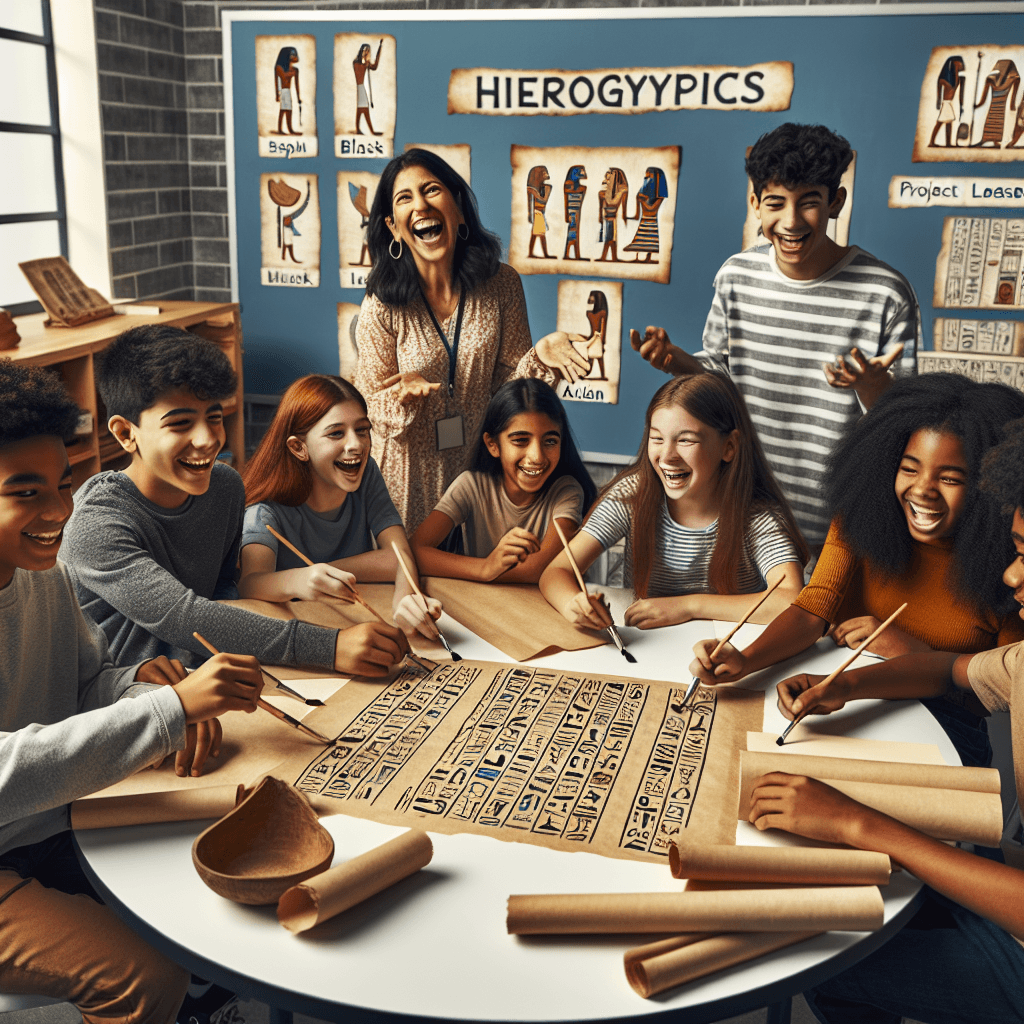
Hieroglyphics Translation Workshop: Modern Stories into Scrolls
Inquiry Framework
Question Framework
Driving Question
The overarching question that guides the entire project.How can we bridge the past and present by translating modern stories into ancient hieroglyphics, and what can this teach us about the communication and societal roles in ancient Egypt?Essential Questions
Supporting questions that break down major concepts.- How did hieroglyphics shape ancient Egyptian communication and record-keeping?
- In what ways can modern stories be expressed through ancient symbols like hieroglyphics?
- What role did scribes play in ancient Egyptian society and how does their work compare to modern professions?
Standards & Learning Goals
Learning Goals
By the end of this project, students will be able to:- Understand the role and significance of hieroglyphics in ancient Egyptian culture.
- Develop skills in translating English text into ancient Egyptian hieroglyphics.
- Create an illustrated scroll that integrates visual art and translated text.
- Analyze the societal impact of scribes in ancient Egypt compared to modern professions.
- Enhance understanding of historical communication methods by comparing them with modern ones.
Common Core Standards for History/Social Studies
Entry Events
Events that will be used to introduce the project to studentsHieroglyphics Escape Room
The classroom transforms into an escape room where puzzles and clues require students to translate and interpret hieroglyphics to unlock the secrets left by 'Pharaoh Ali'. The goal is to 'escape' by completing the translation of a contemporary short story into hieroglyphics.Portfolio Activities
Portfolio Activities
These activities progressively build towards your learning goals, with each submission contributing to the student's final portfolio.Hieroglyphic Symbol Hunt
In this introductory activity, students will embark on a scavenger hunt to discover and familiarize themselves with common hieroglyphic symbols. This activity sets the foundation for understanding the basics of hieroglyphics and how symbols convey meaning.Steps
Here is some basic scaffolding to help students complete the activity.Final Product
What students will submit as the final product of the activityA personalized chart with matched symbols and sentences demonstrating basic understanding of hieroglyphics.Alignment
How this activity aligns with the learning objectives & standardsAligns with CCSS.ELA-LITERACY.RH.6-8.1 as students analyze hieroglyphic symbols as primary sources.Story Selection and Translation Prep
This activity focuses on selecting a contemporary story that students will eventually translate into hieroglyphics and includes preparing translation guides for their work.Steps
Here is some basic scaffolding to help students complete the activity.Final Product
What students will submit as the final product of the activityA translation guide consisting of key words from a modern story and their hieroglyphic equivalents.Alignment
How this activity aligns with the learning objectives & standardsSupports CCSS.ELA-LITERACY.RH.6-8.1 by allowing students to analyze and translate modern prose into ancient symbols.Hieroglyphic Storyboard Creation
In this activity, students will create a visual storyboard of their selected story using their translation guides. This activity builds on their translation work by adding visual elements.Steps
Here is some basic scaffolding to help students complete the activity.Final Product
What students will submit as the final product of the activityA complete storyboard that visually and textually interprets a modern story using hieroglyphics.Alignment
How this activity aligns with the learning objectives & standardsAligns with CCSS.ELA-LITERACY.RH.6-8.7, integrating visual information with textual hieroglyphic translations.Illustrated Scroll Masterpiece
For the culminating activity, students will create their illustrated scrolls. They will transfer their hieroglyphic storyboards into artistic scrolls that mimic ancient Egyptian styles.Steps
Here is some basic scaffolding to help students complete the activity.Final Product
What students will submit as the final product of the activityAn illustrated scroll that combines hieroglyphic translations and artistic elements inspired by ancient Egypt.Alignment
How this activity aligns with the learning objectives & standardsSupports CCSS.ELA-LITERACY.WHST.6-8.2 by creating and presenting informative texts with historical contexts and visual representations.Rubric & Reflection
Portfolio Rubric
Grading criteria for assessing the overall project portfolioHieroglyphics Workshop Assessment Rubric
Historical Understanding
Assesses the depth of students' understanding of hieroglyphics and their role in ancient Egyptian culture.Cultural Significance
Measures understanding of the role and significance of hieroglyphics in ancient Egyptian communication and record-keeping.
Exemplary
4 PointsDemonstrates sophisticated understanding of hieroglyphics' role in shaping ancient Egyptian communication and society, providing comprehensive evidence in discussions and activities.
Proficient
3 PointsDemonstrates thorough understanding of hieroglyphics' role with clear evidence in discussions and activities.
Developing
2 PointsShows emerging understanding of hieroglyphics' role with limited evidence.
Beginning
1 PointsShows initial understanding of hieroglyphics' role with minimal or no clear evidence.
Scribe Comparison
Evaluates students' ability to compare the societal roles of ancient scribes with modern professions.
Exemplary
4 PointsProvides a detailed comparison of ancient scribes and modern professions, highlighting insightful connections and analyses.
Proficient
3 PointsProvides a clear comparison with relevant connections between ancient scribes and modern professions.
Developing
2 PointsAttempts comparison with some connections but lacks depth.
Beginning
1 PointsStruggles to make connections between ancient scribes and modern professions.
Translation and Language Skills
Evaluates the accuracy and creativity in translating modern stories into hieroglyphics.Translation Accuracy
Measures the accuracy of translated text from modern English to hieroglyphics.
Exemplary
4 PointsTranslates text with exceptional accuracy and detail, maintaining original meanings flawlessly.
Proficient
3 PointsTranslates text accurately with minor errors in maintaining original meanings.
Developing
2 PointsTranslates text with some errors affecting meaning.
Beginning
1 PointsTranslates text with significant errors, affecting comprehension.
Creative Expression
Evaluates the creative integration of hieroglyphics in expressing modern stories.
Exemplary
4 PointsIntegrates hieroglyphics creatively, enhancing the narrative with innovative visual storytelling.
Proficient
3 PointsUses hieroglyphics effectively to convey the narrative with appropriate creative elements.
Developing
2 PointsAttempts creative expression with limited impact on narrative storytelling.
Beginning
1 PointsStruggles to use hieroglyphics creatively, with minimal narrative impact.
Visual and Artistic Quality
Assesses the quality and historical accuracy of the visual elements in their final scroll.Artistic Design of Scroll
Measures the historical accuracy and artistry of the illustrated scrolls.
Exemplary
4 PointsCreates a scroll with exceptional historical accuracy and artistic quality, closely reflecting ancient Egyptian styles.
Proficient
3 PointsCreates a scroll with clear historical elements and good artistic quality.
Developing
2 PointsCreates a scroll with some historical elements but limited artistic quality.
Beginning
1 PointsCreates a scroll with minimal historical or artistic quality.
Presentation and Communication
Evaluates students' ability to present their scrolls and explain their translation and design process.Presentation Skills
Assesses clarity, engagement, and depth of explanation during the presentation of the final product.
Exemplary
4 PointsPresents with exceptional clarity and engagement, providing deep insights into the translation and design processes.
Proficient
3 PointsPresents clearly with relevant insights into the translation and design processes.
Developing
2 PointsPresents with partial clarity and limited insights.
Beginning
1 PointsPresents with minimal clarity and lacks insights into the processes.