
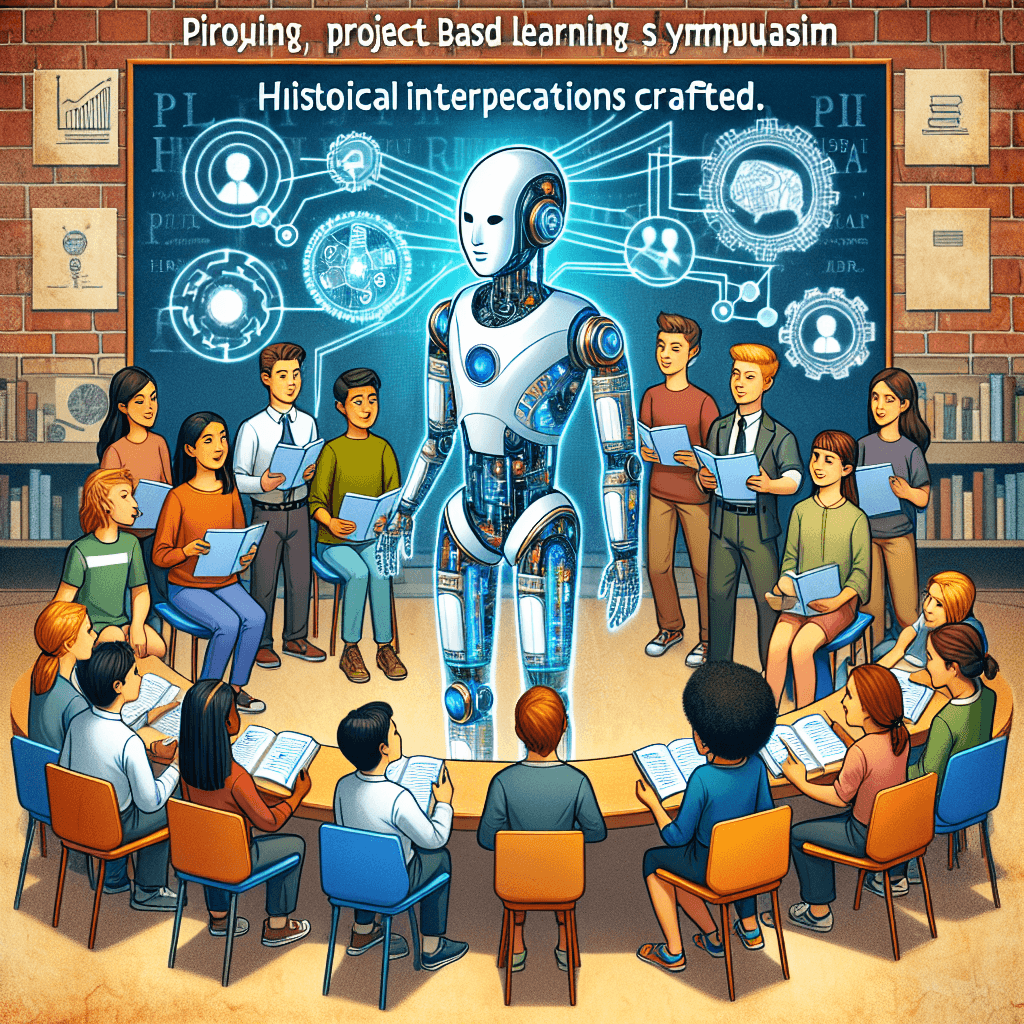
Historians' AI Symposium: Crafting Unique Historical Interpretations
Inquiry Framework
Question Framework
Driving Question
The overarching question that guides the entire project.How can AI transform our understanding of history by generating unique interpretations and narratives, while addressing the challenges and opportunities it presents?Essential Questions
Supporting questions that break down major concepts.- How can AI be utilized to generate unique interpretations of historical events?
- What are the challenges and opportunities in analyzing historical sources using AI?
- How does understanding the causes and effects of historical events equip us to comprehend present circumstances?
- In what ways can interdisciplinary approaches enhance our understanding of historical contexts?
- How can storytelling techniques be applied to create engaging and accurate historical narratives?
- What methodologies can be employed to design and manage a comprehensive historical investigation utilizing digital tools?
- How can critical thinking be fostered during historical problem-solving involving AI generated data?
- What role does collaboration play in developing and presenting a historical project effectively in the digital era?
- How can digital presentations (like videos or podcasts) change the way we learn and interpret history?
- In what ways can historical awareness and active citizenship be developed through the study of historical events and narratives?
- How can AI assist in recognizing and understanding historical misinformation or ideologically charged narratives?
- What is the significance of intercultural dialogue in understanding global historical contexts?
- How does historical knowledge contribute to a sense of civic responsibility and active participation in society?
Standards & Learning Goals
Learning Goals
By the end of this project, students will be able to:- Students will develop the ability to critically analyze primary and secondary historical sources using AI tools to generate unique interpretations.
- Students will understand historical processes and the connections between events, causes, and effects to appreciate the long-term evolution of history.
- Students will apply interdisciplinary approaches to enrich their understanding of historical contexts, integrating insights from literature, philosophy, and other fields.
- Students will create coherent and documented historical narratives that present new interpretations or storytelling formats, utilizing AI.
- Students will enhance their problem-solving skills by formulating and testing hypotheses based on evidence gathered through AI-assisted historical investigations.
- Students will utilize digital tools to design, manage, and present comprehensive historical research projects.
- Students will cultivate critical thinking and autonomous evaluation skills by assessing AI-generated data and the narratives they produce.
- Students will improve collaboration skills by working in groups to plan, develop, and present historical projects.
- Students will practice effective communication by presenting research findings clearly and persuasively in both written and oral forms.
- Students will foster creativity and innovation by developing new ways of presenting historical narratives, such as through videos or podcasts.
- Students will deepen their understanding of historical memory and its relevance to interpreting current events.
- Students will learn to identify and critique misinformation, bias, and ideological manipulation in historical contexts with AI assistance.
- Students will engage with intercultural dialogue to appreciate and analyze history from a global and inclusive perspective.
- Students will develop a sense of civic responsibility and understand their role as informed citizens through the study of historical events and narratives.
Obiettivi Cognitivi e Disciplinari
Obiettivi Metodologici e di Ricerca
Obiettivi Competenze Trasversali (Soft Skills)
Obiettivi di Cittadinanza Attiva e Consapevolezza Storica
Entry Events
Events that will be used to introduce the project to studentsInteractive Virtual Exhibit on 'What If' Scenarios
Students engage with an interactive virtual exhibit where AI presents alternative historical scenarios (e.g., 'What if the printing press was never invented?'). Each scenario is supported by AI-generated evidence and analyses, encouraging students to explore the complexity of historical causality and the impact of innovation on society.The Future Historian Challenge
Invite students to become 'future historians' using AI to predict how current events might be interpreted in the future. This activity connects past historical analysis with present events, fostering critical thinking and an appreciation for the dynamics of historical narrative construction.Portfolio Activities
Portfolio Activities
These activities progressively build towards your learning goals, with each submission contributing to the student's final portfolio.Historical Source Detective
In this activity, students will learn to analyze primary and secondary historical sources using AI tools. They will critically examine the reliability and validity of sources, developing skills crucial for historical interpretation.Steps
Here is some basic scaffolding to help students complete the activity.Final Product
What students will submit as the final product of the activityA detailed report evaluating the chosen source's reliability and relevance.Alignment
How this activity aligns with the learning objectives & standardsOCD1 (Analisi critica delle fonti storiche)Cause and Effect Web
This activity focuses on understanding the interconnections between historical events, causes, and effects. Students will use AI to map out these relationships, visualizing the evolution of history over time.Steps
Here is some basic scaffolding to help students complete the activity.Final Product
What students will submit as the final product of the activityAn interactive digital map showcasing historical cause-and-effect relationships.Alignment
How this activity aligns with the learning objectives & standardsOCD2 (Comprensione dei processi storici)Interdisciplinary Explorer
In this activity, students will enhance their understanding of historical contexts by integrating perspectives from multiple disciplines using AI tools. This will help in constructing a more thorough historical narrative.Steps
Here is some basic scaffolding to help students complete the activity.Final Product
What students will submit as the final product of the activityA multimedia presentation integrating interdisciplinary insights.Alignment
How this activity aligns with the learning objectives & standardsOCD3 (Contestualizzazione e interdisciplinarità)Storytelling with AI
Students will learn to develop coherent historical narratives using AI-generated data. This activity emphasizes storytelling techniques and AI assistance in weaving compelling history stories.Steps
Here is some basic scaffolding to help students complete the activity.Final Product
What students will submit as the final product of the activityA well-documented historical story, either written or in multimedia form.Alignment
How this activity aligns with the learning objectives & standardsOCD4 (Sviluppo di una narrazione storica)AI Hypothesis Workshop
This methodologically rich activity involves students acting as historians to formulate hypotheses based on AI-gathered evidence, testing and refining these hypotheses in light of emerging data.Steps
Here is some basic scaffolding to help students complete the activity.Final Product
What students will submit as the final product of the activityA documented hypothesis supported or refuted by AI-driven evidence.Alignment
How this activity aligns with the learning objectives & standardsOMR1 (Problem-solving storico)Digital Research Design
Students will design, manage, and execute a historical investigation using AI and other digital tools, focusing on defining objectives and workflows.Steps
Here is some basic scaffolding to help students complete the activity.Final Product
What students will submit as the final product of the activityA comprehensive digital research report detailing the investigation process and findings.Alignment
How this activity aligns with the learning objectives & standardsOMR3 (Progettazione e gestione di un'indagine storica)Critical Thinking Challenge
This activity enhances students' critical thinking capabilities when evaluating AI-generated historical information and narratives.Steps
Here is some basic scaffolding to help students complete the activity.Final Product
What students will submit as the final product of the activityA critical analysis essay evaluating AI-generated historical narratives.Alignment
How this activity aligns with the learning objectives & standardsOCT1 (Pensiero critico e autonomia)Collaborative Presentation Creation
Focusing on collaboration, this activity guides students to work in groups to develop and present a history project using digital tools.Steps
Here is some basic scaffolding to help students complete the activity.Final Product
What students will submit as the final product of the activityA group digital presentation on a historical topic.Alignment
How this activity aligns with the learning objectives & standardsOCT2 (Collaborazione e lavoro di gruppo)Innovative Communication Hub
This activity focuses on effective communication strategies for presenting historical research findings through modern digital means.Steps
Here is some basic scaffolding to help students complete the activity.Final Product
What students will submit as the final product of the activityA polished digital presentation related to a historical investigation.Alignment
How this activity aligns with the learning objectives & standardsOCT3 (Comunicazione efficace)Creative History Lab
In this activity, students tap into creativity and innovation to propose new methods of presenting historical narratives, experimenting with AI to craft engaging formats like virtual exhibits.Steps
Here is some basic scaffolding to help students complete the activity.Final Product
What students will submit as the final product of the activityAn innovative historical presentation, for example, a virtual exhibit or interactive experience.Alignment
How this activity aligns with the learning objectives & standardsOCT4 (Creatività e innovazione)Rubric & Reflection
Portfolio Rubric
Grading criteria for assessing the overall project portfolioHistorians' AI Symposium Assessment Rubric
Historical Analysis
Assessment of students' ability to critically evaluate primary and secondary sources using AI tools.Source Evaluation
Ability to analyze and critique the reliability and validity of historical sources using AI tools.
Exemplary
4 PointsDemonstrates outstanding critical evaluation of numerous sources, identifying biases and authenticity with sophisticated AI tool application.
Proficient
3 PointsEffectively evaluates multiple sources, consistently identifying key biases and reliability issues using AI tools.
Developing
2 PointsEvaluates a limited number of sources with some consistency, occasionally identifying evident biases.
Beginning
1 PointsStruggles to evaluate sources effectively, infrequently identifying biases or reliability issues.
Causal Analysis
Understanding of historical causality and ability to create a web of interactions using AI.
Exemplary
4 PointsSkillfully maps complex historical relationships using AI, demonstrating deep understanding of causes and effects.
Proficient
3 PointsCreates logical cause-and-effect maps that show a thorough understanding of historical processes using AI.
Developing
2 PointsCreates basic cause-and-effect maps with limited use of AI, showing some understanding of historical interactions.
Beginning
1 PointsShows a minimal ability to map cause-and-effect relationships, with limited use and understanding of AI.
Interdisciplinary Integration
Evaluation of students' ability to integrate insights from other academic disciplines into historical analysis.Interdisciplinary Approach
Ability to incorporate perspectives from other disciplines (e.g., literature, philosophy) into historical research.
Exemplary
4 PointsExceptionally integrates diverse academic insights, offering innovative perspectives in historical narrative.
Proficient
3 PointsSuccessfully incorporates relevant interdisciplinary insights, enriching historical understanding.
Developing
2 PointsIntegrates some interdisciplinary insights, but lacks depth or consistency.
Beginning
1 PointsStruggles to integrate interdisciplinary insights effectively into historical analysis.
Digital Proficiency
Assessment of skills in utilizing digital tools for historical research and presentation.AI Tool Utilization
Proficiency in using AI and digital tools for research and presentation of historical narratives.
Exemplary
4 PointsDemonstrates exceptional use of AI tools, enhancing research depth and presentation quality.
Proficient
3 PointsEffectively uses AI tools to support research and presentation of historical content.
Developing
2 PointsUses AI tools with basic proficiency, occasionally enhancing research or presentation.
Beginning
1 PointsStruggles to use AI tools effectively, needing additional support for research and presentation.
Storytelling and Communication
Evaluation of students' ability to craft compelling historical narratives and communicate findings effectively.Narrative Construction
Ability to develop coherent and engaging historical narratives with AI support.
Exemplary
4 PointsCreates highly engaging, well-structured narratives that vividly portray historical events with AI support.
Proficient
3 PointsDevelops clear and coherent narratives that effectively convey historical information using AI.
Developing
2 PointsProduces basic narratives, occasionally lacking clarity and engagement.
Beginning
1 PointsStruggles to create coherent narratives, lacking engagement and structure.
Communication Effectiveness
Skill in presenting historical research findings through digital and oral communication.
Exemplary
4 PointsPresents findings with outstanding clarity and persuasiveness, utilizing diverse digital formats effectively.
Proficient
3 PointsCommunicates findings clearly and effectively, using digital formats appropriately.
Developing
2 PointsDisplays basic communication skills, occasionally lacking clarity or persuasiveness.
Beginning
1 PointsPresents findings with limited clarity, struggling to utilize digital formats effectively.