
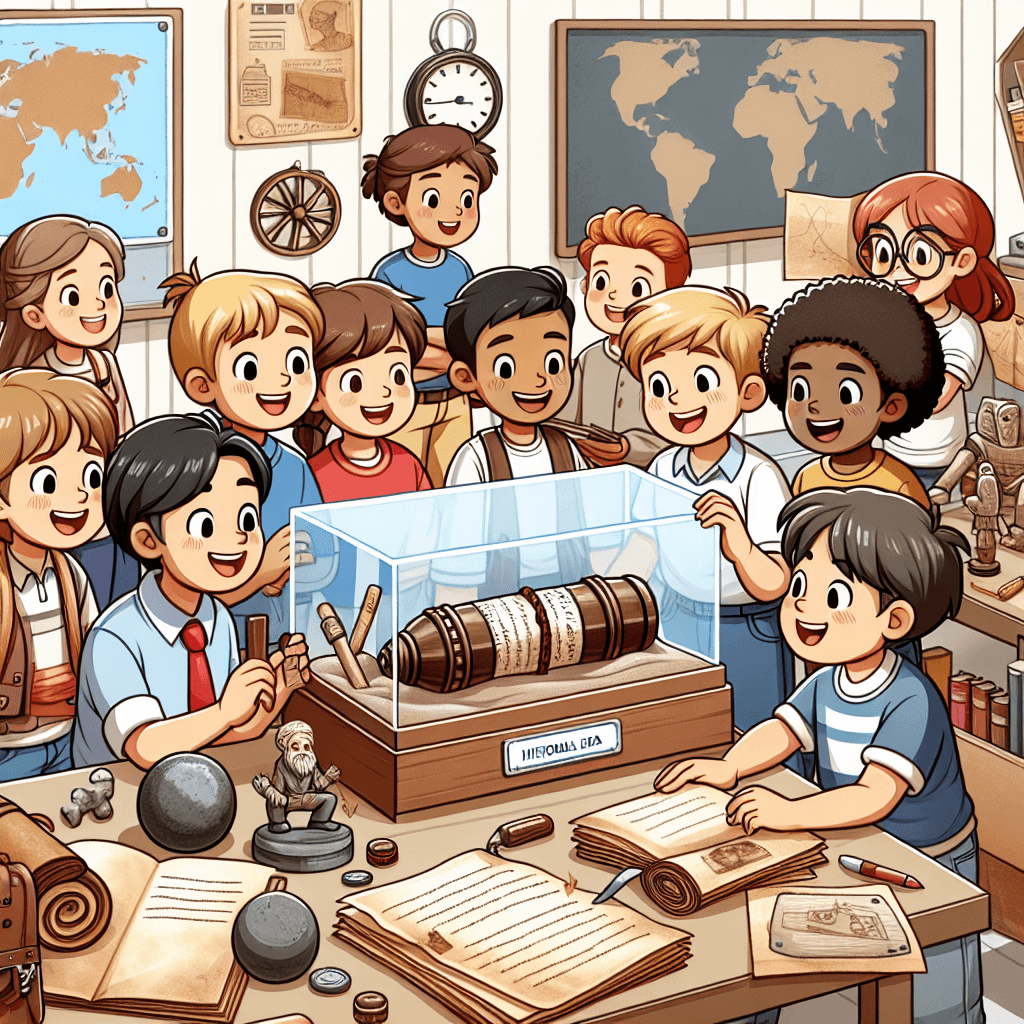
Historical Era Time Capsule Creation
Inquiry Framework
Question Framework
Driving Question
The overarching question that guides the entire project.How can we create a time capsule that effectively captures the culture, technology, and significant events of a historical era, while highlighting its influence on today's world?Essential Questions
Supporting questions that break down major concepts.- What events or inventions define a historical era, and why are they significant?
- How can objects and artifacts represent the culture and daily life of a historical era?
- In what ways did people communicate and express themselves during this historical era?
- What were the major challenges people faced during this time, and how did they overcome them?
- How does the exploration of a historical era's technology and science help us understand their everyday life and worldviews?
- What contributions from this historical era have influenced our modern world?
- How can we effectively and creatively present historical information in a time capsule?
- How do people, places, and events from the past influence our lives today?
Standards & Learning Goals
Learning Goals
By the end of this project, students will be able to:- Understand and identify key cultural, technological, and significant events of a chosen historical era while recognizing their impact on current times.
- Develop and refine writing skills through planning, drafting, revising, and editing written content that will accompany the chosen artifacts for the time capsule.
- Research and select historically significant objects and artifacts, justifying their inclusion in a time capsule to represent a particular era.
- Enhance public speaking and presentation skills by sharing the historical importance and selected artifacts of the time capsule with peers and others.
- Collaborate with classmates to plan, organize, and assemble a time capsule, ensuring each artifact's historical context and significance is well-understood and expressed.
Texas Education Standards
Entry Events
Events that will be used to introduce the project to studentsHistorical News Broadcast
The classroom is transformed into a makeshift news studio from the past. Students take on roles of reporters and citizens, investigating and reporting on key events, cultural aspects, or innovations of the era. They must collaborate to create an engaging news segment for a historical audience, merging creative writing with fact-based research.Portfolio Activities
Portfolio Activities
These activities progressively build towards your learning goals, with each submission contributing to the student's final portfolio.Time Capsule Treasure Hunt
In this activity, students will embark on a scavenger hunt to find and select objects or artifacts representing their chosen historical era. They will also begin the planning stage by brainstorming ideas about how these artifacts represent the era's culture, technology, and key events.Steps
Here is some basic scaffolding to help students complete the activity.Final Product
What students will submit as the final product of the activityA selection of artifacts and a chart linking these artifacts to their corresponding historical significance.Alignment
How this activity aligns with the learning objectives & standards3.11(A) - Students plan the first draft of their time capsule content by selecting a genre (artifacts) suited for their topic, purpose, and audience, brainstorming and mapping connections.Artifact Storyboard Creation
Students will create a storyboard for each artifact chosen during the treasure hunt, detailing the artifact's significance and historical context. This visual representation will help organize ideas and provide structure for future drafting of the time capsule's written documents.Steps
Here is some basic scaffolding to help students complete the activity.Final Product
What students will submit as the final product of the activityA completed storyboard with all selected artifacts and corresponding historical significance, organized in a logical sequence.Alignment
How this activity aligns with the learning objectives & standards3.11(B) - Students develop drafts into a focused, structured, and coherent piece of writing using the storyboard to logically organize information with an introduction and conclusion.Editing Fort: Wordsmith Workshop
In the Wordsmith Workshop, students will refine and edit their captions and storyboard text, focusing on improving sentence structure, word choice, verb tense, and punctuation. This exercise will enhance the clarity and coherence of their time capsule presentations.Steps
Here is some basic scaffolding to help students complete the activity.Final Product
What students will submit as the final product of the activityA revised and polished storyboard with refined captions and text, ready for the final time capsule assembly.Alignment
How this activity aligns with the learning objectives & standards3.11(C) - Students revise drafts by improving sentence structure and word choice, enhancing the coherence and clarity of their time capsule documentation.Publish and Present: History In Our Hands
Students will present their final time capsule and its contents to the class, focusing on public speaking skills and effective communication of historical information. They will also publish a written document describing each artifact's significance for inclusion in the time capsule.Steps
Here is some basic scaffolding to help students complete the activity.Final Product
What students will submit as the final product of the activityAn interactive presentation of the time capsule and a published booklet with written documentation of the time capsule's contents.Alignment
How this activity aligns with the learning objectives & standards3.11(D) - Students edit and publish written work using standard English conventions, focusing on clear expression of historical context and significance in their presentations and written documents.Rubric & Reflection
Portfolio Rubric
Grading criteria for assessing the overall project portfolioTime Capsule Historical Project Rubric
Artifact Selection and Historical Understanding
Assessment of students' ability to select suitable artifacts representing their assigned historical era, and demonstrate understanding of the artifacts’ historical significance.Artifact Relevance
Evaluates the appropriateness and historical relevance of selected artifacts.
Exemplary
4 PointsAll selected artifacts are highly relevant and accurately represent key cultural or technological aspects of the era, with clear justification provided for each choice.
Proficient
3 PointsMost artifacts are relevant and represent significant aspects of the era, with adequate justification for most choices.
Developing
2 PointsSome selected artifacts are relevant, but the choices lack consistent justification or clear representation of the era.
Beginning
1 PointsSelected artifacts have limited historical relevance, with insufficient justification for their inclusion.
Historical Contextualization
Assesses the depth of understanding of the historical context and significance of each artifact.
Exemplary
4 PointsProvides in-depth context and insight into how each artifact is historically significant, showing a sophisticated understanding of the era.
Proficient
3 PointsProvides clear context and explanation of most artifacts' historical significance with a solid understanding of the era.
Developing
2 PointsOffers some context and explanation, but lacks depth and a strong connection between artifacts and the era.
Beginning
1 PointsProvides minimal context or inaccurate explanation for the artifacts' historical significance.
Written Communication and Storyboard Organization
Evaluates the effectiveness of written drafts, including logical organization using storyboards, clarity, coherence, and adherence to English conventions.Organization and Structure
Measures the coherence, structure, and logical flow of the storyboard and written drafts.
Exemplary
4 PointsThe storyboard and written text are excellently organized, with a clear introduction, body, and conclusion; ideas flow logically and coherently.
Proficient
3 PointsThe work is well-organized, with a structured introduction, body, and conclusion, maintaining clear focus throughout.
Developing
2 PointsThe organization is weak, with some lack of clarity in the structure and logical flow of ideas.
Beginning
1 PointsThe storyboard and drafts lack clear organization and coherent structure.
Language and Conventions
Assesses the use of standard English conventions, including grammar, punctuation, and vocabulary.
Exemplary
4 PointsUses precise language and follows English conventions impeccably, with no errors in grammar, punctuation, or spelling.
Proficient
3 PointsUses language clearly and correctly, with minor errors that do not impede understanding.
Developing
2 PointsInconsistent use of language and conventions, with errors occasionally impairing comprehension.
Beginning
1 PointsFrequent errors in language and conventions, making comprehension difficult.
Presentation and Collaboration
Evaluates students' abilities to effectively communicate their time capsule project's findings and collaborate with peers.Presentation Skills
Measures the effectiveness of the oral presentation, including clarity, engagement, and communication of historical content.
Exemplary
4 PointsDemonstrates exceptional presentation skills with clear, engaging delivery, and communicates historical content effectively.
Proficient
3 PointsPresents information clearly and engagingly, effectively communicating most historical content.
Developing
2 PointsPresents information with limited clarity and engagement, partially communicating historical content.
Beginning
1 PointsStruggles with presentation, providing unclear or incomplete communication of historical content.
Collaboration and Contribution
Assesses students' ability to collaborate and contribute meaningfully in group activities.
Exemplary
4 PointsShows leadership in collaboration, consistently contributing valuable ideas and supporting peers effectively.
Proficient
3 PointsCollaborates well with the group, contributing constructive ideas and supporting peers adequately.
Developing
2 PointsParticipates in collaboration with occasional constructive contributions and limited support for peers.
Beginning
1 PointsRarely contributes to collaboration, offering minimal or no support to peers.