
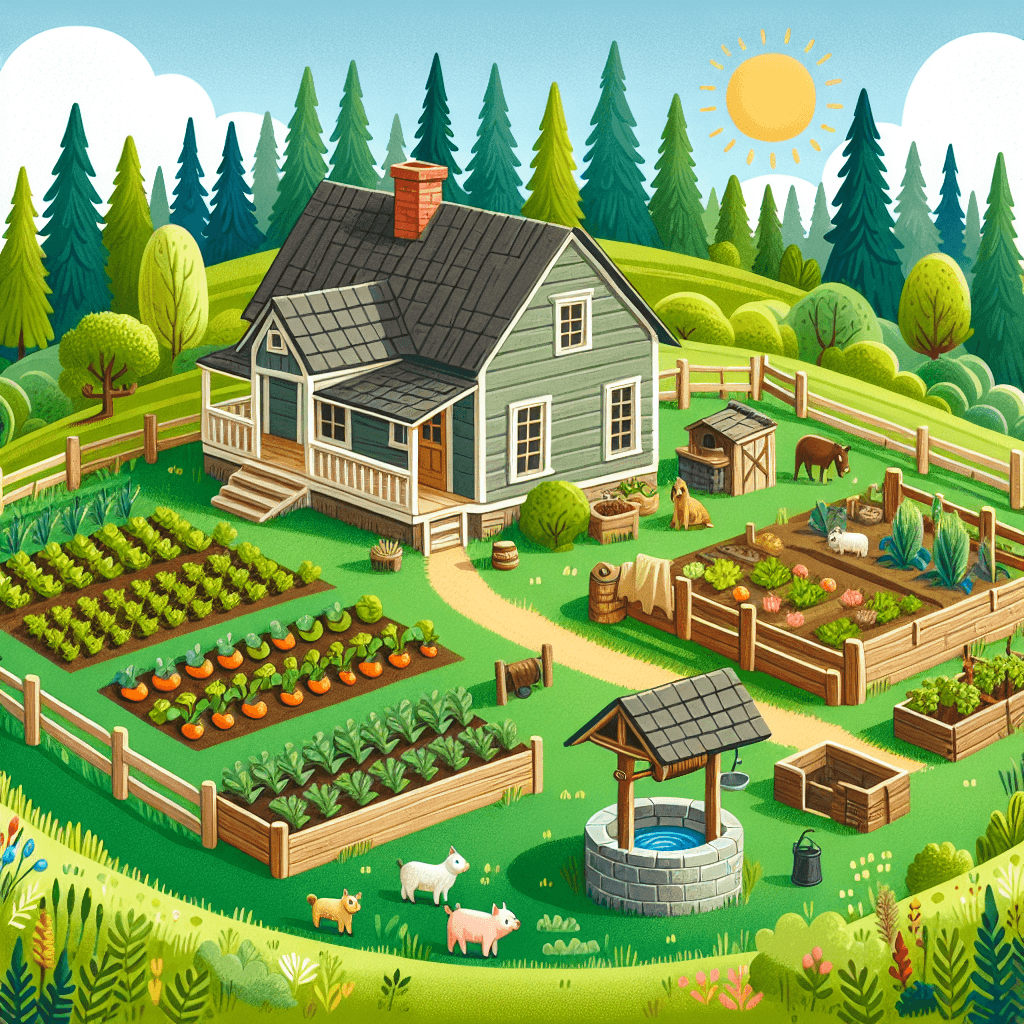
Homestead in A Land Remembered
Inquiry Framework
Question Framework
Driving Question
The overarching question that guides the entire project.How can we collaboratively design and construct a sustainable and historically influenced homestead model, incorporating elements from 'A Land Remembered Volume 2', while applying art, social studies, and math skills?Essential Questions
Supporting questions that break down major concepts.- How can we design and plan a homestead inspired by 'A Land Remembered Volume 2'?
- What elements of a homestead are essential for survival and sustainability?
- In what ways can the history, geography, and economy found in 'A Land Remembered Volume 2' influence the creation of a homestead?
- How can we incorporate architectural and artistic concepts to visually represent a homestead from the story?
- How can mathematical concepts be applied to the layout and construction of a homestead?
- What historical and cultural elements can we include in our homestead model based on the story 'A Land Remembered'?
- How does the connection between humanity and the land influence the social structure and daily life of a homestead in 'A Land Remembered'?
Standards & Learning Goals
Learning Goals
By the end of this project, students will be able to:- Students will design and construct a scale model of a sustainable homestead inspired by 'A Land Remembered Volume 2', integrating elements from the book.
- Students will apply mathematical concepts to calculate area, volume, and spatial relationships in the design of their homestead.
- Students will explore historical and cultural contexts from the story to influence their homestead’s design, demonstrating understanding through artistic representation.
- Students will engage in research to collect data and information necessary for accurately representing a historical homestead model.
- Students will collaborate effectively to merge insights from art, social studies, and math, reflecting on their contributions to construct the final model.
Common Core Standards
Entry Events
Events that will be used to introduce the project to studentsDesign a 19th Century Homestead
Kick off the project with a virtual reality tour of a 19th-century Florida homestead, allowing students to explore the lifestyle and challenges faced by early settlers. Challenge them to create their homestead model, integrating art for design, math for measurement scaling, and social studies to understand the historical context.Homestead Economic Simulation
Engage students with an economic simulation game based on managing a homestead, where they must make economic decisions on trading, resource management, and community-building. The integration of social studies with math helps them appreciate the economic realities of the time.Homestead Recipe Book Creation
Initiate the project by involving students in researching and recreating authentic 19th-century recipes that would have been relevant to the homestead setting, blending social studies and math in measuring ingredients and exploring cultural influences.Portfolio Activities
Portfolio Activities
These activities progressively build towards your learning goals, with each submission contributing to the student's final portfolio.Research Resiliency Ralliance
Students will conduct research, utilizing various sources to inform their homestead designs with historical and cultural accuracy, fostering skills in finding, evaluating, and integrating information efficiently.Steps
Here is some basic scaffolding to help students complete the activity.Final Product
What students will submit as the final product of the activityA comprehensive presentation detailing researched findings on historical homesteads to inform project design.Alignment
How this activity aligns with the learning objectives & standardsCCSS.ELA-LITERACY.RI.5.7 - Utilize multiple print or digital sources for efficient research.Collaborative Creativity Conclave
In this activity, students will engage in group discussions to brainstorm, plan, and reflect on their homestead designs, leveraging collective insights and feedback to enrich their final models.Steps
Here is some basic scaffolding to help students complete the activity.Final Product
What students will submit as the final product of the activityA well-rounded and reflective joint homestead design that encapsulates the best ideas from group discussions.Alignment
How this activity aligns with the learning objectives & standardsCCSS.ELA-LITERACY.SL.5.1 - Engage effectively in collaborative discussions.Coordinate Cartography Challenge
Students will begin their homestead design by mapping out a plot using coordinate planes, allowing them to understand space and layout within the first quadrant mapping. It's a blend of creativity and strategic math application.Steps
Here is some basic scaffolding to help students complete the activity.Final Product
What students will submit as the final product of the activityA coordinate map showcasing the initial layout of a homestead, plotted on the first quadrant of a graph.Alignment
How this activity aligns with the learning objectives & standardsCCSS.MATH.CONTENT.5.G.A.2 - Represent real world and mathematical problems by graphing points in the first quadrant of the coordinate plane.Storytelling through Structures
As students construct their homestead models, they will integrate themes from 'A Land Remembered Volume 2', using their understanding of the text to inform their design decisions, thus enhancing their frames of reference.Steps
Here is some basic scaffolding to help students complete the activity.Final Product
What students will submit as the final product of the activityA homestead model deeply intertwined with specific themes and elements from 'A Land Remembered Volume 2'.Alignment
How this activity aligns with the learning objectives & standardsCCSS.ELA-LITERACY.RI.5.2 - Determine themes of a text and support them with key details.Rubric & Reflection
Portfolio Rubric
Grading criteria for assessing the overall project portfolioSustainable Homestead Model Assessment Rubric
Research and Integration
Assesses students' ability to research and integrate historical and cultural elements effectively into their homestead design.Research Skills
Ability to locate, evaluate, and use information from multiple sources to inform the homestead design.
Exemplary
4 PointsUtilizes a wide range of reliable sources, synthesizes complex information, and clearly integrates findings to enhance design.
Proficient
3 PointsUses multiple reliable sources, integrates relevant information neatly, and presents findings clearly in the design.
Developing
2 PointsAccesses some sources, partially integrates information, and occasionally applies findings to the design.
Beginning
1 PointsRelies on few sources, struggles to integrate information, and seldom applies findings to the design.
Historical and Cultural Integration
How well historical and cultural elements from 'A Land Remembered Volume 2' are reflected in the model.
Exemplary
4 PointsSkillfully integrates multiple historical and cultural elements into the model, displaying nuanced understanding of the text.
Proficient
3 PointsEffectively integrates several historical and cultural elements, reflecting a clear understanding of the text.
Developing
2 PointsIntegrates some historical and cultural elements with basic references to the text.
Beginning
1 PointsIncorporates few historical elements with minimal connection to the text.
Collaborative Process
Evaluates students' engagement and effectiveness in collaborative discussions and planning for the homestead model.Engagement in Discussion
Participation in collaborative planning and feedback sessions.
Exemplary
4 PointsActively leads discussions, engages peers with thoughtful contributions, and integrates feedback seamlessly into planning.
Proficient
3 PointsContributes regularly with valuable insights and incorporates peer feedback into planning.
Developing
2 PointsParticipates in discussions with some contribution and uses minimal feedback in planning.
Beginning
1 PointsSeldom participates or contributes to discussions, with limited use of feedback in planning.
Mathematical Application
Assesses the use of mathematical concepts in designing the homestead layout using coordinate planes.Coordinate Mapping
Ability to plot homestead elements accurately on a coordinate plane using math concepts.
Exemplary
4 PointsAccurately plots all elements on the coordinate plane, demonstrating advanced understanding of spatial relationships.
Proficient
3 PointsCorrectly plots most elements, showing a clear understanding of the first quadrant coordinate plane.
Developing
2 PointsPlots some elements with occasional errors or misunderstandings of spatial concepts.
Beginning
1 PointsStruggles to plot elements correctly, with frequent errors in spatial understanding.
Artistic and Structural Design
Assesses the creativity, accuracy, and construction quality of the homestead model, including artistic elements.Artistic Creativity and Detail
Creativity and attention to detail in the design and execution of the homestead model.
Exemplary
4 PointsDemonstrates unparalleled creativity and meticulous attention to detail, with innovative artistic representation.
Proficient
3 PointsShows good creativity with careful detail, resulting in a cohesive and visually appealing model.
Developing
2 PointsExhibits some creativity with basic detail in artistic representation.
Beginning
1 PointsShows limited creativity and detail, with basic artistic execution.