
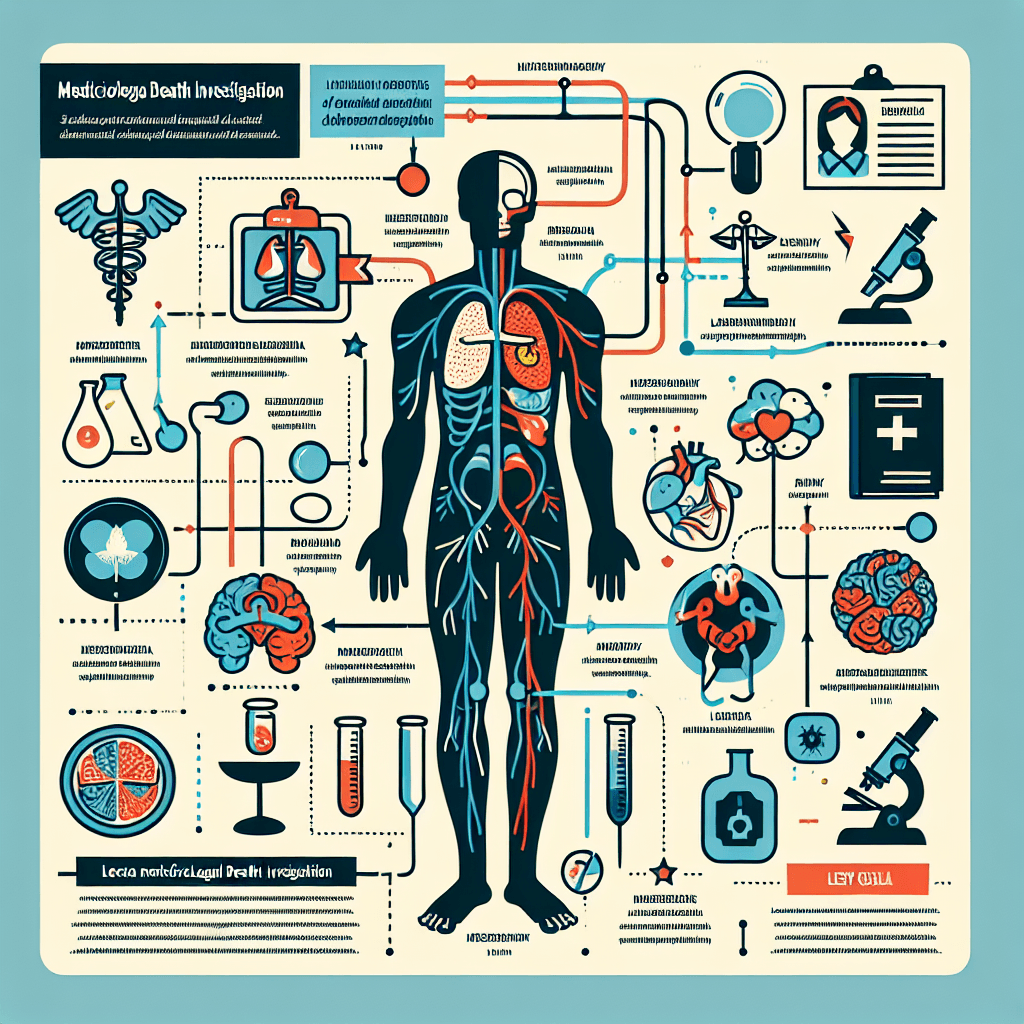
Human Body Poster: Medicolegal Death Investigation
Inquiry Framework
Question Framework
Driving Question
The overarching question that guides the entire project.How can we create a comprehensive poster that explains the various forensic techniques used to determine causes, mechanisms, and time of death in a medicolegal investigation?Essential Questions
Supporting questions that break down major concepts.- What are the various causes and mechanisms of death, and how can they be identified in a forensic investigation?
- How can mathematical and computational thinking be applied to understand post-mortem changes and estimate the post-mortem interval?
- In what ways do insects contribute to the decomposition process, and how can entomological data be used to evaluate time of death?
- How can physical anthropological data be used to create a profile of a victim or perpetrator in forensic science?
- How do forensic scientists construct arguments based on evidence to determine the manner of death?
- What historical methods used in forensic science, such as Algor Mortis, are less commonly used today, and why?
Standards & Learning Goals
Learning Goals
By the end of this project, students will be able to:- Students will be able to identify and explain various causes and mechanisms of death in forensic science.
- Students will effectively use mathematical and computational tools to analyze post-mortem changes and determine post-mortem intervals.
- Students will evaluate the significance of entomological data in forensic investigations related to PMI.
- Students will research physical anthropological data to create a profile for forensic purposes.
- Students will develop the ability to construct evidence-based arguments to determine the manner of death.
- Students will explore historical and modern forensic techniques, understanding their evolution over time.
State Forensic Science Standards
Entry Events
Events that will be used to introduce the project to studentsGuest Lecture by Forensic Expert
Invite a local forensic expert to share real-life stories and cases that challenge students to think about death investigations. This authentic connection fuels student interest by providing insider perspectives and allows for direct Q&A about science concepts applied in the real-world.Portfolio Activities
Portfolio Activities
These activities progressively build towards your learning goals, with each submission contributing to the student's final portfolio.Forensic Questioning Quest
Students engage with real-life forensic cases to identify causes and mechanisms of death by formulating and responding to investigative questions. This activity helps students deepen their understanding of forensic processes and prepares them for more complex argument construction about causes of death.Steps
Here is some basic scaffolding to help students complete the activity.Final Product
What students will submit as the final product of the activityA set of clear, investigative questions about a chosen forensic case, with potential answers discussed and noted.Alignment
How this activity aligns with the learning objectives & standardsAligns with SFS5.a by focusing on questioning techniques to identify causes and mechanisms of death.Evidence-Based Argument Construct
In this activity, students build skills in constructing evidence-based arguments to identify the manner of death using gathered forensic evidence. This enhances their critical thinking and argumentative skills, which are essential in forensic science.Steps
Here is some basic scaffolding to help students complete the activity.Final Product
What students will submit as the final product of the activityA written or verbal argument that explains the determined manner of death, supported by evidence.Alignment
How this activity aligns with the learning objectives & standardsAligns with SFS5.b by training students to use evidence in constructing arguments about the manner of death.Math Mortis Analysis
This activity focuses on applying mathematics and computational tools to analyze post-mortem changes and estimate the post-mortem interval (PMI). Students will explore rigor mortis, livor mortis, and more, using math to enhance their scientific analysis.Steps
Here is some basic scaffolding to help students complete the activity.Final Product
What students will submit as the final product of the activityA detailed report illustrating the use of mathematical and computational tools in determining PMI for a given scenario.Alignment
How this activity aligns with the learning objectives & standardsAligns with SFS5.c, focusing on the use of mathematics and computational thinking to explain post-mortem changes.Decomposition Dossier
Students dive into the fascinating world of forensic entomology, analyzing how insect data contributes to understanding decomposition and PMI. This activity develops skills in analyzing scientific data and understanding its forensic applications.Steps
Here is some basic scaffolding to help students complete the activity.Final Product
What students will submit as the final product of the activityA visual presentation that details the relationship between insects and decomposition in determining PMI.Alignment
How this activity aligns with the learning objectives & standardsAligns with SFS5.d by analyzing and interpreting entomological data to evaluate its role in decomposition and PMI determination.Anthropological Analysis Adventure
In this activity, students become forensic anthropologists, using physical data to develop profiles that inform investigations. They will explore how variables like height, sex, age, and race impact the understanding of forensic cases.Steps
Here is some basic scaffolding to help students complete the activity.Final Product
What students will submit as the final product of the activityA detailed anthropological profile based on provided data, illustrating its utility in generating insights into forensic cases.Alignment
How this activity aligns with the learning objectives & standardsAligns with SFS5.e by utilizing anthropological data to develop profiles in forensic science.Rubric & Reflection
Portfolio Rubric
Grading criteria for assessing the overall project portfolioForensic Science Portfolio Evaluation Rubric
Understanding Forensic Concepts
Assesses student's grasp of forensic science concepts, including causes and mechanisms of death, forensic anthropology, and the role of insects.Identification of Causes and Mechanisms of Death
Level of understanding in identifying various causes and mechanisms of death through investigation.
Exemplary
4 PointsDemonstrates a sophisticated understanding of causes and mechanisms of death, formulating insightful questions and connections.
Proficient
3 PointsShows a thorough understanding of causes and mechanisms of death, with well-formed questions and rationale.
Developing
2 PointsShows emerging understanding of causes and mechanisms of death, with basic questions and some rationale.
Beginning
1 PointsDisplays initial understanding of causes and mechanisms of death, formulating simple or incomplete questions.
Knowledge of Forensic Anthropology
Assess understanding of how anthropological data is applied to develop forensic profiles.
Exemplary
4 PointsExhibits advanced comprehension of forensic anthropology, adeptly integrating anthropological data into comprehensive profiles.
Proficient
3 PointsDemonstrates solid understanding of forensic anthropology, effectively using anthropological data in profile development.
Developing
2 PointsShows partial understanding of forensic anthropology, with some use of anthropological data in basic profiles.
Beginning
1 PointsDisplays minimal understanding of forensic anthropology, struggling to use anthropological data in profiles.
Application of Mathematical and Scientific Tools
Evaluates the student's ability to apply mathematical and computational thinking in forensic science scenarios.Mathematical and Computational Analysis for PMI
Measures ability to use math and computational tools to estimate post-mortem interval.
Exemplary
4 PointsUses advanced mathematical and computational methods to accurately estimate PMI, integrating insights seamlessly.
Proficient
3 PointsApplies appropriate mathematical and computational tools to estimate PMI effectively, with clear logic.
Developing
2 PointsAttempts to use mathematical and computational tools for PMI estimation with partial success and clarity.
Beginning
1 PointsStruggles to apply mathematical and computational methods accurately for PMI estimation.
Evidence-Based Argumentation
Assesses ability to construct reasoned arguments using forensic evidence.Construction of Evidence-Based Argument
The ability to construct and support arguments about the manner of death.
Exemplary
4 PointsCrafts compelling, well-supported arguments that demonstrate excellent understanding and use of forensic evidence.
Proficient
3 PointsConstructs sound arguments supported adequately by forensic evidence, demonstrating good understanding.
Developing
2 PointsDevelops basic arguments with limited supporting evidence and some comprehension of concepts.
Beginning
1 PointsAttempts to construct arguments with minimal support and understanding of forensic evidence.
Scientific Communication and Presentation
Assesses the effectiveness of communicating forensic findings through various formats (reports, presentations).Clarity and Depth in Scientific Presentations
Assesses quality of student presentations and clarity in communicating scientific concepts.
Exemplary
4 PointsDelivers clear, persuasive presentations with exceptional depth and precision in forensic concepts.
Proficient
3 PointsCommunicates forensic ideas clearly and accurately in well-organized presentations.
Developing
2 PointsCommunicates basic ideas with some clarity and organization, but lacks depth or precision.
Beginning
1 PointsStruggles to communicate ideas clearly, with presentations lacking organization and depth.