
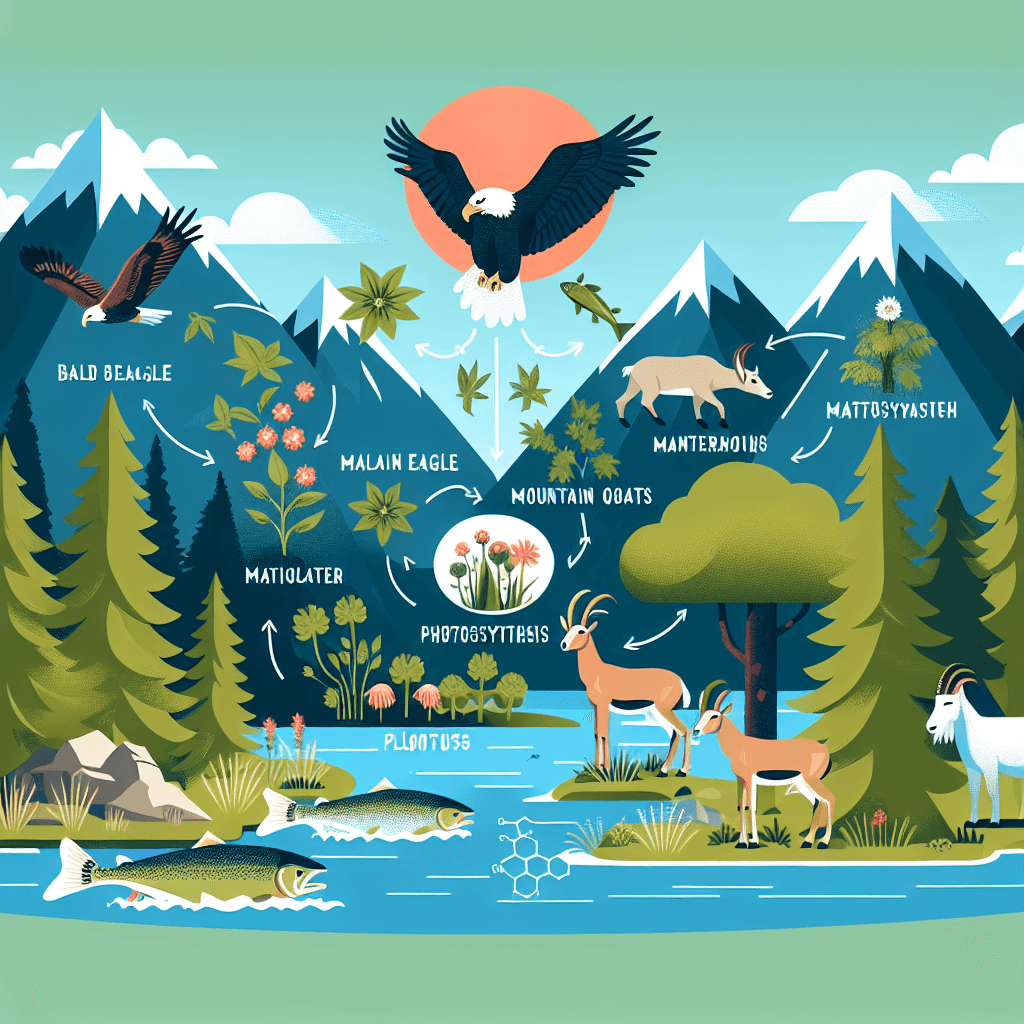
Idaho Ecosystems: Cycling of Matter and Photosynthesis
Inquiry Framework
Question Framework
Driving Question
The overarching question that guides the entire project.How do the unique ecosystems of your chosen Idaho region demonstrate the interconnectedness of resource availability, organism interactions, and the cycling of matter and energy through photosynthesis and food webs?Essential Questions
Supporting questions that break down major concepts.- How does the availability of resources affect organisms and populations in the chosen Idaho region?
- What are the key interactions between organisms in different ecosystems within the selected region?
- How can a model describe the cycling of matter and flow of energy in the ecosystems of the chosen Idaho region?
- How does photosynthesis contribute to the cycling of matter and flow of energy in the selected Idaho region?
- How are food molecules rearranged to support growth and/or release energy as matter moves through organisms in the ecosystems of the chosen Idaho region?
Standards & Learning Goals
Learning Goals
By the end of this project, students will be able to:- Students will be able to identify and describe the major ecosystems within their chosen Idaho region.
- Students will be able to explain how resource availability impacts the organisms and populations within their selected ecosystems.
- Students will be able to model the cycling of matter and flow of energy through an ecosystem, including both biotic and abiotic components.
- Students will be able to explain the role of photosynthesis in the cycling of matter and energy within their chosen Idaho region.
- Students will be able to describe the interactions between different organisms within the ecosystems of their chosen Idaho region.
Idaho Science Standards
Entry Events
Events that will be used to introduce the project to studentsMystery Ecosystem Collapse
Students are presented with a simulated news report detailing a sudden ecosystem collapse in one of Idaho's regions. They must investigate the potential causes, focusing on disruptions to the cycling of matter and photosynthesis, to propose solutions and prevent further damage.Virtual Field Trip Disaster Simulation
Students embark on a virtual field trip to their chosen Idaho region, where they encounter a simulated environmental disaster (e.g., wildfire, invasive species). They must work collaboratively to analyze the impact of the disaster on the ecosystem's matter cycling and photosynthetic processes, developing a recovery plan based on scientific principles.Portfolio Activities
Portfolio Activities
These activities progressively build towards your learning goals, with each submission contributing to the student's final portfolio.Idaho Region Explorer: Ecosystem Identification
Students begin by selecting one of the seven regions of Idaho and identifying its major ecosystems. They will research and document the unique characteristics of each ecosystem, focusing on the key biotic and abiotic factors that define them.Steps
Here is some basic scaffolding to help students complete the activity.Final Product
What students will submit as the final product of the activityA comprehensive report detailing the major ecosystems of the chosen Idaho region, including descriptions of biotic and abiotic factors.Alignment
How this activity aligns with the learning objectives & standardsAddresses Learning Goal 1 (identify and describe major ecosystems) and aligns with MS-LS-2.1 (effects of resource availability on organisms) by requiring students to consider how environmental factors influence ecosystem composition.Resource Rumble: Availability Impact Analysis
Students analyze how the availability of key resources (e.g., water, sunlight, nutrients) affects the organisms and populations within their selected ecosystems. They will investigate how these resources are distributed and utilized, and what happens when they become limited or disrupted.Steps
Here is some basic scaffolding to help students complete the activity.Final Product
What students will submit as the final product of the activityAn infographic or presentation illustrating the flow of resources in the chosen ecosystems and the impact of resource availability on organisms and populations.Alignment
How this activity aligns with the learning objectives & standardsAddresses Learning Goal 2 (resource availability impacts) and directly aligns with MS-LS-2.1 (effects of resource availability on organisms). It also sets the stage for understanding matter cycling and energy flow.Matter Cycling Modelers: Ecosystem in Motion
Students develop a model (physical or digital) to represent the cycling of matter and flow of energy through one of the ecosystems in their chosen Idaho region. They will show how carbon, water, and nutrients move through the biotic and abiotic components of the ecosystem, with a focus on the role of producers, consumers, and decomposers.Steps
Here is some basic scaffolding to help students complete the activity.Final Product
What students will submit as the final product of the activityA physical or digital model depicting the cycling of matter and flow of energy through an ecosystem, with a clear explanation of the processes involved.Alignment
How this activity aligns with the learning objectives & standardsAddresses Learning Goal 3 (modeling cycling of matter and energy) and directly aligns with MS-LS-2.3 (model of cycling of matter and energy). It builds upon previous activities by integrating resource availability and organism interactions.Photosynthesis Powerhouse: The Engine of Life
Students investigate the role of photosynthesis in the cycling of matter and energy within their selected ecosystem. They will explain how plants and other photosynthetic organisms convert light energy into chemical energy, and how this process supports the entire food web.Steps
Here is some basic scaffolding to help students complete the activity.Final Product
What students will submit as the final product of the activityA diagram or presentation explaining the role of photosynthesis in the cycling of matter and energy within the ecosystem's food web.Alignment
How this activity aligns with the learning objectives & standardsAddresses Learning Goal 4 (role of photosynthesis) and directly aligns with MS-LS-1.5 (photosynthesis in the cycling of matter). It reinforces the concepts introduced in the Matter Cycling Modelers activity.Ecosystem Interconnections: Food Web Architects
Students explore the interactions between different organisms within their chosen Idaho region by constructing a detailed food web. They will identify producers, consumers (herbivores, carnivores, omnivores), and decomposers, and explain how energy and matter are transferred between them. Students will also construct an explanation that predicts patterns of interactions among organisms across multiple ecosystems.Steps
Here is some basic scaffolding to help students complete the activity.Final Product
What students will submit as the final product of the activityA food web diagram illustrating the interactions between organisms in the ecosystem, along with a written analysis of the food web's stability and resilience. Also includes an explanation that predicts patterns of interactions among organisms across multiple ecosystems.Alignment
How this activity aligns with the learning objectives & standardsAddresses Learning Goal 5 (interactions between organisms) and directly aligns with MS-LS-2.2 (patterns of interactions among organisms). It synthesizes the knowledge gained in previous activities, demonstrating a comprehensive understanding of the ecosystem.Molecular Cuisine: Food Rearrangement Analysis
Students will delve into the molecular level to understand how food is rearranged through chemical reactions within organisms. They will choose a specific organism from their ecosystem and trace how the molecules from its food are broken down and reassembled to support growth, release energy, or build new tissues.Steps
Here is some basic scaffolding to help students complete the activity.Final Product
What students will submit as the final product of the activityA report or presentation tracing the molecular transformations of food within a chosen organism, explaining how food is rearranged to support life processes.Alignment
How this activity aligns with the learning objectives & standardsConnects to Learning Goals 3, 4, and 5 by exploring the underlying chemical processes that drive matter cycling and energy flow. Directly aligns with MS-LS-1.6 (food rearrangement through chemical reactions).Rubric & Reflection
Portfolio Rubric
Grading criteria for assessing the overall project portfolioIdaho Ecosystem Exploration Rubric
Research and Understanding
Evaluates the student's ability to conduct thorough research and exhibit a deep understanding of Idaho's ecosystems.Ecosystem Description
Clarity and depth in describing the major ecosystems, their biotic and abiotic components.
Exemplary
4 PointsProvides an in-depth description of the ecosystems with comprehensive details on biotic and abiotic components, supported by highly relevant examples.
Proficient
3 PointsDescribes ecosystems accurately, with relevant details on key biotic and abiotic components.
Developing
2 PointsDescribes ecosystems with some relevant details, but lacks depth in explaining biotic or abiotic components.
Beginning
1 PointsProvides minimal or inaccurate descriptions of ecosystems with little detail on biotic and abiotic components.
Resource Impact Analysis
Ability to analyze and explain the influence of resource availability on ecosystems.
Exemplary
4 PointsProvides a detailed and insightful analysis of resource availability impacts, with strong evidence and logical conclusions.
Proficient
3 PointsExplains the impacts of resource availability on ecosystems with clear reasoning and evidence.
Developing
2 PointsOffers a limited analysis of resource impacts, with some evidence but lacks depth.
Beginning
1 PointsPresents a minimal analysis with insufficient understanding of resource impacts.
Modeling and Application
Assesses the student's ability to create models and apply scientific principles to demonstrate ecosystem processes.Matter and Energy Model
Effectiveness of the model depicting cycling of matter and flow of energy.
Exemplary
4 PointsCreates a highly accurate and detailed model that illustrates complex matter and energy cycling processes with clear annotations.
Proficient
3 PointsDevelops a clear model representing matter and energy cycling, with accurate components and relationships.
Developing
2 PointsConstructs a basic model with some accurate depiction of matter and energy cycling, but lacks detail.
Beginning
1 PointsOffers an incomplete or inaccurate model with minimal understanding of the processes.
Photosynthesis Explanation
Clarity and accuracy in explaining the role of photosynthesis in ecosystems.
Exemplary
4 PointsExplains photosynthesis with exceptional clarity and detail, integrating its role in energy and matter cycling with precision.
Proficient
3 PointsProvides a clear and accurate explanation of photosynthesis and its ecological role.
Developing
2 PointsDescribes photosynthesis with basic accuracy, but lacks detail and integration.
Beginning
1 PointsPresents a limited or inaccurate explanation of photosynthesis with significant misunderstandings.
Critical Thinking and Analysis
Evaluates the student's analytical skills and ability to synthesize information into coherent arguments and predictions.Food Web Analysis
Quality of the food web representation and analysis of organism interactions.
Exemplary
4 PointsConstructs a comprehensive food web with accurate interactions and insightful analysis of ecological interconnections.
Proficient
3 PointsCreates an accurate food web and provides a clear analysis of interactions.
Developing
2 PointsIllustrates a basic food web with some accurate interactions but limited analysis.
Beginning
1 PointsProduces an incomplete or incorrect food web with minimal analysis.