
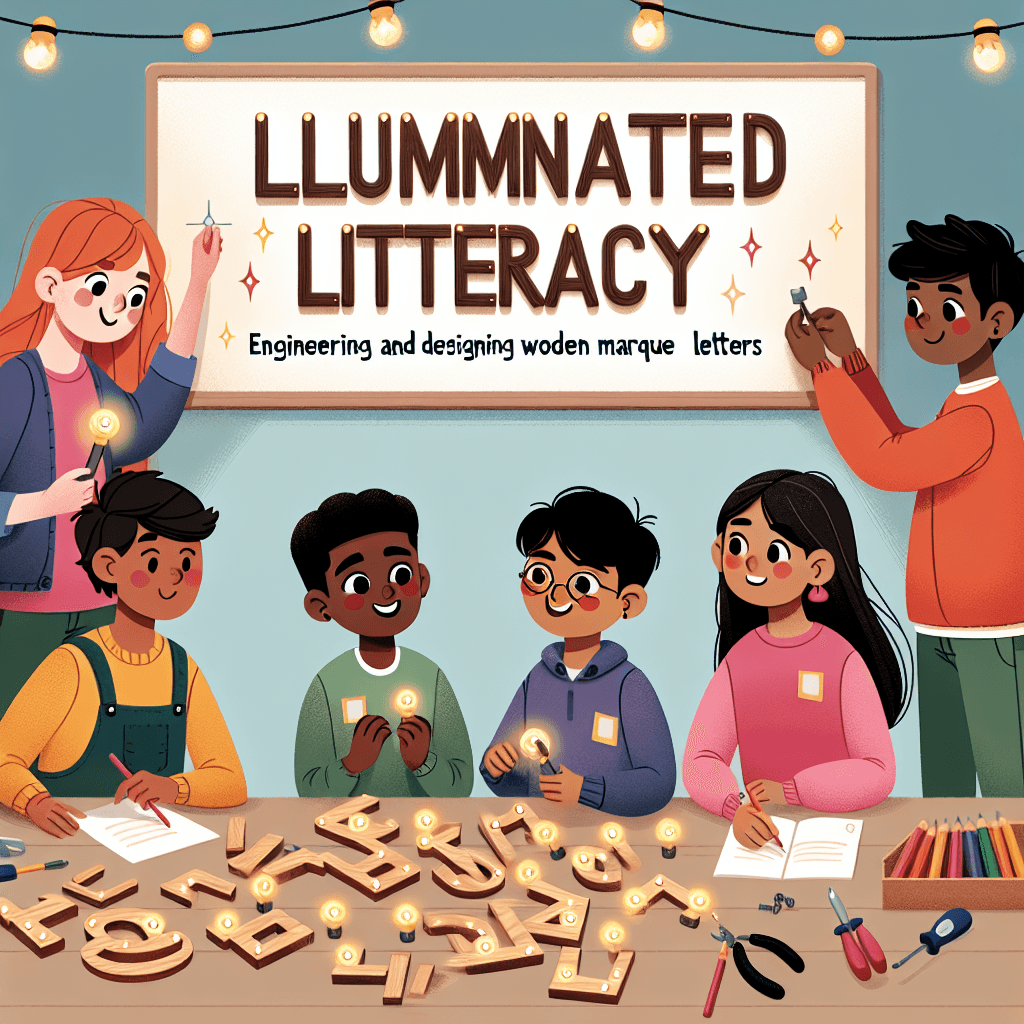
Illuminated Literacy: Engineering and Designing Wooden Marquee Letters
Inquiry Framework
Question Framework
Driving Question
The overarching question that guides the entire project.How can we, as design consultants, use mathematical scaling and technical documentation to create and pitch custom wooden marquee letters that effectively communicate a specific message or mood for a community stakeholder?Essential Questions
Supporting questions that break down major concepts.- How do scale factor and geometric proportions ensure that a small template translates accurately into a large-scale wooden structure?
- How can we use technical writing to document a complex building process for others to follow?
- How does the choice of typography and lighting influence the mood and message of a visual design?
- In what ways does precise mathematical measurement minimize material waste and optimize project budgeting?
- How can persuasive communication be used to pitch a design concept to a potential client or stakeholder?
Standards & Learning Goals
Learning Goals
By the end of this project, students will be able to:- Apply scale factors and geometric transformations to accurately translate small-scale letter templates into large-scale wooden structures.
- Calculate surface area, volume, and material costs to develop a project budget and minimize construction waste.
- Compose a comprehensive technical manual that uses precise language and sequence to document the building process for a specific audience.
- Synthesize typography, color theory, and lighting choices to create a visual design that communicates a specific mood or message.
- Deliver a persuasive pitch to a community stakeholder that justifies design and mathematical decisions using evidence-based reasoning.
Common Core State Standards for Mathematics
Common Core State Standards for English Language Arts
Entry Events
Events that will be used to introduce the project to studentsThe 'One Word' Manifesto
The classroom is transformed into a dark studio with a single, massive, glowing wooden letter '?' in the center. Students must investigate 'The Power of a Single Word' by selecting one evocative word that represents a social issue, calculating the precise surface area and lighting spacing (Math) while writing an accompanying artist statement that analyzes the word's etymology and rhetorical weight (English).Portfolio Activities
Portfolio Activities
These activities progressively build towards your learning goals, with each submission contributing to the student's final portfolio.The 'One Word' Manifesto
Before touching a saw or a calculator, students must define the purpose of their marquee letter. In this activity, students select a single, evocative word that represents a social issue or a community value. They will perform a 'rhetorical deep dive' into this word, exploring its etymology, its history, and why a specific font (typography) conveys the right mood for that word.Steps
Here is some basic scaffolding to help students complete the activity.Final Product
What students will submit as the final product of the activityA written 'Artist Statement' or 'Manifesto' (approx. 500 words) that justifies the word choice and typography.Alignment
How this activity aligns with the learning objectives & standardsThis activity aligns with CCSS.ELA-LITERACY.W.9-10.2 by requiring students to examine and convey complex ideas and information clearly through the analysis of their chosen word's rhetorical weight.Scaling the Soul of Design
Students move from concept to geometry. Using a small printed template of their chosen letter, students must determine a scale factor to enlarge it to a marquee size (e.g., 3 feet tall). They will use similarity transformations to ensure the proportions of the font remain perfect during the enlargement process.Steps
Here is some basic scaffolding to help students complete the activity.Final Product
What students will submit as the final product of the activityA full-scale paper blueprint of the letter with all scale factor calculations documented.Alignment
How this activity aligns with the learning objectives & standardsThis activity aligns with CCSS.MATH.CONTENT.HSG.SRT.A.2, as students use scale factors to ensure their large-scale letter is geometrically similar to their small-scale template.The Geometric Blueprint
With a blueprint in hand, students must now act as engineers. They will deconstruct their letter into composite geometric shapes (rectangles, triangles, circles) to calculate the exact amount of wood needed for the face and the 'troughs' (sides). They will also use perimeter calculations to determine the spacing for the marquee lights.Steps
Here is some basic scaffolding to help students complete the activity.Final Product
What students will submit as the final product of the activityA 'Technical Spec Sheet' including a material list, budget estimate, and surface area/perimeter calculations.Alignment
How this activity aligns with the learning objectives & standardsThis activity aligns with CCSS.MATH.CONTENT.HSG.MG.A.1 (modeling objects as geometric shapes) and CCSS.MATH.CONTENT.HSG.GMD.A.3 (using formulas to solve surface area problems).The Artisan’s Assembly Guide
As students begin the physical construction (or prepare for it), they must document the process. This activity tasks students with writing a professional-grade technical manual that someone else could use to build the same letter. This requires clear sequencing, precise terminology, and the use of diagrams.Steps
Here is some basic scaffolding to help students complete the activity.Final Product
What students will submit as the final product of the activityAn illustrated 'Artisan’s Assembly Guide' (Technical Manual).Alignment
How this activity aligns with the learning objectives & standardsThis activity aligns with CCSS.ELA-LITERACY.W.9-10.2, focusing on writing technical documentation and using precise language to explain a complex process.The Luminary Pitch
In the final phase, students act as design consultants pitching their work to a community stakeholder. They must use their math data to prove efficiency and their English analysis to prove the word’s impact. They will present their finished (or near-finished) marquee letter alongside their portfolio of work.Steps
Here is some basic scaffolding to help students complete the activity.Final Product
What students will submit as the final product of the activityA 5-minute 'Design Pitch' delivered to a panel of peers or community members, supported by a visual slide deck.Alignment
How this activity aligns with the learning objectives & standardsThis activity aligns with CCSS.ELA-LITERACY.SL.9-10.4 (presenting findings and evidence) and CCSS.ELA-LITERACY.W.9-10.1 (forming an argument for design choices).Rubric & Reflection
Portfolio Rubric
Grading criteria for assessing the overall project portfolioThe Luminary Letters: Design & Engineering Portfolio Rubric
Rhetorical & Visual Design
Evaluates the student's ability to use language and visual design (typography) to convey complex ideas and impact a community stakeholder (CCSS.ELA-LITERACY.W.9-10.2).Rhetorical Analysis & Design Intent
Analyzes the rhetorical weight of a chosen word through its etymology and historical context, justifying typography and design choices to communicate a specific mood or message.
Exemplary
4 PointsDemonstrates a sophisticated understanding of rhetoric; etymological analysis is deep and nuanced. Typography choices are innovatively justified, creating a powerful and precise mood that perfectly aligns with the stakeholder's needs.
Proficient
3 PointsDemonstrates a thorough understanding of the word's impact; etymological research is clear. Typography choices are appropriate and effectively communicate the intended mood.
Developing
2 PointsShows emerging understanding of the word's meaning; etymological research is basic. Connections between typography and mood are present but inconsistent or superficial.
Beginning
1 PointsShows initial understanding; word choice lacks depth. Struggles to explain the connection between visual design and the intended message.
Geometric Transformations
Focuses on the mathematical accuracy of enlarging designs using scale factors and similarity (CCSS.MATH.CONTENT.HSG.SRT.A.2).Similarity & Scaling Precision
Applies scale factors and similarity transformations to enlarge a small template into a full-scale blueprint while maintaining geometric integrity.
Exemplary
4 PointsCalculations for scale factor are flawless. Provides comprehensive evidence of similarity by verifying all corresponding angles are congruent and side ratios are perfectly proportional. Blueprint is professional-grade.
Proficient
3 PointsCalculates scale factor accurately. Uses similarity transformations to ensure the large-scale letter is proportional to the template. Blueprint is clear and documented correctly.
Developing
2 PointsScale factor calculations are mostly accurate but may contain minor errors. Similarity is maintained inconsistently, resulting in slight proportional distortions.
Beginning
1 PointsStruggles with scale factor application. Letter is not geometrically similar to the template (distorted), and calculations are missing or incorrect.
Engineering & Material Logic
Assesses the application of geometric formulas and modeling to solve real-world construction and budgeting problems (CCSS.MATH.CONTENT.HSG.MG.A.1, HSG.GMD.A.3).Composite Modeling & Budgeting
Deconstructs complex letters into composite geometric shapes to calculate surface area, perimeter (for lighting), and material costs.
Exemplary
4 PointsModels the letter as a sophisticated composition of geometric shapes. Surface area and lighting spacing calculations are precise. Budget is optimized for material waste and documented with advanced technical detail.
Proficient
3 PointsModels the letter correctly using geometric shapes. Calculates surface area and lighting perimeter accurately. Provides a clear and realistic material budget.
Developing
2 PointsIdentifies basic geometric sub-shapes. Calculations for surface area or perimeter contain some inaccuracies. Material list is provided but lacks precise cost optimization.
Beginning
1 PointsFails to model the letter as geometric shapes. Calculations are incomplete or insufficient to determine material needs or costs.
Technical Communication
Evaluates the ability to communicate complex, technical information through organized and accurate explanatory writing (CCSS.ELA-LITERACY.W.9-10.2).Technical Writing & Procedural Clarity
Writes a comprehensive technical manual for the building process, using precise language, chronological sequencing, and safety protocols.
Exemplary
4 PointsManual is professional-grade. Uses sophisticated technical terminology and imperative verbs perfectly. Includes innovative 'Tech Tips' for troubleshooting and comprehensive safety guidelines.
Proficient
3 PointsWrites a clear, informative manual. Organization is logical, language is precise, and the sequence of construction is easy to follow. Includes necessary safety protocols.
Developing
2 PointsDocumentation is inconsistent. Some steps are unclear or out of sequence. Technical language is used sparingly or incorrectly. Basic safety information is present.
Beginning
1 PointsManual is incomplete or confusing. Struggles to convey the construction process clearly. Lacks technical terminology and safety considerations.
Professional Pitch & Delivery
Assesses the student's ability to present complex findings and arguments to a community stakeholder with clarity and professional poise (CCSS.ELA-LITERACY.SL.9-10.4, W.9-10.1).Evidence-Based Argumentation
Delivers a persuasive pitch that justifies design and mathematical decisions using evidence-based reasoning and professional delivery.
Exemplary
4 PointsPresentation is compelling and visionary. Seamlessly integrates mathematical evidence with rhetorical analysis. Exhibits exceptional leadership and confidence during the Q&A session.
Proficient
3 PointsPresents findings clearly and logically. Uses valid mathematical data and design reasoning to support the argument. Delivery is professional and appropriate for the audience.
Developing
2 PointsPresentation is mostly organized but lacks a strong argumentative link between the math and the design. Delivery is inconsistent; relies heavily on notes.
Beginning
1 PointsPresentation is disorganized or lacks supporting evidence. Fails to justify design choices with mathematical or rhetorical logic. Struggles to engage the audience.