
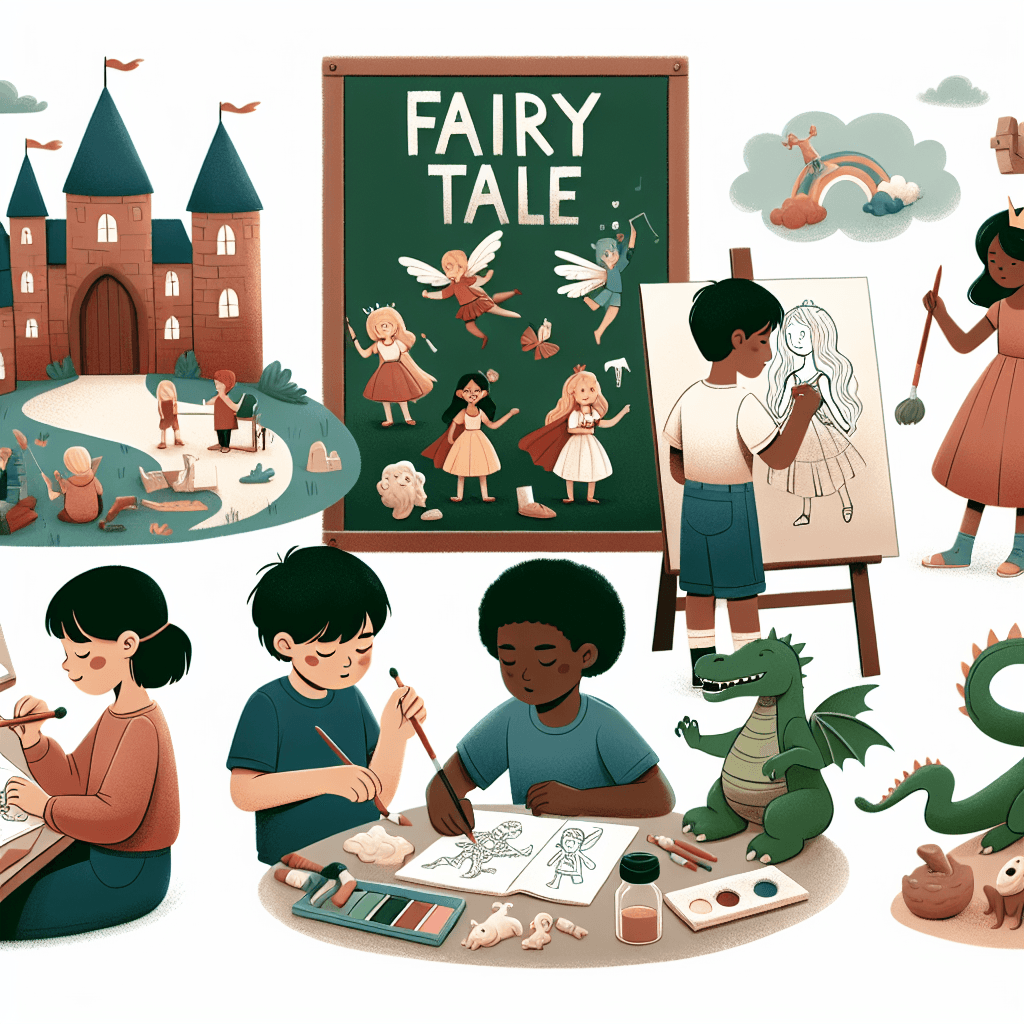
Illustrated Fairy Tale Creation
Inquiry Framework
Question Framework
Driving Question
The overarching question that guides the entire project.How can we create an illustrated fairy tale book by developing unique themes, characters, and plots that reflect cultural values and enhance the storytelling experience?Essential Questions
Supporting questions that break down major concepts.- What are the key elements that make up a fairy tale?
- How can illustrations enhance the storytelling experience in a fairy tale?
- What techniques can be used to develop interesting characters and plots in a fairy tale?
- How do themes in fairy tales reflect cultural values and lessons?
Standards & Learning Goals
Learning Goals
By the end of this project, students will be able to:- Students will learn to construct a narrative by writing a complete fairy tale, including theme development, plot structure, and character creation.
- Students will understand the role of illustrations in storytelling and create drawings that enhance their written fairy tales.
- Students will identify key elements of fairy tales and analyze how these reflect cultural themes and values.
- Students will develop skills in planning, drafting, revising, and editing written narratives.
- Students will practice collaborative discussion techniques to improve writing processes and express ideas clearly.
Common Core State Standards
Entry Events
Events that will be used to introduce the project to studentsCreate Your Own Fairy Tale Creature
Challenge students to create a new fairy tale creature using art supplies. Students will not only illustrate but also describe the creature’s characteristics and role in a fairy tale, providing a springboard for character development and plot creation.Portfolio Activities
Portfolio Activities
These activities progressively build towards your learning goals, with each submission contributing to the student's final portfolio.Fantastic Creature Creation
Students will create their own unique fairy tale creature, developing both visual and descriptive elements to lay the foundation for character creation in their fairy tale.Steps
Here is some basic scaffolding to help students complete the activity.Final Product
What students will submit as the final product of the activityA detailed illustration and descriptive paragraph of a fairy tale creature.Alignment
How this activity aligns with the learning objectives & standardsAligns with CCSS.ELA-LITERACY.W.3.3 by developing imagined characters and CCSS.ELA-LITERACY.SL.3.1 through class presentation.Magical Plot Planning
Students will craft the plot of their fairy tale, ensuring it contains clear event sequences and incorporates their created creature.Steps
Here is some basic scaffolding to help students complete the activity.Final Product
What students will submit as the final product of the activityA structured narrative outline of the fairy tale plot.Alignment
How this activity aligns with the learning objectives & standardsMeets CCSS.ELA-LITERACY.W.3.3 by developing a coherent narrative and CCSS.ELA-LITERACY.W.3.5 through planning and drafting.Theme and Cultural Reflection Workshop
Students will explore and incorporate learned cultural values and lessons into their fairy tales, enhancing theme development.Steps
Here is some basic scaffolding to help students complete the activity.Final Product
What students will submit as the final product of the activityA paragraph explaining the fairy tale's theme and its cultural reflections.Alignment
How this activity aligns with the learning objectives & standardsSupports CCSS.ELA-LITERACY.RL.3.2 by analyzing cultural values and CCSS.ELA-LITERACY.L.3.3 through detailed writing.Illustration Inspiration Station
Students will create illustrations that enhance their written fairy tales, focusing on visual storytelling techniques.Steps
Here is some basic scaffolding to help students complete the activity.Final Product
What students will submit as the final product of the activityA series of illustrations that depict key scenes from the fairy tale.Alignment
How this activity aligns with the learning objectives & standardsAligns with the project’s art integration goals and supports CCSS.ELA-LITERACY.W.3.3 by enhancing the narrative with visuals.Peer Review and Revision Rally
Students will engage in peer reviews to refine their fairy tales, focusing on narrative clarity and grammatical accuracy.Steps
Here is some basic scaffolding to help students complete the activity.Final Product
What students will submit as the final product of the activityA polished version of the fairy tale ready for publication.Alignment
How this activity aligns with the learning objectives & standardsMeets CCSS.ELA-LITERACY.W.3.5 by revising and editing with support from peers, and CCSS.ELA-LITERACY.L.3.3 by applying language conventions.Rubric & Reflection
Portfolio Rubric
Grading criteria for assessing the overall project portfolioIllustrated Fairy Tale Creation Rubric
Creativity and Originality
Evaluates the student's ability to create unique fairy tale elements, including characters, settings, and plots, through both written and visual mediums.Unique Character and Plot Creation
Assessing the originality and coherence of characters and plots developed for the fairy tale.
Exemplary
4 PointsCharacters and plot are highly original, imaginative, and detailed, with clear contributions to the theme and setting.
Proficient
3 PointsCharacters and plot are original and coherent, contributing appropriately to the theme and setting.
Developing
2 PointsCharacters and plot show some originality but lack coherence or depth, with limited contribution to the theme and setting.
Beginning
1 PointsCharacters and plot are minimally original or coherent, poorly contributing to the theme and setting.
Illustration Quality
Assessing the quality and creativity of illustrations developed to enhance the fairy tale.
Exemplary
4 PointsIllustrations are creative, detailed, and deeply enhance the fairy tale, effectively conveying moods and themes.
Proficient
3 PointsIllustrations are creative and enhance the fairy tale, effectively conveying moods and themes.
Developing
2 PointsIllustrations show some creativity and partially enhance the fairy tale, inconsistently conveying moods and themes.
Beginning
1 PointsIllustrations lack creativity and do not effectively enhance the fairy tale or convey moods and themes.
Narrative Development
Assesses the effectiveness of narrative structure, including coherence, sequence of events, and incorporation of a central theme.Coherent and Engaging Plot
Evaluating plot coherence, structure, and ability to engage the reader.
Exemplary
4 PointsPlot is highly coherent and engaging with well-developed sequences that captivate the reader from start to finish.
Proficient
3 PointsPlot is coherent and engaging with clear sequences that generally sustain reader interest.
Developing
2 PointsPlot has some coherent sequences but may lack engagement and sufficient structure.
Beginning
1 PointsPlot is incoherent with disconnected sequences and fails to engage the reader.
Cultural Reflection and Theme
Evaluates student's understanding and incorporation of cultural themes and values into their fairy tale narrative.Cultural Theme Integration
Assesses how well cultural themes and values are integrated into the fairy tale.
Exemplary
4 PointsCultural themes and values are seamlessly integrated, enhancing the fairy tale's depth and reflecting thoughtful analysis.
Proficient
3 PointsCultural themes and values are well integrated, contributing to the fairy tale's depth and showing good analysis.
Developing
2 PointsCultural themes and values are present but weakly integrated, showing superficial analysis.
Beginning
1 PointsCultural themes and values are minimally present or not integrated, showing poor analysis.
Collaboration and Reflection
Assesses engagement in peer review, ability to incorporate feedback, and demonstration of collaborative skills.Peer Review Engagement
Evaluates active participation in peer reviews and effective use of peer feedback to improve the fairy tale.
Exemplary
4 PointsActively engages in peer reviews with insightful contributions and effectively uses feedback to significantly enhance the fairy tale.
Proficient
3 PointsEngages in peer reviews with thoughtful contributions and uses feedback to improve the fairy tale.
Developing
2 PointsParticipates minimally in peer reviews with basic contributions and uses feedback with limited impact on the fairy tale.
Beginning
1 PointsLacks engagement in peer reviews and makes minimal use of feedback to improve the fairy tale.