
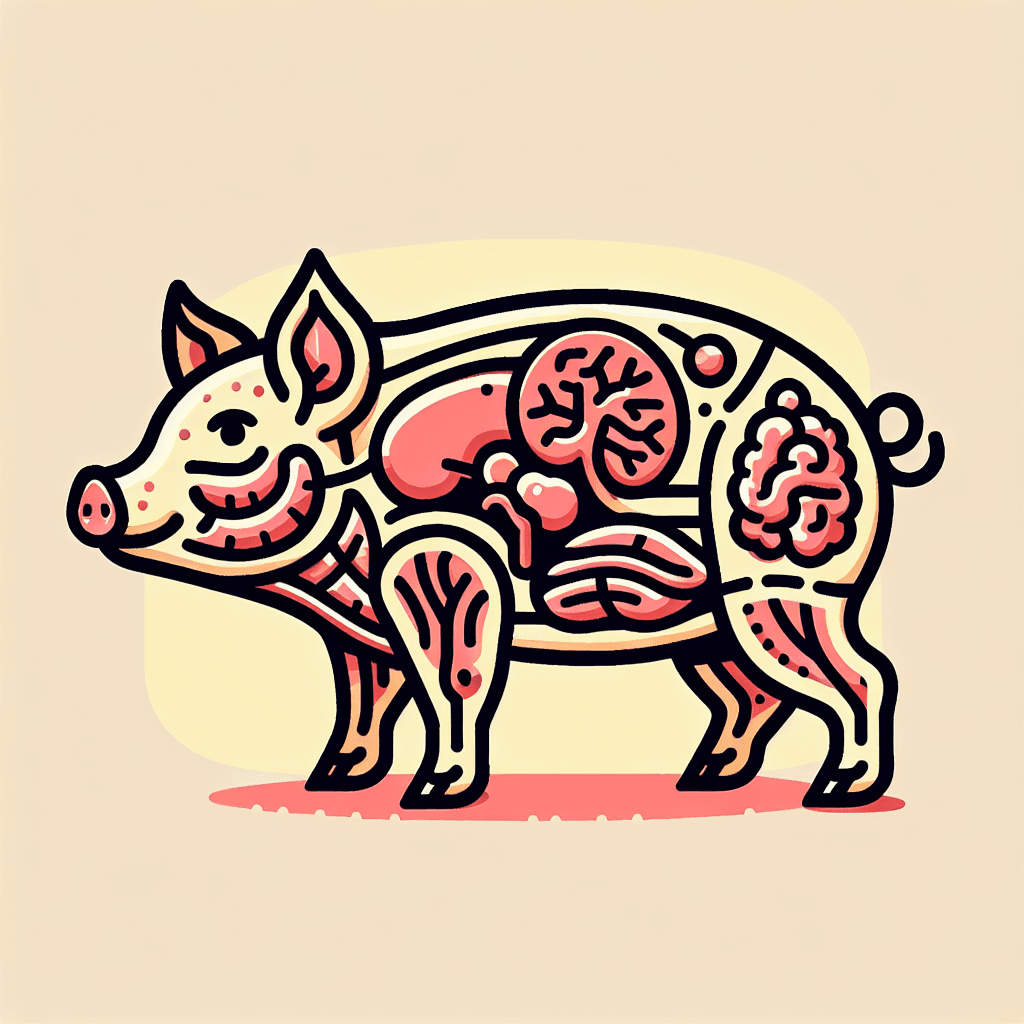
Illustrating Pig Anatomy: A Science and Art Fusion
Inquiry Framework
Question Framework
Driving Question
The overarching question that guides the entire project.How can artistic techniques be used to enhance our understanding of pig anatomy and its significance in biology and medicine, while considering the ethical implications of illustrating animal anatomy?Essential Questions
Supporting questions that break down major concepts.- What are the major anatomical structures of a pig, and what are their functions?
- How can artistic techniques be used to accurately represent biological structures?
- Why is understanding pig anatomy important in the broader context of biology and medicine?
- What are the ethical considerations when studying and illustrating animal anatomy?
Standards & Learning Goals
Learning Goals
By the end of this project, students will be able to:- Students will identify and describe the major anatomical structures of a pig and their functions.
- Students will apply artistic techniques to accurately represent biological structures of a pig.
- Students will explore the significance of understanding pig anatomy in the context of biology and medicine.
- Students will analyze ethical considerations related to studying and illustrating animal/anatomical subjects.
NGSS
Common Core Standards
Entry Events
Events that will be used to introduce the project to studentsAnatomy in Fashion
Host a fashion show where models wear costumes representing different parts of pig anatomy. This avant-garde approach allows students to visually explore anatomy in a relatable fashion context, prompting them to create their anatomical art through a similar lens of creativity.Celebrity Chef Anatomy
Invite a local chef to perform a cooking demonstration involving pig parts, highlighting their anatomical significance. Students see the culinary world connect with biology, sparking curiosity about anatomy and compelling them to depict this understanding artistically.Portfolio Activities
Portfolio Activities
These activities progressively build towards your learning goals, with each submission contributing to the student's final portfolio.Anatomy Sketching Workshop
Students begin by sketching basic anatomical structures of a pig, focusing on the major parts and their functions. This helps them build foundational knowledge and improve their observational drawing skills.Steps
Here is some basic scaffolding to help students complete the activity.Final Product
What students will submit as the final product of the activityA series of labeled sketches illustrating major pig anatomical structures.Alignment
How this activity aligns with the learning objectives & standardsAligns with HS-LS1-2 (Illustrate the hierarchical organization of interacting systems in multicellular organisms).3D Pig Anatomy Mapping
Students translate their sketches into 3D models using clay or digital modeling software. This activity develops spatial awareness and a deeper understanding of the interaction between anatomical structures.Steps
Here is some basic scaffolding to help students complete the activity.Final Product
What students will submit as the final product of the activityA 3D model of pig anatomical structures with labels explaining functions.Alignment
How this activity aligns with the learning objectives & standardsSupports HS-LS1-2 by creating models to illustrate biological structures.Artistic Anatomy Exhibit
Students create a final artistic piece depicting pig anatomy, integrating creative techniques to highlight the importance of these biological structures in a biologically and ethically informed context.Steps
Here is some basic scaffolding to help students complete the activity.Final Product
What students will submit as the final product of the activityAn educational art piece representing pig anatomy, with explanatory text.Alignment
How this activity aligns with the learning objectives & standardsAligns with HS-LS1-2 and CCSS.ELA-LITERACY.W.11-12.2, as students illustrate and communicate biological structures creatively and accurately.Rubric & Reflection
Portfolio Rubric
Grading criteria for assessing the overall project portfolioPig Anatomy Art Project Assessment
Scientific Understanding and Application
Assessment of student's comprehension of pig anatomy and ability to apply this understanding in art.Comprehension of Anatomical Structures
Evaluates the student's knowledge of major pig anatomical structures and their functions.
Exemplary
4 PointsDemonstrates a sophisticated understanding of all major pig anatomical structures and their functions, with no inaccuracies.
Proficient
3 PointsShows thorough understanding of most major pig anatomical structures and their functions, with minor inaccuracies.
Developing
2 PointsShows emerging understanding of some major pig anatomical structures with notable inaccuracies.
Beginning
1 PointsShows limited understanding of major pig anatomical structures with significant inaccuracies.
Application in Art
Assesses the student's ability to apply anatomical knowledge creatively and accurately in their art.
Exemplary
4 PointsApplies anatomical knowledge innovatively and accurately, showcasing a deep integration of concepts in the artistic medium.
Proficient
3 PointsApplies anatomical knowledge accurately with effective integration into the artistic medium.
Developing
2 PointsApplies anatomical knowledge with partial accuracy and inconsistent integration with artistic elements.
Beginning
1 PointsStruggles to apply anatomical knowledge accurately in an artistic context, with minimal integration of concepts.
Artistic Expression and Communication
Evaluation of the creativity and clarity of the artistic and explanatory components.Creativity and Artistic Technique
Evaluates the originality and technical execution of the artistic piece.
Exemplary
4 PointsDemonstrates exceptional creativity and flawless execution of artistic techniques, resulting in a highly impactful piece.
Proficient
3 PointsShows creativity and solid execution of artistic techniques, resulting in a compelling piece.
Developing
2 PointsShows some creativity with basic execution of artistic techniques, resulting in a piece of varying impact.
Beginning
1 PointsShows minimal creativity and technical execution, resulting in an underdeveloped piece.
Clarity and Depth of Explanation
Assesses the clarity and depth of the explanatory text accompanying the art piece.
Exemplary
4 PointsProvides a comprehensive, well-structured explanation that thoroughly illuminates artistic and biological concepts.
Proficient
3 PointsPresents a clear and coherent explanation that effectively covers artistic and biological concepts.
Developing
2 PointsOffers a basic explanation that partially addresses artistic and biological concepts but lacks depth.
Beginning
1 PointsProvides a limited explanation lacking clarity and comprehensiveness of concepts.
Ethical Consideration
Assessment of student's understanding and integration of ethical issues related to illustrating animal anatomy.Ethical Understanding and Analysis
Evaluates the student's ability to identify and reflect on the ethical considerations in studying and illustrating pig anatomy.
Exemplary
4 PointsOffers insightful analysis of ethical issues, highlighting thoughtful decision-making processes in artistic work.
Proficient
3 PointsProvides clear recognition and consideration of ethical issues, reflecting thoughtful engagement with the topic.
Developing
2 PointsShows basic awareness of ethical issues with limited analysis.
Beginning
1 PointsPresents minimal awareness of ethical issues without detailed analysis.