
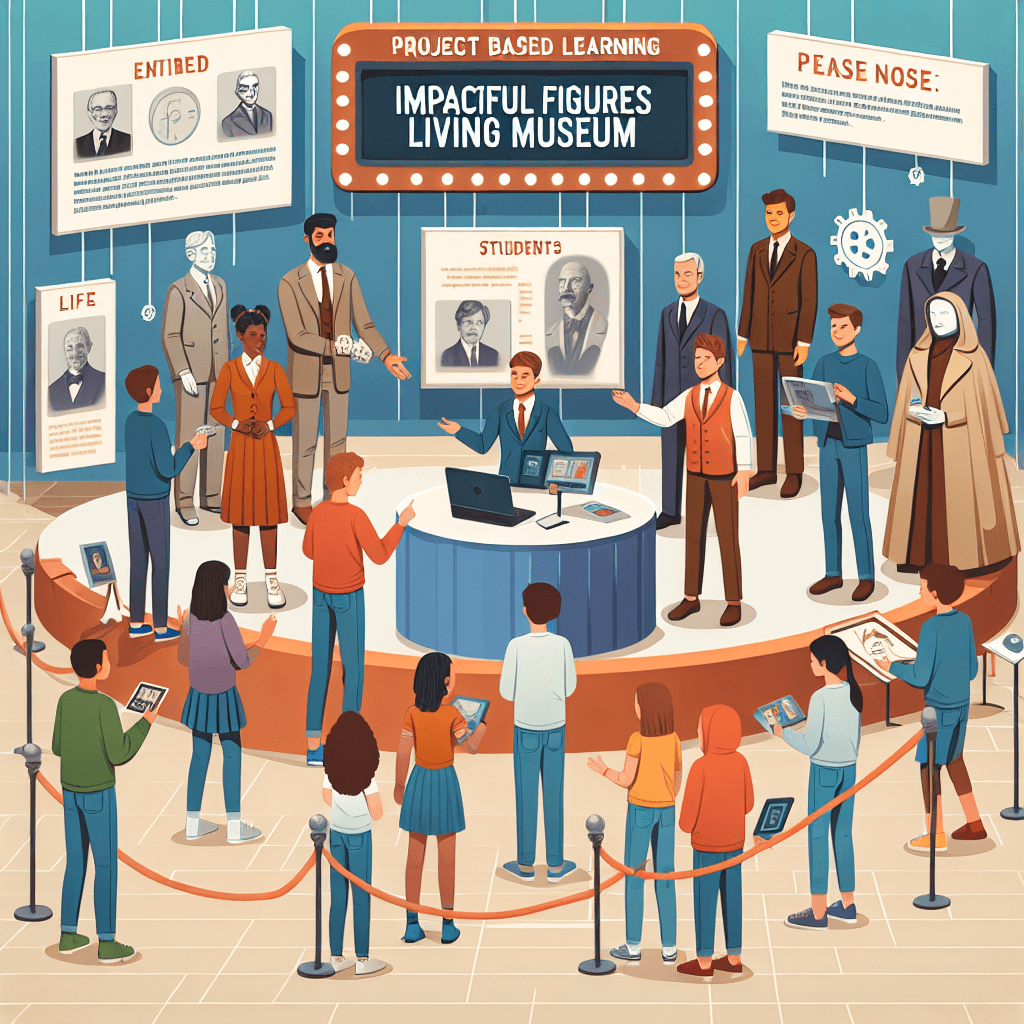
Impactful Figures Living Museum
Inquiry Framework
Question Framework
Driving Question
The overarching question that guides the entire project.How can we use technology to create an engaging living museum that showcases individuals from history who have had a significant impact on the world today?Essential Questions
Supporting questions that break down major concepts.- Who are some individuals from history that have had a significant impact on today's world?
- How can stories from the past help us understand the present?
- What makes someone influential or impactful?
- In what ways can technology help us present historical information in engaging ways?
- How do different cultures and societies remember influential individuals throughout history?
Standards & Learning Goals
Learning Goals
By the end of this project, students will be able to:- Students will research and identify individuals from history who have significantly impacted today's world.
- Students will analyze the contributions of influential historical figures and articulate their relevance to contemporary society.
- Students will utilize technology to design and create an interactive living museum exhibit.
- Students will develop skills in storytelling and presentation to effectively communicate historical information.
- Students will explore how different cultures remember and honor influential individuals, fostering cross-cultural understanding.
Common Core Standards
ISTE Standards for Students
Entry Events
Events that will be used to introduce the project to studentsImpact Interviews Live!
Students take on roles of modern journalists given exclusive 'interviews' with historical figures. Using primary source materials, they draft questions and role-play interviews with classmates acting as the historical figures, exploring how these individuals influenced the past and the present.Portfolio Activities
Portfolio Activities
These activities progressively build towards your learning goals, with each submission contributing to the student's final portfolio.Storytelling Studio
Apply storytelling techniques to enhance museum exhibit presentations, refining communication skills.Steps
Here is some basic scaffolding to help students complete the activity.Final Product
What students will submit as the final product of the activityA rehearsed storytelling presentation ready for museum visitors.Alignment
How this activity aligns with the learning objectives & standardsAligned with CCSS.ELA-Literacy.SL.6.4 by focusing on logical sequencing and engaging presentation skills.Impact Influencers Research Quest
Students embark on a research quest to identify a historical figure who significantly impacted today's world, aligning with standards on gathering relevant information and summarizing it.Steps
Here is some basic scaffolding to help students complete the activity.Final Product
What students will submit as the final product of the activityA written summary and evaluation of the historical figure’s contributions.Alignment
How this activity aligns with the learning objectives & standardsAligned with CCSS.ELA-Literacy.RI.6.2 and CCSS.ELA-Literacy.W.6.8, focusing on identifying central themes and credible information synthesis.Historical Impact Analysis
Develop insights into the historical figure's contributions, focusing on writing explanatory texts.Steps
Here is some basic scaffolding to help students complete the activity.Final Product
What students will submit as the final product of the activityAn essay analyzing the historical impact and relating it to present-day influence.Alignment
How this activity aligns with the learning objectives & standardsSupports CCSS.ELA-Literacy.W.6.2 by guiding the writing and organization of explanatory content.Rubric & Reflection
Portfolio Rubric
Grading criteria for assessing the overall project portfolioLiving Museum Project Rubric
Research & Information Synthesis
Evaluates students' ability to gather, assess, and synthesize information about historical figures.Source Selection
Quality and credibility of sources selected for research on historical figures.
Exemplary
4 PointsSelects highly credible and varied sources, ensuring a balanced perspective of historical figures.
Proficient
3 PointsSelects credible sources with some variety to support research.
Developing
2 PointsSelects limited or partially credible sources with some weaknesses in variety.
Beginning
1 PointsStruggles to select credible sources; lacks variety.
Summarization & Central Ideas
Ability to determine and summarize central ideas without bias from the collected information.
Exemplary
4 PointsAccurately synthesizes and summarizes central ideas with clarity and without personal bias.
Proficient
3 PointsSummarizes central ideas with minor bias or clarity issues.
Developing
2 PointsIdentifies central ideas inconsistently; summarization lacks clarity.
Beginning
1 PointsStruggles to identify or summarize central ideas effectively.
Writing & Analysis
Assesses students' ability to organize thoughts and articulate the historical figure's impact in writing.Organization & Clarity
Logical flow and clarity of writing in presenting historical analysis.
Exemplary
4 PointsPresents information with excellent logical flow and exceptional clarity.
Proficient
3 PointsPresents information with logical flow and good clarity.
Developing
2 PointsPresents information with some logical or clarity issues.
Beginning
1 PointsStruggles with logical flow and clarity; writing is hard to follow.
Analytical Depth
Depth of analysis in articulating the figure's historical impact.
Exemplary
4 PointsProvides insightful analysis, showing a deep understanding of historical impact.
Proficient
3 PointsProvides clear analysis with some depth.
Developing
2 PointsProvides basic analysis with limited depth.
Beginning
1 PointsStruggles to provide meaningful analysis; lacks depth.
Presentation & Storytelling
Evaluates the presentation skills and storytelling techniques in delivering historical content.Engagement & Delivery
Effectiveness of the presentation in engaging the audience and delivering content clearly.
Exemplary
4 PointsDelivers an exceptionally engaging presentation, using voice, engagement strategies, and clarity.
Proficient
3 PointsDelivers a clear and engaging presentation with good use of voice.
Developing
2 PointsPresentation is somewhat engaging but lacks consistency in clarity.
Beginning
1 PointsStruggles to engage audience; presentation lacks clarity.
Use of Multimedia
Integration and effectiveness of multimedia elements to enhance storytelling.
Exemplary
4 PointsIntegrates multimedia elements seamlessly, greatly enhancing the storytelling experience.
Proficient
3 PointsUses multimedia effectively to support the presentation.
Developing
2 PointsUses some multimedia elements, but they may not fully support the storytelling.
Beginning
1 PointsLimited use of multimedia elements; they minimally support the storytelling.
Technology Integration
Assesses the use of technology tools to customize presentations for the intended audience.Customization & Audience Appropriateness
Use of technology to customize the message and appeal to the audience.
Exemplary
4 PointsCustomizes presentation with technology to fully engage and resonate with the audience.
Proficient
3 PointsUses technology effectively to tailor the presentation to the audience.
Developing
2 PointsAttempts to use technology for customization, but effectiveness is limited.
Beginning
1 PointsStruggles to use technology to engage the audience appropriately.