
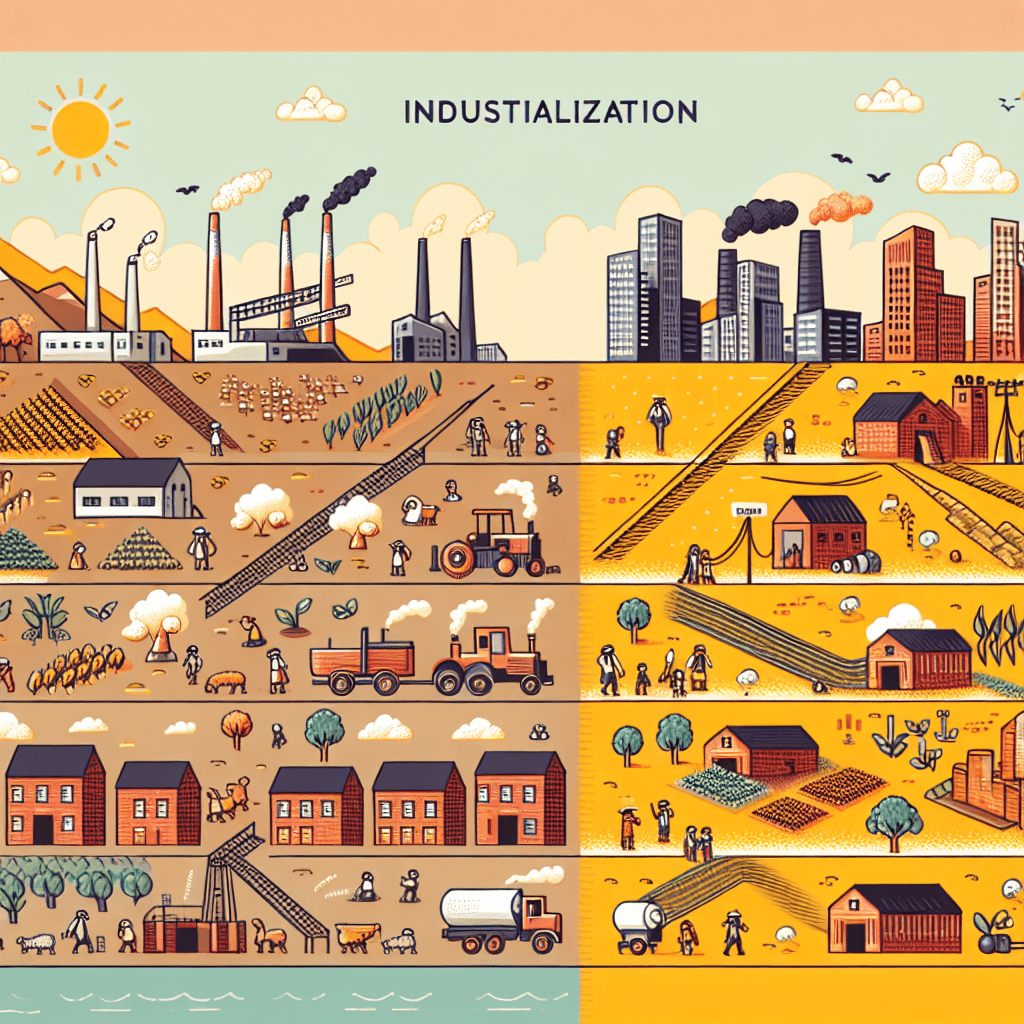
Industrialization's Impact: Life, Labor, and The Jungle
Inquiry Framework
Question Framework
Driving Question
The overarching question that guides the entire project.How did the drive for industrial progress transform American society, and to what extent did works like Upton Sinclair's 'The Jungle' ignite social and political reforms in response to its human cost?Essential Questions
Supporting questions that break down major concepts.- How did industrialization impact urban environments and living conditions?
- In what ways did industrialization change the nature of work and the lives of workers?
- How did Upton Sinclair's 'The Jungle' expose the realities of working conditions and food safety during the industrial era?
- What were the major social and political responses to the problems highlighted in 'The Jungle' and other critiques of industrial society?
Standards & Learning Goals
Learning Goals
By the end of this project, students will be able to:- Understand the effects of industrialization on living conditions.
- Understand the effects of industrialization on working conditions.
- Analyze the portrayal of working conditions in Upton Sinclair’s The Jungle.
- Analyze the portrayal of food safety in Upton Sinclair’s The Jungle.
- Analyze the social and political reforms that occurred in response to the human cost of industrial progress.
Entry Events
Events that will be used to introduce the project to studentsThe Jungle Escape Room
Students enter a classroom transformed into a 1906 Chicago tenement and meatpacking plant. They must solve puzzles based on excerpts from *The Jungle* and historical data to "escape" and reveal the true human cost of industrialization, fostering empathy and critical thinking.Portfolio Activities
Portfolio Activities
These activities progressively build towards your learning goals, with each submission contributing to the student's final portfolio.'The Jungle' Unveiled: A Literary Analysis of Food Safety
Students will conduct a close reading of specific passages from 'The Jungle' to identify and analyze Sinclair's portrayal of food safety practices (or lack thereof) in the meatpacking industry. They will examine the literary techniques used to expose these conditions and their impact on public perception.Steps
Here is some basic scaffolding to help students complete the activity.Final Product
What students will submit as the final product of the activityAn analytical essay exploring Sinclair's portrayal of food safety in 'The Jungle,' examining the literary techniques used and the historical accuracy of his depictions.Alignment
How this activity aligns with the learning objectives & standardsAddresses the learning goal: Analyze the portrayal of food safety in Upton Sinclair’s The Jungle.From Outcry to Action: Charting Social and Political Reforms
Students will research and analyze the social and political reforms that emerged in response to the issues exposed in 'The Jungle' and other critiques of industrial society. They will create a timeline illustrating the sequence of events, key figures, and legislative changes.Steps
Here is some basic scaffolding to help students complete the activity.Final Product
What students will submit as the final product of the activityA detailed timeline that illustrates the social and political reforms spurred by 'The Jungle' and other critiques of industrial society, highlighting key events, figures, and legislative changes.Alignment
How this activity aligns with the learning objectives & standardsAddresses the learning goal: Analyze the social and political reforms that occurred in response to the human cost of industrial progress.The Working Life: Voices from the Factory Floor
Students will explore the experiences of industrial workers through primary and secondary sources. They will analyze excerpts from 'The Jungle,' oral histories, and statistical data to understand the daily lives, challenges, and dangers faced by workers.Steps
Here is some basic scaffolding to help students complete the activity.Final Product
What students will submit as the final product of the activityA multimedia presentation or short documentary illustrating the daily lives, challenges, and dangers faced by industrial workers, integrating literary excerpts, historical accounts, and statistical evidence.Alignment
How this activity aligns with the learning objectives & standardsAddresses the learning goal: Understand the effects of industrialization on working conditions. Analyzes the portrayal of working conditions in Upton Sinclair’s The Jungle.Urban Landscape Analysis: Mapping Industrial Impact
Students will investigate the physical transformation of urban environments due to industrialization. Focusing on Chicago in the early 1900s, they will map changes in population density, housing types, and infrastructure.Steps
Here is some basic scaffolding to help students complete the activity.Final Product
What students will submit as the final product of the activityAn annotated map of Chicago showing the spatial relationship between industrial sites, residential areas, and changes in population density, accompanied by a reflective essay.Alignment
How this activity aligns with the learning objectives & standardsAddresses the learning goal: Understand the effects of industrialization on living conditions. Connects to understanding the transformation of urban environments due to industrialization.Rubric & Reflection
Portfolio Rubric
Grading criteria for assessing the overall project portfolioAnalysis of 'The Jungle' and Industrialization's Impact
Understanding of Industrialization's Effects
Demonstrates comprehension of the social, economic, and environmental consequences of industrialization on urban life and working conditions.Impact on Living Conditions
Assesses the student's understanding of how industrialization affected urban environments and the living conditions of its inhabitants.
Exemplary
4 PointsDemonstrates a sophisticated understanding of the multifaceted impacts of industrialization on urban living conditions, providing specific examples and insightful analysis.
Proficient
3 PointsDemonstrates a thorough understanding of the effects of industrialization on urban living conditions, providing clear examples and analysis.
Developing
2 PointsShows an emerging understanding of the effects of industrialization on urban living conditions, providing some examples but lacking in-depth analysis.
Beginning
1 PointsShows a limited understanding of the effects of industrialization on urban living conditions, with few or no examples provided.
Impact on Working Conditions
Assesses the student's understanding of how industrialization affected the nature of work, worker safety, and the lives of laborers.
Exemplary
4 PointsProvides a nuanced analysis of how industrialization transformed working conditions, including detailed insights into worker safety, wages, and the overall quality of life for laborers.
Proficient
3 PointsDemonstrates a clear understanding of the impact of industrialization on working conditions, providing specific details about worker safety, wages, and the lives of laborers.
Developing
2 PointsShows an emerging understanding of the impact of industrialization on working conditions, but provides limited details or analysis.
Beginning
1 PointsDemonstrates a limited understanding of the impact of industrialization on working conditions, lacking specific details or analysis.
Analysis of 'The Jungle'
Evaluates the student's ability to analyze Upton Sinclair's 'The Jungle' as a literary and historical document, focusing on its portrayal of food safety and working conditions.Portrayal of Food Safety
Assesses the student's ability to analyze Sinclair's depiction of food safety practices (or lack thereof) in 'The Jungle,' and how literary techniques contribute to its impact.
Exemplary
4 PointsOffers an insightful and comprehensive analysis of Sinclair's portrayal of food safety, demonstrating a deep understanding of literary techniques and their impact on the reader.
Proficient
3 PointsProvides a thorough analysis of Sinclair's portrayal of food safety, identifying relevant literary techniques and explaining their impact.
Developing
2 PointsShows an emerging understanding of Sinclair's portrayal of food safety, but may not fully analyze the literary techniques used or their impact.
Beginning
1 PointsDemonstrates a limited understanding of Sinclair's portrayal of food safety, with little or no analysis of literary techniques.
Portrayal of Working Conditions
Assesses the student's ability to analyze Sinclair's depiction of working conditions in 'The Jungle,' and how literary techniques contribute to its impact.
Exemplary
4 PointsOffers an insightful and comprehensive analysis of Sinclair's portrayal of working conditions, demonstrating a deep understanding of literary techniques and their impact on the reader.
Proficient
3 PointsProvides a thorough analysis of Sinclair's portrayal of working conditions, identifying relevant literary techniques and explaining their impact.
Developing
2 PointsShows an emerging understanding of Sinclair's portrayal of working conditions, but may not fully analyze the literary techniques used or their impact.
Beginning
1 PointsDemonstrates a limited understanding of Sinclair's portrayal of working conditions, with little or no analysis of literary techniques.
Synthesis and Application
Evaluates the student's ability to synthesize information from 'The Jungle,' historical sources, and other materials to demonstrate a comprehensive understanding of the era and its reforms.Historical Context
Assesses the student's ability to place 'The Jungle' within its historical context, demonstrating an understanding of the social, economic, and political climate of the time.
Exemplary
4 PointsDemonstrates a sophisticated understanding of the historical context surrounding 'The Jungle,' providing nuanced insights into the social, economic, and political forces at play.
Proficient
3 PointsDemonstrates a thorough understanding of the historical context surrounding 'The Jungle,' providing clear examples of the social, economic, and political climate of the time.
Developing
2 PointsShows an emerging understanding of the historical context surrounding 'The Jungle,' but may lack specific details or in-depth analysis.
Beginning
1 PointsDemonstrates a limited understanding of the historical context surrounding 'The Jungle,' with few or no specific details provided.
Impact on Reforms
Assesses the student's ability to analyze the social and political reforms that occurred in response to 'The Jungle' and other critiques of industrial society.
Exemplary
4 PointsProvides an insightful and comprehensive analysis of the social and political reforms that were spurred by 'The Jungle,' including a nuanced understanding of their long-term impact.
Proficient
3 PointsProvides a thorough analysis of the social and political reforms that were spurred by 'The Jungle,' providing clear examples of their impact.
Developing
2 PointsShows an emerging understanding of the social and political reforms that were spurred by 'The Jungle,' but may lack specific details or in-depth analysis.
Beginning
1 PointsDemonstrates a limited understanding of the social and political reforms that were spurred by 'The Jungle,' with few or no specific details provided.