
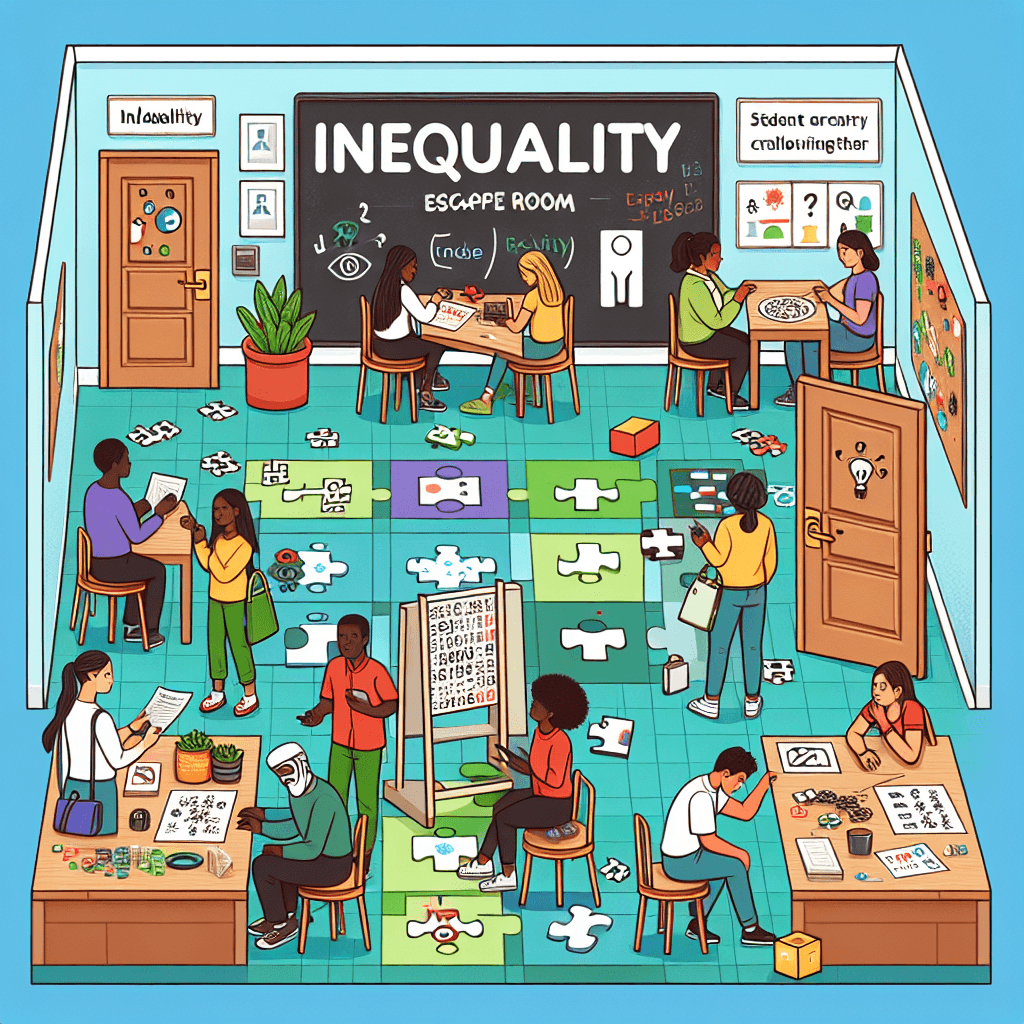
Inequality Escape Room Challenge
Inquiry Framework
Question Framework
Driving Question
The overarching question that guides the entire project.How can we creatively design an escape room that uses mathematical inequalities to challenge participants and enhance their problem-solving skills?Essential Questions
Supporting questions that break down major concepts.- What are inequalities and how are they represented mathematically?
- How can inequalities be used to solve real-world problems?
- In what ways can solving inequalities be like solving a puzzle?
- How do different inequality symbols change the solutions to a problem?
- How can learning about inequalities enhance our problem-solving skills in everyday situations?
- What strategies can we use to represent and solve inequalities effectively?
Standards & Learning Goals
Learning Goals
By the end of this project, students will be able to:- Students will understand and represent mathematical inequalities.
- Students will apply inequalities to solve real-world problems.
- Students will enhance problem-solving skills through creative puzzle design.
- Students will interpret and graph solutions to inequality problems.
- Students will collaborate and communicate effectively to design and solve escape room puzzles.
Common Core State Standards
Entry Events
Events that will be used to introduce the project to studentsReality TV Challenges
Design a project launch event mimicking popular reality TV challenges where contestants (students) solve puzzles using inequalities to 'survive' or 'advance' in the game. This immersive experience draws connections to shows they watch and enjoy, converting entertainment into education.Digital Inequality Adventure
Students are introduced to an augmented reality app that depicts a digital escape room where they must solve real-life scenarios using inequalities, such as budgeting for a trip or planning a community event under constraints. This digital twist allows tech-savvy students to engage with their devices, providing a modern touch to math problems.Inequality Art Installation
Host a challenge where students use inequalities to design and create an art installation that represents mathematical concepts visually. Students can work with artists or art teachers to make math 'visible' and tangible, combining creativity with analytical skills.Portfolio Activities
Portfolio Activities
These activities progressively build towards your learning goals, with each submission contributing to the student's final portfolio.Inequality Puzzle Designer
Students will design their first puzzle using mathematical inequalities, learning to construct simple equations from word problems.Steps
Here is some basic scaffolding to help students complete the activity.Final Product
What students will submit as the final product of the activityThe students will create a draft puzzle containing one inequality and supporting clues.Alignment
How this activity aligns with the learning objectives & standardsCCSS.MATH.CONTENT.7.EE.B.4 - Use variables to represent quantities and construct simple inequalities to solve problems.Collaborative Inequality Challenge
Students work in teams to refine their puzzle, ensuring the mathematical accuracy and clarity of instructions.Steps
Here is some basic scaffolding to help students complete the activity.Final Product
What students will submit as the final product of the activityA fully developed puzzle with an answer key that explains the solution process.Alignment
How this activity aligns with the learning objectives & standardsCCSS.MATH.CONTENT.7.EE.B.4.B - Students solve word problems leading to inequalities and interpret solutions.Inequality Escape Room Construction
Students integrate all completed puzzles to construct their final escape room design, testing and refining the entire experience.Steps
Here is some basic scaffolding to help students complete the activity.Final Product
What students will submit as the final product of the activityA functioning escape room comprised of student-created puzzles that accurately incorporates inequalities.Alignment
How this activity aligns with the learning objectives & standardsCCSS.MATH.CONTENT.7.EE.A.1 - Manipulating inequalities using properties of operation, integrating them into comprehensive escape room puzzles.Rubric & Reflection
Portfolio Rubric
Grading criteria for assessing the overall project portfolioSeventh Grade Inequality Escape Room Rubric
Understanding and Representation of Inequalities
Assessing student's comprehension and ability to accurately represent mathematical inequalities from real-world scenarios.Mathematical Accuracy
Ability to correctly form inequalities and solve them accurately from given scenarios.
Exemplary
4 PointsStudent consistently demonstrates the ability to accurately represent and solve inequalities, with no errors detected in the interpretation of scenarios or formation of inequalities.
Proficient
3 PointsStudent generally forms inequalities accurately from scenarios, with minor errors that do not impact the solution significantly.
Developing
2 PointsStudent shows basic ability to form inequalities, but inconsistencies and errors in their understanding lead to incorrect solutions occasionally.
Beginning
1 PointsStudent struggles to form correct inequalities, frequently resulting in incorrect solutions and misconceptions about scenarios.
Logical Reasoning
Evaluate how well students can use logical reasoning to develop clues that guide to solving the inequality puzzle.
Exemplary
4 PointsStudent designs highly logical and coherent clues that effectively guide users towards solving the inequality with agility and precision.
Proficient
3 PointsStudent designs logical clues with minor hiccups, generally guiding users to solutions satisfactorily.
Developing
2 PointsStudent designs somewhat vague clues that occasionally mislead or confuse users in solving the inequality.
Beginning
1 PointsStudent designs poorly structured clues that often fail to guide users effectively, lacking logical reasoning.
Problem-Solving and Application
Assessment of the student's ability to integrate inequalities into creative puzzles and apply them to solve real-world problems.Creative Application
Integration of inequalities into puzzles and real-world scenarios in a novel and engaging way.
Exemplary
4 PointsStudent seamlessly integrates inequalities creatively into puzzles, showcasing innovative thinking and real-world relevance.
Proficient
3 PointsStudent incorporates inequalities into puzzles that are interesting and relevant, with some creative aspects.
Developing
2 PointsStudent attempts to integrate inequalities into puzzles, though with limited creativity and real-world connection.
Beginning
1 PointsStudent's integration of inequalities into puzzles is minimal, lacking creativity and real-world applicability.
Solution Process and Interpretation
Ability to design and interpret the solution process clearly for solving the inequalities.
Exemplary
4 PointsThe solution process is structured logically, with precise interpretation and comprehensive explanations.
Proficient
3 PointsThe solution process is well-structured with mostly clear explanations and interpretations, though details may occasionally be lacking.
Developing
2 PointsThe solution process is moderately structured with some clear aspects, but often lacks consistency and depth in interpretation.
Beginning
1 PointsThe solution process is poorly structured and lacks clarity, with minimal interpretation or coherent explanation.
Collaboration and Communication
Evaluating students' abilities to work effectively in teams to develop and refine escape room puzzles, demonstrating effective communication and collaboration skills.Team Contribution
The extent and quality of student's contribution to the team project in developing and refining puzzles.
Exemplary
4 PointsStudent consistently contributes innovative ideas and takes lead roles in collaboration, significantly enhancing the project outcome.
Proficient
3 PointsStudent contributes effectively to discussions and teamwork, providing valuable insights towards the project.
Developing
2 PointsStudent participates in team activities with some useful contributions, yet inconsistently engaged in discussions.
Beginning
1 PointsStudent minimally participates in team efforts, with limited contribution and engagement.
Effective Communication
Clarity and effectiveness of communication in team settings and presentation of the final project.
Exemplary
4 PointsStudent communicates ideas clearly and effectively enhances the team's understanding and collaboration.
Proficient
3 PointsStudent communicates well within the team, ensuring most ideas are clearly expressed and understood.
Developing
2 PointsStudent inconsistently communicates ideas, occasionally leading to misunderstandings or incomplete understanding within the team.
Beginning
1 PointsStudent exhibits poor communication, frequently unclear, leading to confusion and misinterpretation.