
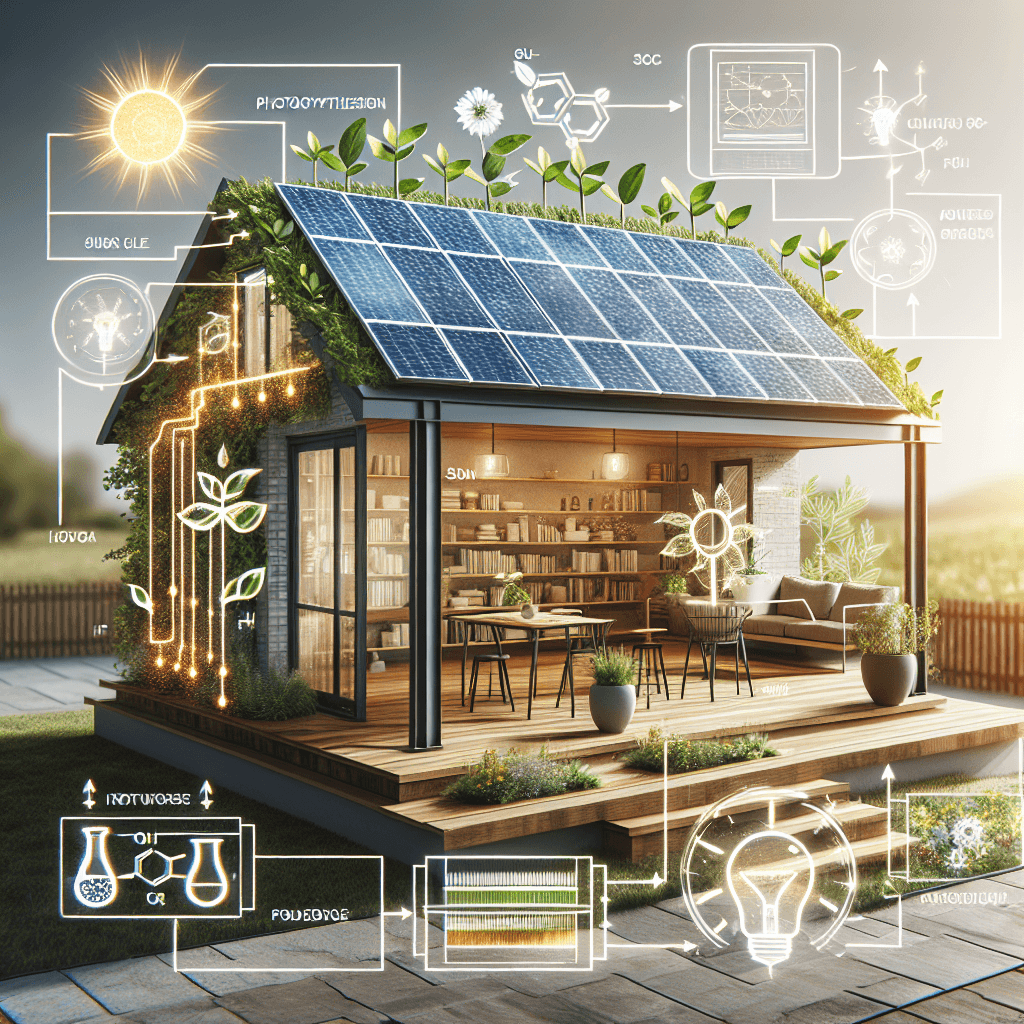
Innovative Sustainable Living through Photosynthesis
Inquiry Framework
Question Framework
Driving Question
The overarching question that guides the entire project.How can we innovate a sustainable living model that leverages the principles of photosynthesis to enhance the cycling of matter and flow of energy, while impacting environmental interactions and Earth's energy systems?Essential Questions
Supporting questions that break down major concepts.- What is photosynthesis and how does it contribute to the cycling of matter and energy in ecosystems?
- How can the principles of photosynthesis be applied to develop sustainable living models?
- In what ways does photosynthesis impact the environment and organism interactions within it?
- What innovative methods can be developed to enhance sustainability through understanding photosynthesis?
- How does the balance of photosynthesis and respiration affect the Earth's energy systems?
Standards & Learning Goals
Learning Goals
By the end of this project, students will be able to:- Understand and explain the process of photosynthesis and its importance in ecosystems.
- Apply principles of photosynthesis to innovate sustainable living models.
- Analyze the impact of photosynthesis on environmental interactions and Earth's energy systems.
- Evaluate methods to enhance sustainability through understanding photosynthesis.
- Develop and present a scientific explanation of the cycling of matter and flow of energy using photosynthesis.
Next Generation Science Standards (NGSS)
Entry Events
Events that will be used to introduce the project to studentsGreen Innovation Fair
Kick off the project with a school-wide fair where students explore booths showcasing cutting-edge technologies utilizing photosynthesis for sustainable solutions. Each booth features interactive components to engage students' curiosity and spark inquiry into how these innovations can affect their lives.Portfolio Activities
Portfolio Activities
These activities progressively build towards your learning goals, with each submission contributing to the student's final portfolio.Photosynthesis Detective
In this initial activity, students will delve into the mysteries of photosynthesis, unraveling its processes, and understanding its role in ecosystems. They will gather detailed information to form a foundational knowledge of how energy and matter cycle through photosynthesis.Steps
Here is some basic scaffolding to help students complete the activity.Final Product
What students will submit as the final product of the activityA comprehensive mind map outlining photosynthesis processes and its role in cycling matter and energy.Alignment
How this activity aligns with the learning objectives & standardsAligns with MS-LS1-6 to understand the role of photosynthesis in matter and energy flow.Photosynthesis Web Quest
Students will embark on a digital journey to discover real-world applications of photosynthesis in green technologies and sustainable solutions. They will explore curated online resources to gather diverse perspectives and compelling data, which forms the basis of their inspiration board project.Steps
Here is some basic scaffolding to help students complete the activity.Final Product
What students will submit as the final product of the activityAn inspiration board highlighting technologies and practices that apply photosynthesis for sustainable living, sourced from online research.Alignment
How this activity aligns with the learning objectives & standardsConnects with MS-ESS3-3 by exploring innovative methods for environmental impact reduction using photosynthesis through a digital platform.Ecosystem Energy Explorers
In this activity, students will dive deeper into ecosystems, examining the interaction between living and nonliving components, accentuated by photosynthesis.Steps
Here is some basic scaffolding to help students complete the activity.Final Product
What students will submit as the final product of the activityA model and presentation depicting the flow of energy and matter in ecosystems with a focus on photosynthesis.Alignment
How this activity aligns with the learning objectives & standardsSupports MS-LS2-3 by developing models to describe energy and matter cycling in ecosystems.Sustainable Design Challenge
Building on their knowledge of photosynthesis, students will design sustainable living models. They are challenged to devise innovative solutions that integrate the principles of photosynthesis, considering environmental and energy impacts.Steps
Here is some basic scaffolding to help students complete the activity.Final Product
What students will submit as the final product of the activityA proposal and prototype of a sustainable model leveraging photosynthesis.Alignment
How this activity aligns with the learning objectives & standardsAligns with MS-ESS3-3 and MS-LS2-5 by applying scientific principles and evaluating design solutions for sustainability.Global Impact Investigators
In this culminating activity, students will investigate broader environmental contexts and critiques regarding photosynthesis-related innovations, focusing on potential solutions for global sustainability challenges.Steps
Here is some basic scaffolding to help students complete the activity.Final Product
What students will submit as the final product of the activityA comprehensive report or presentation evaluating the potential global impact of photosynthesis-based innovations.Alignment
How this activity aligns with the learning objectives & standardsSupports MS-ESS3-5 by clarifying evidence on how photosynthesis influences global environmental factors.Rubric & Reflection
Portfolio Rubric
Grading criteria for assessing the overall project portfolioSustainable Living Project Rubric
Understanding of Photosynthesis
Assesses students' grasp of photosynthesis processes and their role in matter and energy cycles within ecosystems.Conceptual Understanding
Evaluates the depth of students' understanding of photosynthesis processes and their role in ecosystems.
Exemplary
4 PointsDemonstrates comprehensive and insightful understanding of photosynthesis and energy cycles, integrating complex concepts clearly.
Proficient
3 PointsShows a clear and thorough understanding of photosynthesis with accurate descriptions of its role in ecosystems.
Developing
2 PointsDisplays basic understanding with some misconceptions about photosynthesis processes and ecosystem interactions.
Beginning
1 PointsShows limited understanding of photosynthesis, with major misconceptions and lack of clarity on its role in ecosystems.
Application of Concepts
Measures ability to apply photosynthesis knowledge innovatively in sustainable models.
Exemplary
4 PointsApplies photosynthesis principles innovatively in sustainable designs, showing creativity and scientific accuracy.
Proficient
3 PointsAccurately applies photosynthesis concepts in models with clear connections to sustainability.
Developing
2 PointsApplies photosynthesis concepts with partial success in relation to sustainability, lacking innovation.
Beginning
1 PointsStruggles to apply photosynthesis principles to sustainability models.
Research and Information Synthesis
Assesses the quality of research conducted and ability to synthesize information into coherent formats.Research Depth
Evaluates the students’ ability to gather and utilize diverse sources during information gathering.
Exemplary
4 PointsEmploys extensive and varied resources, demonstrating deep engagement with rich, relevant content.
Proficient
3 PointsUses a range of relevant sources effectively, providing clear insights into project topics.
Developing
2 PointsIncorporates limited sources with some relevance but lacks depth.
Beginning
1 PointsUses minimal sources, many of which are irrelevant or superficial.
Information Synthesis
Measures students’ ability to integrate researched information into logical, engaging formats.
Exemplary
4 PointsSynthesizes information creatively and logically into formats that clearly communicate complex ideas and insights.
Proficient
3 PointsIntegrates information into coherent formats, with logical organization and clarity.
Developing
2 PointsOrganizes information with partial success, shows gaps in logic or clarity.
Beginning
1 PointsStruggles to synthesize information clearly, lacks logical structure in formats.
Collaboration and Presentation Skills
Evaluates students' effectiveness in collaborating with peers and presenting their findings.Collaboration
Measures ability and leadership in collaborative learning environments.
Exemplary
4 PointsDemonstrates exemplary leadership and initiative in collaborative settings, consistently contributing high-quality ideas.
Proficient
3 PointsContributes effectively in group work, sharing ideas and supporting peers.
Developing
2 PointsParticipates in collaborative efforts with occasional contributions.
Beginning
1 PointsRequires support to engage in group work and contribute ideas.
Presentation Skills
Evaluates clarity, engagement, and effectiveness in presenting project findings.
Exemplary
4 PointsPresents findings clearly and confidently, engaging the audience with insightful visuals and explanations.
Proficient
3 PointsDelivers clear presentations with relevant information and supporting visuals.
Developing
2 PointsPresents information with limited clarity, lacking engagement or coherence.
Beginning
1 PointsStruggles to convey information clearly, lacks structure in presentation.