
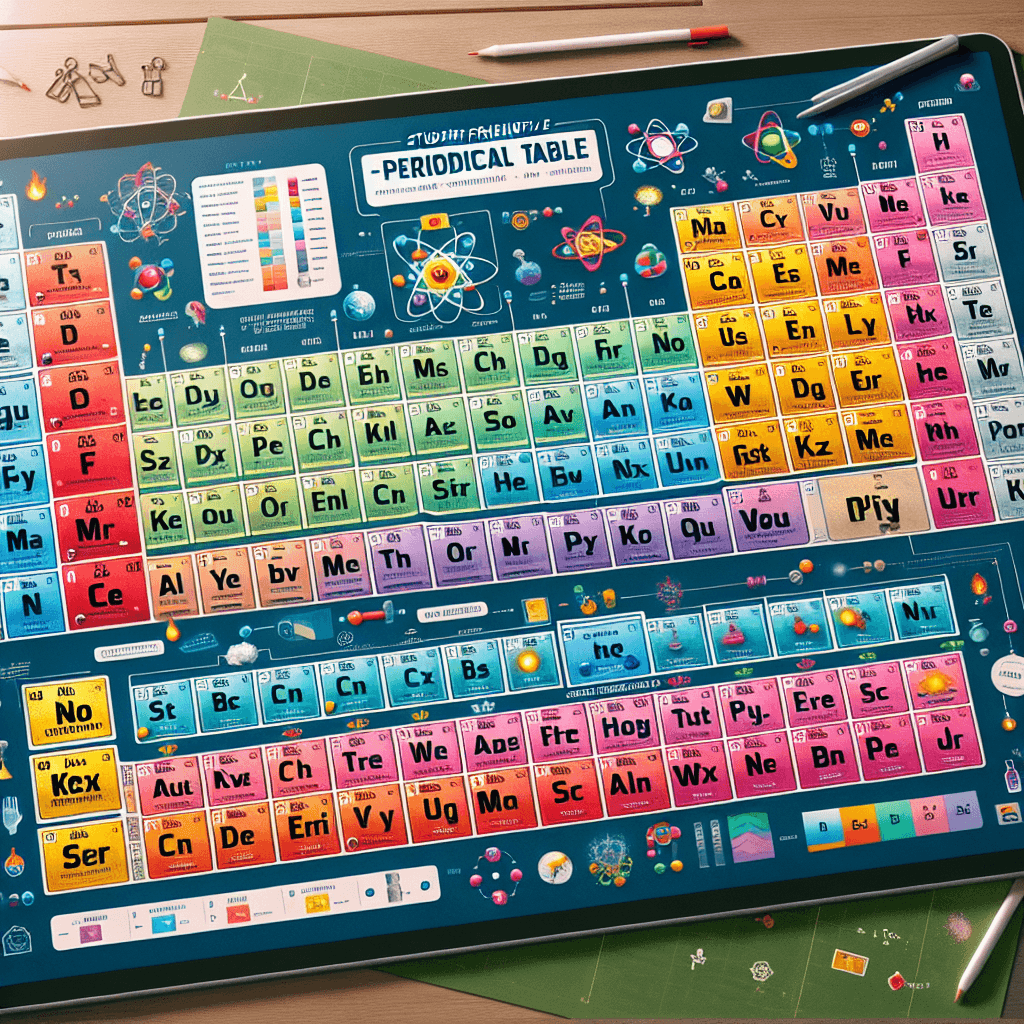
Interactive Periodic Table: Chemical Property Redesign
Inquiry Framework
Question Framework
Driving Question
The overarching question that guides the entire project.How can we redesign the periodic table into an interactive infographic that effectively communicates the relationship between electron arrangement, periodic trends, and chemical properties of elements?Essential Questions
Supporting questions that break down major concepts.- How do the periodic trends influence the chemical properties of elements?
- In what ways can we visually represent the relationships between elements and their properties on the periodic table?
- How does the arrangement of electrons in an atom determine its chemical behavior?
- What are the most effective methods for communicating complex scientific information through infographics?
- How can we use interactive elements to enhance understanding and engagement with the periodic table?
Standards & Learning Goals
Learning Goals
By the end of this project, students will be able to:- Understand the relationship between electron arrangement and chemical properties.
- Apply periodic trends to predict element behavior.
- Communicate chemical information visually and interactively.
Next Generation Science Standards
Entry Events
Events that will be used to introduce the project to studentsMystery Elements Escape Room
Students participate in an escape room challenge where they must identify mystery elements based on their properties to unlock clues and 'escape'. This gamified introduction sparks curiosity about element properties and the importance of organization.Portfolio Activities
Portfolio Activities
These activities progressively build towards your learning goals, with each submission contributing to the student's final portfolio.Electron Configuration Unveiled
Students will explore the relationship between electron configuration and an element's position on the periodic table. They will learn how electron arrangement dictates an element's chemical properties.Steps
Here is some basic scaffolding to help students complete the activity.Final Product
What students will submit as the final product of the activityA table or chart that displays the electron configurations of the first 36 elements, highlighting patterns and relationships to the periodic table's structure.Alignment
How this activity aligns with the learning objectives & standardsAddresses the learning goal: Understand the relationship between electron arrangement and chemical properties. Aligns with HS-PS1-1 by focusing on the patterns of electrons in the outermost energy level of atoms.Periodic Trend Tracker
Students will investigate and analyze major periodic trends (electronegativity, ionization energy, atomic radius) and their impact on chemical properties. They will create visual representations of these trends.Steps
Here is some basic scaffolding to help students complete the activity.Final Product
What students will submit as the final product of the activityA series of graphs or charts visually representing the periodic trends, accompanied by a written analysis explaining the trends and their implications for chemical properties.Alignment
How this activity aligns with the learning objectives & standardsAddresses the learning goal: Apply periodic trends to predict element behavior. Aligns with HS-PS1-1 by using the periodic table to predict relative properties of elements.Interactive Element Profiles
Students will choose specific elements and create interactive profiles highlighting their chemical properties, uses, and importance. These profiles will be integrated into the redesigned periodic table.Steps
Here is some basic scaffolding to help students complete the activity.Final Product
What students will submit as the final product of the activityInteractive element profiles that can be integrated into the redesigned periodic table, showcasing the chemical properties, uses, and importance of each element.Alignment
How this activity aligns with the learning objectives & standardsAddresses the learning goal: Communicate chemical information visually and interactively. Reinforces HS-PS1-1 by applying understanding of periodic trends to specific elements.Periodic Table Redesign: Interactive Infographic
Students synthesize their knowledge to create a visually engaging, interactive periodic table infographic, emphasizing chemical properties and periodic trends. They will incorporate the element profiles created in the previous activity.Steps
Here is some basic scaffolding to help students complete the activity.Final Product
What students will submit as the final product of the activityA completed interactive periodic table infographic that effectively communicates the relationship between electron arrangement, periodic trends, and chemical properties. Includes interactive element profiles and a design rationale.Alignment
How this activity aligns with the learning objectives & standardsAddresses all learning goals: Understand the relationship between electron arrangement, Apply periodic trends to predict element behavior, and Communicate chemical information visually and interactively. Directly aligns with HS-PS1-1 as the final product models and predicts element properties based on electron patterns.Rubric & Reflection
Portfolio Rubric
Grading criteria for assessing the overall project portfolioPeriodic Table Redesign Rubric
Electron Configuration & Periodic Trends
This category assesses the student's understanding of electron configuration and its relationship to periodic trends and chemical properties.Accuracy of Electron Configurations
Demonstrates accurate understanding and representation of electron configurations for elements.
Exemplary
4 PointsElectron configurations are accurately represented for all elements. The relationship between electron configuration and the periodic table is clearly articulated and insightful. Demonstrates deep understanding of valence electrons and bonding.
Proficient
3 PointsElectron configurations are mostly accurate with minor errors. The relationship between electron configuration and the periodic table is explained clearly. Understands valence electrons and bonding.
Developing
2 PointsElectron configurations contain several inaccuracies. The relationship between electron configuration and the periodic table is partially explained, but lacks depth. Shows some understanding of valence electrons and bonding.
Beginning
1 PointsElectron configurations are largely inaccurate or incomplete. The relationship between electron configuration and the periodic table is not clearly explained. Shows limited understanding of valence electrons and bonding.
Analysis of Periodic Trends
Demonstrates understanding of periodic trends (electronegativity, ionization energy, atomic radius) and their impact on chemical properties.
Exemplary
4 PointsProvides a comprehensive and insightful analysis of periodic trends, explaining their impact on chemical properties with specific examples. Explains any exceptions to the trends with valid reasoning.
Proficient
3 PointsProvides a clear analysis of periodic trends and their impact on chemical properties. Identifies general trends and explains their relevance.
Developing
2 PointsIdentifies periodic trends but struggles to explain their impact on chemical properties. The analysis is superficial or incomplete.
Beginning
1 PointsShows limited understanding of periodic trends and their relationship to chemical properties. The analysis is minimal or inaccurate.
Interactive Element Profiles
This category assesses the quality and accuracy of the interactive element profiles created by the student.Accuracy and Completeness of Element Information
Presents accurate and complete information about the selected elements, including chemical properties, uses, and interesting facts.
Exemplary
4 PointsElement profiles are exceptionally thorough, accurate, and engaging. Information is well-researched and presented in a compelling manner. Demonstrates a deep understanding of the element's properties and uses.
Proficient
3 PointsElement profiles are accurate and provide comprehensive information about the element's properties and uses.
Developing
2 PointsElement profiles contain some inaccuracies or are missing key information. The presentation is adequate but not particularly engaging.
Beginning
1 PointsElement profiles are largely incomplete or inaccurate. The presentation is poorly organized and lacks important information.
Interactivity and Engagement
Effectively uses interactive elements to enhance understanding and engagement with the element profiles.
Exemplary
4 PointsInteractive elements are creative, well-integrated, and significantly enhance user engagement and understanding. Demonstrates innovative use of technology.
Proficient
3 PointsInteractive elements are used effectively to enhance user engagement and understanding.
Developing
2 PointsInteractive elements are present but do not significantly enhance user engagement or understanding. Some elements may be poorly implemented.
Beginning
1 PointsInteractive elements are minimal or ineffective. The profiles are largely static and lack engagement.
Periodic Table Redesign & Infographic
This category assesses the overall design and effectiveness of the redesigned periodic table infographic.Visual Communication & Design
The infographic is visually appealing, well-organized, and effectively communicates complex information.
Exemplary
4 PointsThe infographic is exceptionally well-designed, visually stunning, and communicates complex information with clarity and precision. Demonstrates sophisticated understanding of visual communication principles.
Proficient
3 PointsThe infographic is visually appealing, well-organized, and effectively communicates complex information.
Developing
2 PointsThe infographic is adequately designed but may lack visual appeal or clarity. Some information may be difficult to understand.
Beginning
1 PointsThe infographic is poorly designed, disorganized, and difficult to understand. Lacks visual appeal and clarity.
Integration of Element Profiles & Interactivity
The element profiles are seamlessly integrated into the redesigned periodic table, and the interactive elements enhance the user experience.
Exemplary
4 PointsThe element profiles are seamlessly integrated into the redesigned periodic table, creating a cohesive and interactive experience. The interactive elements are intuitive and enhance user exploration and understanding.
Proficient
3 PointsThe element profiles are well-integrated into the redesigned periodic table, and the interactive elements enhance the user experience.
Developing
2 PointsThe element profiles are integrated into the redesigned periodic table, but the integration may be clunky or incomplete. The interactive elements are present but may not significantly enhance the user experience.
Beginning
1 PointsThe element profiles are poorly integrated into the redesigned periodic table. The interactive elements are minimal or ineffective.
Design Rationale & Artist Statement
The artist statement clearly explains the design choices and how the infographic effectively communicates chemical information.
Exemplary
4 PointsThe artist statement is insightful, well-articulated, and demonstrates a deep understanding of the design choices and their impact on communication. Provides a compelling rationale for all design decisions.
Proficient
3 PointsThe artist statement clearly explains the design choices and how the infographic effectively communicates chemical information.
Developing
2 PointsThe artist statement is present but lacks detail or clarity. Some design choices may not be adequately explained.
Beginning
1 PointsThe artist statement is missing or provides minimal explanation of the design choices.