
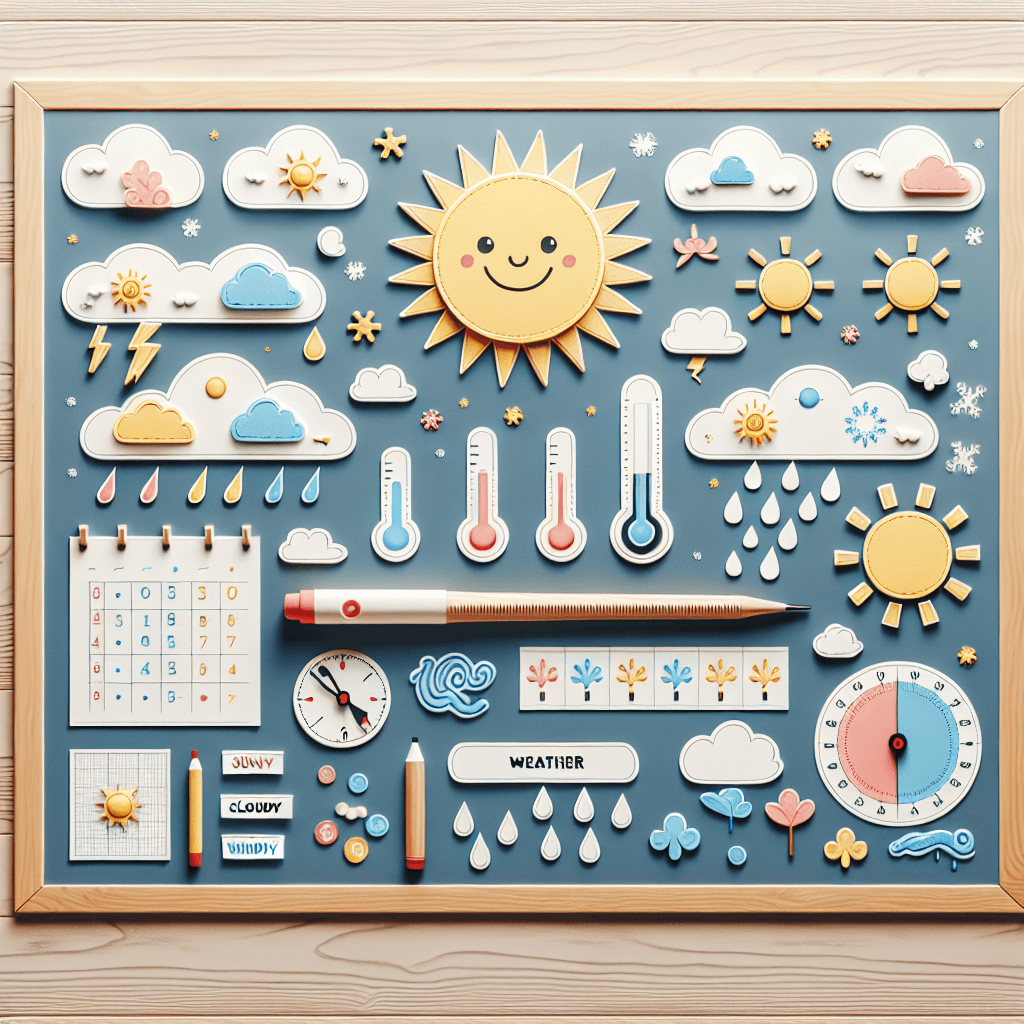
Interactive Weather Wall for First Graders
Inquiry Framework
Question Framework
Driving Question
The overarching question that guides the entire project.How can we observe, record, and classify daily weather patterns to better understand their impact on living and non-living organisms and their habitats?Essential Questions
Supporting questions that break down major concepts.- What are the basic weather patterns we can observe daily?
- How do we create a chart to record and report weather changes?
- What criteria can we use to classify different types of weather?
- How can weather influence the habitat of living and non-living organisms?
- What tools and instruments help us measure weather changes?
Standards & Learning Goals
Learning Goals
By the end of this project, students will be able to:- Students will understand and identify basic weather patterns such as sunny, cloudy, rainy, and windy.
- Students will learn how to categorize and classify weather patterns and their impact on the environment.
- Students will explore how weather affects living and non-living organisms and their habitats.
- Students will develop skills to use weather instruments such as thermometers and barometers to report weather changes.
- Students will be able to create a weather chart to observe and record daily weather changes.
PA State Science Standards
NGSS
Entry Events
Events that will be used to introduce the project to studentsWeather Wizard's Surprise
Start with a mysterious package delivered to the classroom containing unusual weather instruments and data marked "confidential." Students are tasked with understanding these instruments and their connection to daily weather phenomena, sparking curiosity to explore how weather affects the environment and living creatures.Portfolio Activities
Portfolio Activities
These activities progressively build towards your learning goals, with each submission contributing to the student's final portfolio.Weather Instrument Exploration
Students will start by engaging with the mystery package filled with weather instruments. This will kickstart their understanding of different weather phenomena and the tools used to measure them. They will learn to identify instruments like thermometers and rain gauges and match them to the weather elements they measure.Steps
Here is some basic scaffolding to help students complete the activity.Final Product
What students will submit as the final product of the activityA list matching weather instruments to the elements they measure, paired with brief descriptions of each element.Alignment
How this activity aligns with the learning objectives & standardsPA State Science Standards 3.1.1.A5, focusing on identifying characteristics related to weather.Weather Pattern Classifier
Building on their understanding of weather elements, students will now explore various weather patterns observed in their local environment and classify them into categories such as sunny, cloudy, or rainy. This activity helps them understand how different weather patterns affect the local habitat and environment.Steps
Here is some basic scaffolding to help students complete the activity.Final Product
What students will submit as the final product of the activityA classification chart showing different weather patterns and their impacts on the environment.Alignment
How this activity aligns with the learning objectives & standardsNGSS K-ESS3-1, focusing on the relationship between weather and habitat changes.Daily Weather Chart Creation
Students will set up a daily weather chart in the classroom to record and report weather changes over time. They will begin by observing and noting down daily weather conditions, which will enhance their ability to track patterns and use their knowledge of weather elements.Steps
Here is some basic scaffolding to help students complete the activity.Final Product
What students will submit as the final product of the activityAn interactive weather wall displaying daily recorded weather data.Alignment
How this activity aligns with the learning objectives & standardsNGSS K-ESS2-1, which involves observing and sharing local weather conditions to describe patterns.Weather and Habitat Impact Investigation
Students will delve into understanding how different weather conditions can affect living and non-living organisms around them. By using models, they will explore cause and effect relationships in a real-world context. This will deepen their comprehension of the role weather plays in an ecosystem.Steps
Here is some basic scaffolding to help students complete the activity.Final Product
What students will submit as the final product of the activityModels demonstrating the impact of different weather conditions on local habitats and organisms.Alignment
How this activity aligns with the learning objectives & standardsNGSS K-ESS3-1 and PA State Science Standards 3.1.1.A5, by examining the effects on habitats.Sunlight Effect Observers
Building on their knowledge of weather, students will now focus specifically on the effect of sunlight. They will make simple observations and record how sunlight influences different surfaces and elements around them, integrating this knowledge into their overarching understanding of weather and environment.Steps
Here is some basic scaffolding to help students complete the activity.Final Product
What students will submit as the final product of the activityA set of recorded observations highlighting the effects of sunlight on various surfaces.Alignment
How this activity aligns with the learning objectives & standardsNGSS K-PS3-1, through observing sunlight's effects on Earth's surface.Rubric & Reflection
Portfolio Rubric
Grading criteria for assessing the overall project portfolioWeather Exploration and Impact Assessment
Understanding Weather Instruments
Assessment of students' ability to identify and match weather instruments to the elements they measure, demonstrating basic understanding of their function.Instrument Identification
Ability to correctly identify and name weather instruments from the package.
Exemplary
4 PointsAccurately identifies all weather instruments and demonstrates advanced understanding of their functions beyond classroom discussion.
Proficient
3 PointsIdentifies most weather instruments accurately and explains their primary functions.
Developing
2 PointsCorrectly identifies some instruments but struggles with their functions.
Beginning
1 PointsHas difficulty identifying instruments and understanding their functions.
Mapping Instruments to Elements
Skill in matching weather instruments to their respective weather elements.
Exemplary
4 PointsCorrectly matches all instruments with elements, showing insightful connections.
Proficient
3 PointsCorrectly matches most instruments with elements.
Developing
2 PointsMatches some instruments but with inconsistency.
Beginning
1 PointsStruggles to match instruments to weather elements.
Weather Pattern Classification
Evaluation of students' ability to classify weather patterns and understand their impacts on environments.Pattern Identification
Ability to recognize and classify different weather patterns observed locally.
Exemplary
4 PointsIdentifies and classifies all weather patterns accurately and provides examples of their impacts on living and non-living environments.
Proficient
3 PointsIdentifies most weather patterns accurately and classifies them appropriately.
Developing
2 PointsIdentifies some weather patterns but classifies inconsistently.
Beginning
1 PointsStruggles with accurate identification and classification of weather patterns.
Impact Analysis
Ability to understand and explain the effects of weather patterns on the local environment.
Exemplary
4 PointsThoroughly explains the impacts of various weather patterns on local habitats using examples and analogies.
Proficient
3 PointsExplains impacts of most weather patterns on local environments with clarity.
Developing
2 PointsProvides basic explanations with limited understanding of impacts.
Beginning
1 PointsStruggles to explain impacts and lacks understanding.
Daily Weather Charting
Assessment of the ability to record and analyze daily weather changes using appropriate tools.Chart Completion
Successful creation and maintenance of a daily weather chart, recording observations accurately.
Exemplary
4 PointsConsistently completes daily chart with accurate, detailed observations and reflections.
Proficient
3 PointsRegularly completes daily chart with mostly accurate observations.
Developing
2 PointsCompletes chart inconsistently with some inaccuracies.
Beginning
1 PointsStruggles to complete chart and record accurate observations.
Use of Weather Instruments
Skill in effectively using instruments to record weather conditions.
Exemplary
4 PointsUses instruments competently to record precise data, showing deep understanding of their use.
Proficient
3 PointsUses instruments effectively to record data with occasional guidance.
Developing
2 PointsUses instruments with assistance but records data imprecisely.
Beginning
1 PointsStruggles to use instruments correctly and record data.
Weather Impact on Habitats
Evaluation of students' understanding of weather effects on local habitats and their ability to communicate their findings.Model Creation
Ability to create models that represent the relationship between weather conditions and habitat changes.
Exemplary
4 PointsCreates detailed, accurate models that effectively represent weather impacts on habitats.
Proficient
3 PointsCreates models that represent most aspects of weather impacts on habitats.
Developing
2 PointsModels represent basic concepts but lack detail.
Beginning
1 PointsModels are incomplete and lack representation of concepts.
Classroom Presentation
Effectiveness in presenting models and discussing their findings with classmates.
Exemplary
4 PointsPresents findings clearly with confidence, using supportive visual aids and engages classmates effectively.
Proficient
3 PointsPresents findings with clarity and engages audience sufficiently.
Developing
2 PointsPresents with some clarity but struggles to engage audience.
Beginning
1 PointsHas difficulty presenting information and engaging with classmates.
Sunlight Observation Skills
Assessment of students' abilities to observe and record the effects of sunlight on different surfaces.Observation Recording
Ability to accurately observe and document sunlight effects over time.
Exemplary
4 PointsRecords detailed observations with insightful reflections on sunlight effects over time.
Proficient
3 PointsRecords clear observations with some detail on sunlight effects.
Developing
2 PointsRecords limited observations with inconsistent details.
Beginning
1 PointsStruggles to record observations and lacks detail.
Discussion Participation
Engagement in class discussions about the observations and their significance.
Exemplary
4 PointsActively engages in discussions, offering thoughtful insights and connections to broader weather concepts.
Proficient
3 PointsParticipates in discussions, sharing relevant information with peers.
Developing
2 PointsParticipates minimally, with limited contributions to discussions.
Beginning
1 PointsRarely participates and struggles to contribute to discussions.