
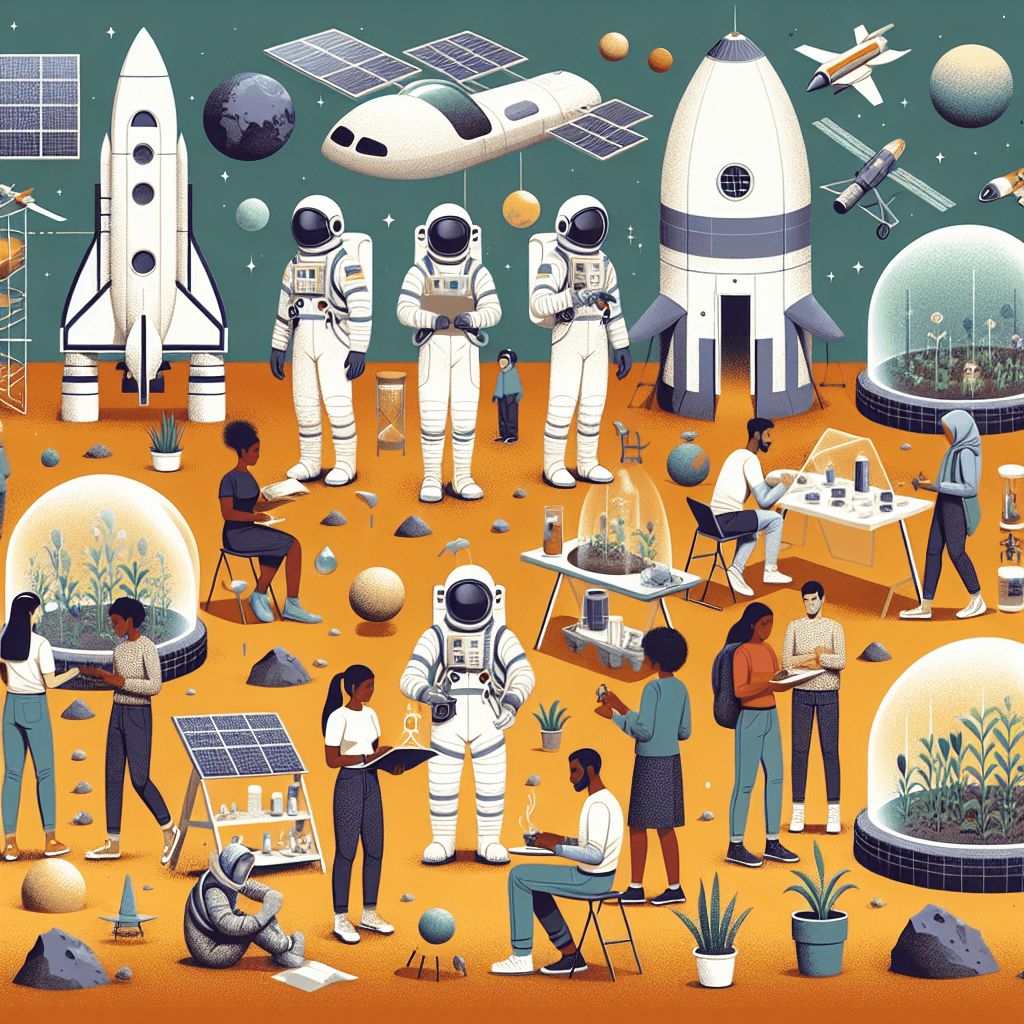
Interplanetary Colonization: Designing a Sustainable Society
Inquiry Framework
Question Framework
Driving Question
The overarching question that guides the entire project.How can we create a self-sustaining interplanetary colony, using knowledge from Earth's history, mathematical principles, and scientific understanding, to overcome environmental challenges and establish a thriving society?Essential Questions
Supporting questions that break down major concepts.- How does the environment of our chosen planet affect the design of our colony?
- How can we use math to calculate the resources needed for our colony?
- What historical events can inform our decisions about social structure and governance in the colony?
- How can we balance the needs of individuals with the needs of the community in our colony?
- How can we create a sustainable economic system that supports our colony's growth and self-sufficiency?
- What are the ethical considerations of establishing a colony on another planet?
- How can we effectively communicate our colony plan to others?
Standards & Learning Goals
Learning Goals
By the end of this project, students will be able to:- Understand the environmental conditions and challenges of different planets and moons for potential colonization.
- Design a habitat that addresses environmental protection and resource management needs for an interplanetary colony.
- Apply mathematical concepts to determine the materials and layout for a sustainable colony habitat.
- Explore historical examples of colonization, social contracts, and governance to inform the creation of a social structure for a new colony.
- Develop a sustainable economic system considering limited resources and the need for self-sufficiency in an interplanetary context.
- Draft and present a comprehensive plan for a self-sustaining interplanetary colony, demonstrating clarity in communication and persuasive argumentation.
- Analyze and apply scientific principles related to Earth's resources and environmental spheres to interplanetary colonization scenarios.
- Demonstrate an understanding of ethical considerations in the establishment of extraterrestrial colonies.
Common Core Standards - Math
Social Studies Standards
Next Generation Science Standards - Science
Common Core Standards - ELA
Entry Events
Events that will be used to introduce the project to studentsDistress Signal from the Future
A simulated 'transmission' from future colonists on their chosen planet, detailing a critical system failure and requesting assistance. This will require students to analyze the colonists' description of their environment, resources, and challenges to propose a solution.Interplanetary Colonization Press Conference
Stage a 'press conference' announcing a new interplanetary colonization initiative. Assign students roles as scientists, engineers, politicians, and even potential colonists, and have them ask questions about the project's feasibility, sustainability, and ethical implications.The Martian Relics
Present students with a series of strange artifacts supposedly recovered from a failed early colonization attempt on Mars. Each artifact (a tool, a piece of clothing, a fragment of a structure) hints at a specific problem the colonists faced (e.g., radiation exposure, water scarcity, social conflict). Students must analyze the artifacts and deduce the reasons for the colony's failure.Portfolio Activities
Portfolio Activities
These activities progressively build towards your learning goals, with each submission contributing to the student's final portfolio.Planetary Explorers: Unveiling Our New World
Students become 'Planetary Explorers' to investigate potential colony locations. They will gather and analyze data about their chosen planet's environment, focusing on factors critical for sustaining life.Steps
Here is some basic scaffolding to help students complete the activity.Final Product
What students will submit as the final product of the activityA detailed Planet Profile, including a summary of environmental characteristics, challenges, and opportunities for colonization. The profile should include a visual representation of the planet's key features and data charts illustrating environmental conditions.Alignment
How this activity aligns with the learning objectives & standardsAligns with 5-ESS-1.1 (brightness of stars), 5-ESS-1.2 (patterns of day and night), 5-ESS-2.1 (interactions of spheres), 5-ESS-2.2 (water distribution).Habitat Architects: Building Our Martian Home
Students will design a habitat that can protect colonists from the harsh environment of their chosen planet. This involves calculating the amounts of materials and the sizes of the habitat components.Steps
Here is some basic scaffolding to help students complete the activity.Final Product
What students will submit as the final product of the activityA detailed Habitat Blueprint, including scaled diagrams, material lists with calculated amounts, and a resource management plan for water, oxygen, and food. A presentation of the design, explaining the rationale behind each decision.Alignment
How this activity aligns with the learning objectives & standardsAligns with 5.NBT.B.5 (Multi-Digit Multiplication), 5.MD.C.4 (Volume of Rectangular Prisms), 5.G.A (Graphing on the Coordinate Plane), and 5-ESS-3.1 (Protecting Earth's Resources).Colony Crafters: Forging a New Society
Students will develop a social structure and system of governance for their interplanetary colony, drawing lessons from historical examples of colonization, immigration, and social contracts. They will consider issues such as immigration policies, dispute resolution, and decision-making processes.Steps
Here is some basic scaffolding to help students complete the activity.Final Product
What students will submit as the final product of the activityA Social Contract document outlining the rights and responsibilities of colonists, the system of governance, and the laws of the colony. A presentation of the social structure and governance system, justifying the choices made based on historical precedents.Alignment
How this activity aligns with the learning objectives & standardsAligns with 5.SS.1.6 (Compromises and Conflicts), 5.SS.1.7 (Motives of Immigrants), 5.SS.1.8 (Indentured Servitude and Slave Trade), and 5.W.RW.3 (Informational Writing).Eco-nomics: Designing Our New World
Students will design an economic system for their interplanetary colony, considering the challenges of operating a closed-loop economy in a remote and resource-constrained environment. They will identify potential industries, such as mining, manufacturing, and tourism, and explore ways to promote economic growth and self-sufficiency.Steps
Here is some basic scaffolding to help students complete the activity.Final Product
What students will submit as the final product of the activityAn Economic Blueprint outlining the colony's economic system, including potential industries, resource management strategies, and plans for promoting economic growth and self-sufficiency. The blueprint should include a budget and a plan for how the colony will trade with other colonies or Earth.Alignment
How this activity aligns with the learning objectives & standardsAligns with 5.SS.1.6 (Understand historical conflict), 5.SS.1.7 (Economic motives), and 5.NBT.B.5 (Calculations).Rubric & Reflection
Portfolio Rubric
Grading criteria for assessing the overall project portfolioInterplanetary Colonization Project Rubric
Planet Profile Content and Presentation
Assesses the accuracy of the information presented about the chosen planet and the clarity of the planet profile.Planetary Analysis
Accuracy of information regarding the planet's environment, challenges, and opportunities for colonization.
Exemplary
4 PointsDemonstrates a comprehensive and accurate understanding of the planet's environment, challenges, and opportunities. Information is well-researched, detailed, and supported by strong evidence.
Proficient
3 PointsDemonstrates a thorough understanding of the planet's environment, challenges, and opportunities. Information is mostly accurate and supported by evidence.
Developing
2 PointsShows an emerging understanding of the planet's environment, challenges, and opportunities. Information may contain some inaccuracies or lack sufficient detail.
Beginning
1 PointsShows a limited understanding of the planet's environment, challenges, and opportunities. Information is incomplete, inaccurate, or lacking supporting evidence.
Presentation and Organization
Clarity and organization of the Planet Profile document. Visual representation of key features and data charts are well-presented.
Exemplary
4 PointsThe Planet Profile is exceptionally clear, well-organized, and visually appealing. The visual representation of key features and data charts enhance understanding and engagement.
Proficient
3 PointsThe Planet Profile is clear, well-organized, and includes effective visual representations of key features and data charts.
Developing
2 PointsThe Planet Profile is generally organized but may lack clarity in some areas. Visual representations and data charts may be basic or need improvement.
Beginning
1 PointsThe Planet Profile is disorganized, unclear, and lacks effective visual representations and data charts.
Habitat Design and Resource Management
Evaluates the feasibility and sustainability of the habitat design, the accuracy of the calculations involved, and the effectiveness of the resource management plan.Habitat Feasibility
Feasibility of the habitat design in protecting colonists from the environment and effectively utilizing available resources.
Exemplary
4 PointsThe habitat design is exceptionally feasible, demonstrating innovative solutions for protecting colonists and efficiently utilizing resources. The design considers potential challenges and offers creative solutions.
Proficient
3 PointsThe habitat design is feasible and effectively protects colonists from the environment while utilizing available resources.
Developing
2 PointsThe habitat design shows some feasibility but may have limitations in protecting colonists or utilizing resources effectively.
Beginning
1 PointsThe habitat design is not feasible and fails to adequately protect colonists or utilize resources effectively.
Mathematical Accuracy
Accuracy of the calculations for material amounts and habitat dimensions. Appropriate use of coordinate planes for layout planning.
Exemplary
4 PointsCalculations are precise and accurate, demonstrating a deep understanding of mathematical concepts. Coordinate planes are used effectively and creatively to optimize the habitat layout.
Proficient
3 PointsCalculations are accurate and demonstrate a solid understanding of mathematical concepts. Coordinate planes are used appropriately for habitat layout planning.
Developing
2 PointsCalculations contain some errors or inconsistencies. The use of coordinate planes for habitat layout planning is basic or needs improvement.
Beginning
1 PointsCalculations are inaccurate and demonstrate a limited understanding of mathematical concepts. Coordinate planes are not used effectively for habitat layout planning.
Resource Management
Effectiveness and sustainability of the resource management plan for water, oxygen, and food. Consideration of resource recycling and conservation methods.
Exemplary
4 PointsThe resource management plan is exceptionally effective and sustainable, demonstrating innovative methods for recycling and conserving resources. The plan considers long-term needs and environmental impacts.
Proficient
3 PointsThe resource management plan is effective and sustainable, including methods for recycling and conserving resources.
Developing
2 PointsThe resource management plan shows some effectiveness but may have limitations in sustainability or resource conservation.
Beginning
1 PointsThe resource management plan is not effective or sustainable and lacks adequate consideration of resource conservation.
Social Structure and Governance
Assesses the relevance of historical knowledge, the quality of the Social Contract, and the ethical considerations of the colony's social structure.Historical Relevance
Relevance and application of historical examples of colonization, immigration, and social contracts to the colony's social structure and governance.
Exemplary
4 PointsDemonstrates an exceptional understanding of historical examples and applies them innovatively to create a unique and effective social structure and governance system.
Proficient
3 PointsDemonstrates a thorough understanding of historical examples and applies them appropriately to create a solid social structure and governance system.
Developing
2 PointsShows an emerging understanding of historical examples, but the application to the colony's social structure and governance may be inconsistent.
Beginning
1 PointsShows a limited understanding of historical examples, with minimal application to the colony's social structure and governance.
Social Contract Quality
Clarity and fairness of the Social Contract document. Effectiveness of the system of governance and laws.
Exemplary
4 PointsThe Social Contract is exceptionally clear, fair, and comprehensive. The system of governance and laws is well-defined and promotes a just and equitable society.
Proficient
3 PointsThe Social Contract is clear, fair, and comprehensive. The system of governance and laws is well-defined and promotes a just society.
Developing
2 PointsThe Social Contract is generally clear but may lack detail or fairness in some areas. The system of governance and laws may be basic or need improvement.
Beginning
1 PointsThe Social Contract is unclear, unfair, and incomplete. The system of governance and laws is poorly defined and may lead to injustice.
Justification and Ethics
Justification of the choices made in the social structure and governance system, based on historical precedents and ethical considerations.
Exemplary
4 PointsProvides a compelling and insightful justification for all choices, demonstrating a deep understanding of historical precedents and ethical considerations.
Proficient
3 PointsProvides a clear and logical justification for the choices made, based on historical precedents and ethical considerations.
Developing
2 PointsProvides a basic justification for the choices made, but may lack detail or connection to historical precedents and ethical considerations.
Beginning
1 PointsProvides a weak or absent justification for the choices made, with minimal consideration of historical precedents and ethical considerations.
Economic System Design
Evaluates the economic viability, resource management strategies, and financial planning of the interplanetary colony.Economic Viability
Identification of potential industries and strategies for promoting economic growth and self-sufficiency in a closed-loop economy.
Exemplary
4 PointsDemonstrates a sophisticated understanding of economic principles and creatively identifies innovative industries and strategies that ensure long-term economic growth and self-sufficiency.
Proficient
3 PointsDemonstrates a thorough understanding of economic principles and identifies viable industries and strategies that promote economic growth and self-sufficiency.
Developing
2 PointsShows an emerging understanding of economic principles but may struggle to identify viable industries and strategies for economic growth and self-sufficiency.
Beginning
1 PointsShows a limited understanding of economic principles and fails to identify viable industries and strategies for economic growth and self-sufficiency.
Resource Management Realism
Realism and feasibility of the resource management strategies in a resource-constrained environment.
Exemplary
4 PointsThe resource management strategies are exceptionally realistic and feasible, demonstrating a deep understanding of resource limitations and innovative solutions for overcoming them.
Proficient
3 PointsThe resource management strategies are realistic and feasible, demonstrating a solid understanding of resource limitations.
Developing
2 PointsThe resource management strategies show some realism but may have limitations in feasibility or effectiveness.
Beginning
1 PointsThe resource management strategies are unrealistic and infeasible, failing to address resource limitations effectively.
Financial Planning
Completeness and accuracy of the colony's budget, including income and expenses. Clarity of the plan for trade with other colonies or Earth.
Exemplary
4 PointsThe colony's budget is meticulously detailed and accurate, demonstrating a comprehensive understanding of financial planning. The plan for trade is innovative and clearly articulated.
Proficient
3 PointsThe colony's budget is complete and accurate, demonstrating a solid understanding of financial planning. The plan for trade is clear and well-articulated.
Developing
2 PointsThe colony's budget may be incomplete or contain inaccuracies. The plan for trade may lack detail or clarity.
Beginning
1 PointsThe colony's budget is incomplete and inaccurate. The plan for trade is poorly defined or absent.