
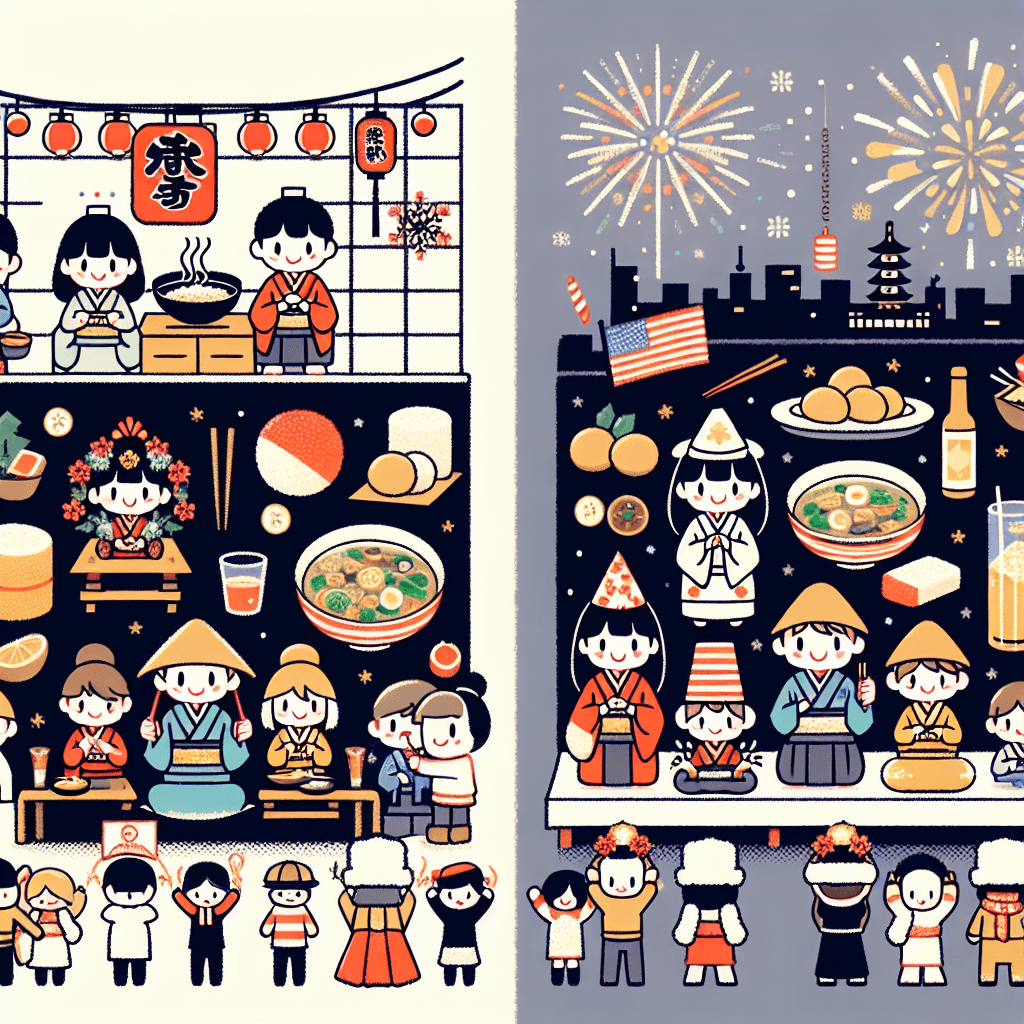
Japanese New Year: A Cultural Comparison
Inquiry Framework
Question Framework
Driving Question
The overarching question that guides the entire project.How do Japanese New Year traditions reveal the interplay of cultural values, historical context, and philosophical perspectives, and how do these differ from Western celebrations?Essential Questions
Supporting questions that break down major concepts.- How does Japanese New Year reflect Japanese cultural values and traditions?
- In what ways does Japanese New Year differ from Western New Year celebrations?
- How do historical and social factors influence the traditions and customs of Japanese New Year?
- What can we learn about Japanese philosophy and regionalism through the celebration of New Year?
Standards & Learning Goals
Learning Goals
By the end of this project, students will be able to:- Students will be able to compare and contrast Japanese and Western New Year traditions.
- Students will be able to analyze Japanese New Year traditions in terms of cultural values, historical context and philosophical perspectives.
- Students will be able to evaluate the interrelation of practices, products, and perspectives within Japanese New Year celebrations.
Teacher Provided
Entry Events
Events that will be used to introduce the project to studentsThe Great New Year's Food Face-Off
Present students with photos of traditional Japanese New Year's foods (Osechi Ryori) and Western New Year's dishes. Challenge them to a taste test (if feasible) and a cultural analysis: What do the ingredients, preparation methods, and presentation styles reveal about each culture's values and priorities?Portfolio Activities
Portfolio Activities
These activities progressively build towards your learning goals, with each submission contributing to the student's final portfolio.Tradition Tracker: Japanese New Year's Deep Dive
Students research and document various traditions associated with Japanese New Year (Shogatsu). This activity encourages exploration into the specific practices, products, and perspectives that define the cultural celebration.Steps
Here is some basic scaffolding to help students complete the activity.Final Product
What students will submit as the final product of the activityA detailed report on the assigned tradition, including visuals and citations.Alignment
How this activity aligns with the learning objectives & standardsFocuses on analyzing practices and products of Japanese culture (CUL.A.1).Cultural Values Unveiled: The 'Why' Behind the Traditions
Building on the previous activity, students analyze the cultural values embedded within the traditions they researched. This involves identifying the underlying beliefs, priorities, and philosophies reflected in these practices.Steps
Here is some basic scaffolding to help students complete the activity.Final Product
What students will submit as the final product of the activityA presentation (written or oral) explaining the cultural values associated with the assigned tradition, supported by evidence.Alignment
How this activity aligns with the learning objectives & standardsExplores the perspectives of Japanese culture and how they relate to philosophical and social issues (CUL.A.1).East Meets West: Comparative Analysis
Students compare and contrast Japanese New Year traditions with Western New Year celebrations, focusing on the similarities and differences in practices, values, and historical context.Steps
Here is some basic scaffolding to help students complete the activity.Final Product
What students will submit as the final product of the activityA comparative analysis essay or presentation that explores the interplay of cultural values and historical context in shaping New Year traditions.Alignment
How this activity aligns with the learning objectives & standardsEncourages comparison and evaluation of cultural practices, products, and perspectives, relating them to history and traditions of their own cultures (CUL.A.1).Rubric & Reflection
Portfolio Rubric
Grading criteria for assessing the overall project portfolioJapanese New Year Portfolio Rubric
Research & Information Gathering
Demonstrates effective research skills and accurate information gathering regarding Japanese New Year traditions.Accuracy of Information
Presents factually correct and detailed information about Japanese New Year traditions.
Exemplary
4 PointsInformation is exceptionally accurate, comprehensive, and well-supported by credible sources. Demonstrates a deep understanding of the nuances of Japanese New Year traditions.
Proficient
3 PointsInformation is accurate and well-supported by credible sources. Demonstrates a good understanding of Japanese New Year traditions.
Developing
2 PointsInformation is mostly accurate, but some details may be missing or lack sufficient support. Demonstrates a basic understanding of Japanese New Year traditions.
Beginning
1 PointsInformation contains inaccuracies or lacks proper sourcing. Demonstrates a limited understanding of Japanese New Year traditions.
Depth of Research
Explores various aspects of Japanese New Year traditions, showing a comprehensive understanding.
Exemplary
4 PointsResearch demonstrates an exceptional depth of understanding, exploring a wide range of aspects of Japanese New Year traditions and uncovering insightful connections.
Proficient
3 PointsResearch demonstrates a thorough understanding, covering multiple key aspects of Japanese New Year traditions.
Developing
2 PointsResearch demonstrates a basic understanding, covering some aspects of Japanese New Year traditions, but may lack depth.
Beginning
1 PointsResearch is superficial and lacks depth, covering only a limited number of aspects of Japanese New Year traditions.
Cultural Values Analysis
Analyzes and interprets the cultural values embedded within Japanese New Year traditions.Identification of Values
Accurately identifies the cultural values reflected in Japanese New Year traditions.
Exemplary
4 PointsIdentifies cultural values with exceptional insight and connects them to specific traditions with strong supporting evidence.
Proficient
3 PointsAccurately identifies key cultural values and connects them to specific traditions with supporting evidence.
Developing
2 PointsIdentifies some cultural values, but connections to specific traditions may be weak or lack sufficient evidence.
Beginning
1 PointsStruggles to identify cultural values and make connections to specific traditions.
Explanation of Significance
Explains the significance of these cultural values within the context of Japanese society.
Exemplary
4 PointsProvides an exceptionally clear and insightful explanation of the significance of cultural values within the broader context of Japanese society, demonstrating a nuanced understanding of historical and social factors.
Proficient
3 PointsProvides a clear explanation of the significance of cultural values within the context of Japanese society.
Developing
2 PointsProvides a basic explanation of the significance of cultural values, but may lack depth or connection to the broader context of Japanese society.
Beginning
1 PointsStruggles to explain the significance of cultural values within the context of Japanese society.
Comparative Analysis
Compares and contrasts Japanese New Year traditions with Western celebrations, highlighting similarities and differences.Identification of Similarities & Differences
Accurately identifies similarities and differences between Japanese and Western New Year traditions.
Exemplary
4 PointsIdentifies similarities and differences with exceptional precision and depth, demonstrating a nuanced understanding of both Japanese and Western New Year traditions.
Proficient
3 PointsAccurately identifies key similarities and differences between Japanese and Western New Year traditions.
Developing
2 PointsIdentifies some similarities and differences, but analysis may be incomplete or superficial.
Beginning
1 PointsStruggles to identify clear similarities and differences between Japanese and Western New Year traditions.
Explanation of Underlying Factors
Explains the historical, social, and philosophical factors that contribute to these similarities and differences.
Exemplary
4 PointsProvides an exceptionally insightful explanation of the historical, social, and philosophical factors that contribute to the similarities and differences, demonstrating a sophisticated understanding of cultural influences.
Proficient
3 PointsProvides a clear explanation of the historical, social, and philosophical factors that contribute to the similarities and differences.
Developing
2 PointsProvides a basic explanation of the factors, but may lack depth or specific examples.
Beginning
1 PointsStruggles to explain the factors that contribute to the similarities and differences.
Presentation & Communication
Presents information clearly, concisely, and engagingly in the final product.Clarity & Organization
Presents information in a clear, logical, and well-organized manner.
Exemplary
4 PointsPresentation is exceptionally clear, concise, and logically organized, making it easy for the audience to understand complex information. Demonstrates excellent communication skills.
Proficient
3 PointsPresentation is clear, concise, and logically organized.
Developing
2 PointsPresentation is generally clear, but may lack organization or conciseness in some areas.
Beginning
1 PointsPresentation is unclear, disorganized, and difficult to follow.
Use of Visuals & Citations
Effectively uses visuals and citations to enhance the presentation and support claims.
Exemplary
4 PointsVisuals are exceptionally relevant, engaging, and effectively enhance the presentation. Citations are accurate and thorough, demonstrating academic integrity.
Proficient
3 PointsVisuals are relevant and enhance the presentation. Citations are accurate and complete.
Developing
2 PointsVisuals are somewhat relevant, but may not significantly enhance the presentation. Citations are present, but may contain errors or omissions.
Beginning
1 PointsVisuals are missing or irrelevant. Citations are missing or inaccurate.