
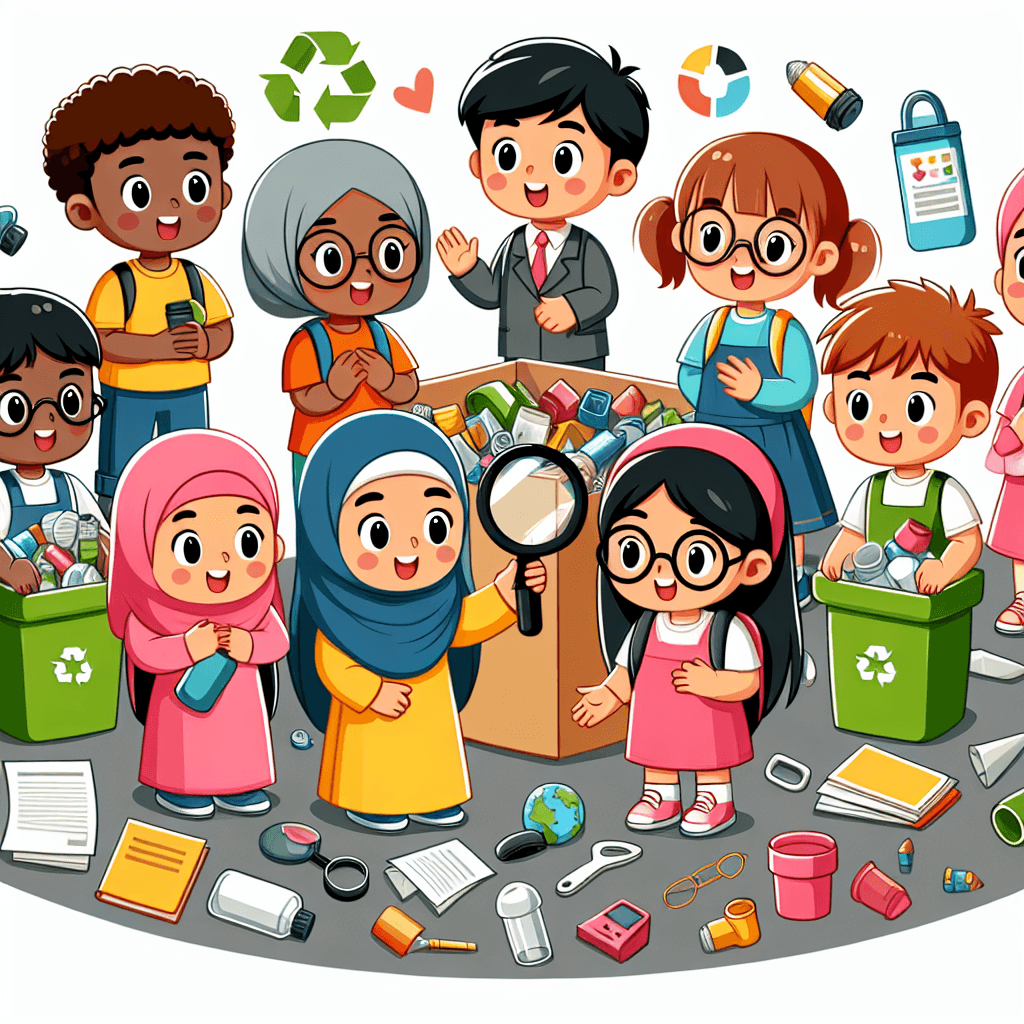
Kindergarten Recycling: Science, English, and Math Adventures!
Inquiry Framework
Question Framework
Driving Question
The overarching question that guides the entire project.How can we, as kindergarteners, help our planet by learning about recycling and sorting different materials?Essential Questions
Supporting questions that break down major concepts.- What materials can we recycle?
- How does recycling help our planet?
- How can we sort different types of recyclable materials?
Standards & Learning Goals
Learning Goals
By the end of this project, students will be able to:- Students will be able to identify different types of recyclable materials.
- Students will understand the importance of recycling for the environment.
Entry Events
Events that will be used to introduce the project to studentsRecycling Detectives
Introduce a mystery involving a 'Litterbug' character who has left a trail of improperly discarded items around the school. Students become 'Recycling Detectives,' following clues, categorizing the trash, and proposing solutions for preventing future littering, promoting environmental responsibility.Portfolio Activities
Portfolio Activities
These activities progressively build towards your learning goals, with each submission contributing to the student's final portfolio.Recycling Rainbow
Students will create a 'Recycling Rainbow' collage by sorting and gluing different recyclable materials onto a rainbow template, reinforcing their ability to identify and categorize recyclables by color.Steps
Here is some basic scaffolding to help students complete the activity.Final Product
What students will submit as the final product of the activityA 'Recycling Rainbow' collage showcasing sorted recyclable materials by color.Alignment
How this activity aligns with the learning objectives & standardsAddresses the learning goal: Students will be able to identify different types of recyclable materials.Recycling Story Time
Students participate in a 'Recycling Story Time' where they listen to age-appropriate stories about recycling and its benefits, followed by a group discussion and drawing activity to illustrate what they learned.Steps
Here is some basic scaffolding to help students complete the activity.Final Product
What students will submit as the final product of the activityA drawing illustrating the benefits of recycling, accompanied by a short verbal explanation.Alignment
How this activity aligns with the learning objectives & standardsAddresses the learning goal: Students will understand the importance of recycling for the environment.Recycling Sort & Count
Students engage in a 'Recycling Sort & Count' activity where they sort recyclable items and count each type of material, recording their findings on a simple chart to understand quantities and practice basic counting skills.Steps
Here is some basic scaffolding to help students complete the activity.Final Product
What students will submit as the final product of the activityA chart showing the counted quantities of each type of recyclable material.Alignment
How this activity aligns with the learning objectives & standardsIntegrates math skills with the science concept of recycling.Rubric & Reflection
Portfolio Rubric
Grading criteria for assessing the overall project portfolioKindergarten Recycling Project Rubric
Recycling Knowledge and Skills
Focuses on the students' ability to sort, identify, and count recyclable materials, as well as their understanding of the benefits of recycling.Material Identification and Sorting
Ability to correctly identify and sort recyclable materials by type (paper, plastic, glass, metal).
Exemplary
4 PointsConsistently and accurately sorts all recyclable materials into the correct categories, demonstrating a sophisticated understanding of recyclable types.
Proficient
3 PointsAccurately sorts most recyclable materials into the correct categories with only minor errors, demonstrating a thorough understanding of recyclable types.
Developing
2 PointsSorts some recyclable materials correctly, but makes frequent errors and requires assistance to identify and categorize materials.
Beginning
1 PointsStruggles to sort recyclable materials and cannot consistently identify different types of recyclables, requiring significant assistance.
Understanding Environmental Impact
Understands and communicates the positive impact of recycling on the environment.
Exemplary
4 PointsClearly and enthusiastically articulates multiple benefits of recycling with detailed explanations and provides creative ideas for promoting recycling.
Proficient
3 PointsClearly explains the main benefits of recycling with supporting details.
Developing
2 PointsIdentifies at least one benefit of recycling, but explanation lacks detail.
Beginning
1 PointsStruggles to identify any benefits of recycling or provides an inaccurate explanation.
Counting and Data Representation
Effectively uses counting skills to quantify the number of recyclable items sorted.
Exemplary
4 PointsAccurately counts and records the number of items in each category, creating a clear and organized chart or graph with no errors.
Proficient
3 PointsCounts and records the number of items in each category with only minor errors, creating a mostly accurate chart or graph.
Developing
2 PointsAttempts to count the items, but makes frequent errors and struggles to record the data accurately.
Beginning
1 PointsUnable to count the items or record the data, requiring significant assistance.
Creative Expression and Visual Communication
Focuses on evaluating the creativity and visual representation demonstrated through the 'Recycling Rainbow' and 'Recycling Story Time' activities.Artistic Expression
The creativity and aesthetic appeal of the Recycling Rainbow collage.
Exemplary
4 PointsThe Recycling Rainbow is exceptionally creative, visually appealing, and demonstrates skillful arrangement of materials.
Proficient
3 PointsThe Recycling Rainbow is creative, visually appealing, and demonstrates good arrangement of materials.
Developing
2 PointsThe Recycling Rainbow shows some creativity but is not particularly visually appealing.
Beginning
1 PointsThe Recycling Rainbow lacks creativity and is not visually appealing.
Visual Communication
Clarity and detail of the drawing illustrating the benefits of recycling.
Exemplary
4 PointsThe drawing is exceptionally clear, detailed, and effectively illustrates the benefits of recycling with labels and explanations.
Proficient
3 PointsThe drawing is clear, detailed, and illustrates the benefits of recycling.
Developing
2 PointsThe drawing is somewhat clear but lacks detail in illustrating the benefits of recycling.
Beginning
1 PointsThe drawing is unclear and does not effectively illustrate the benefits of recycling.