
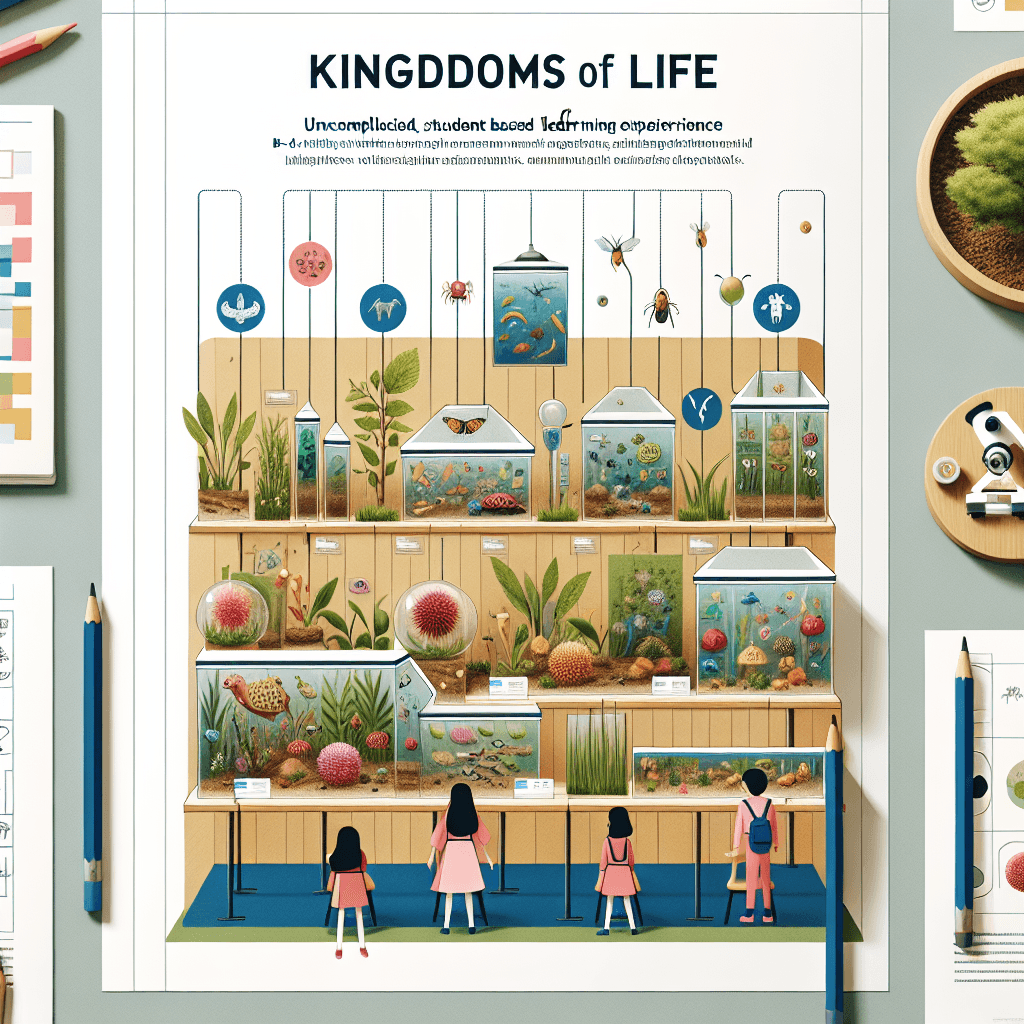
Kingdoms of Life: Creating a Museum Exhibit
Inquiry Framework
Question Framework
Driving Question
The overarching question that guides the entire project.How can we design a museum exhibit that showcases the diversity of the five kingdoms of life and demonstrates the importance of classification in understanding the living world?Essential Questions
Supporting questions that break down major concepts.- How do scientists classify the vast diversity of life on Earth?
- What are the defining characteristics of each of the five kingdoms of life?
- How does understanding the classification of living things help us appreciate the interconnectedness of life and the environment?
- How have classification systems changed over time as new evidence is discovered?
- What are the roles of different scientists in helping us to understand the diversity of living things?
Standards & Learning Goals
Learning Goals
By the end of this project, students will be able to:- Students will be able to classify organisms into the five kingdoms of life based on their characteristics.
- Students will be able to design and create an informative museum exhibit showcasing the diversity within each kingdom.
- Students will be able to explain the importance of classification systems in understanding the natural world.
- Students will be able to identify the adaptations that allow organisms to thrive in different environments.
- Students will be able to compare and contrast vertebrates and invertebrates, providing examples of each.
- Students will be able to evaluate the contributions of scientists to the classification of living things.
- Students will be able to define the characteristics of arthropods and classify them.
Nebraska Science Standards
Entry Events
Events that will be used to introduce the project to studentsClassifying the Unrelated
Students are presented with a set of seemingly unrelated objects (a mushroom, a feather, a piece of bread, a petri dish with bacteria, a coral fragment). They must work together to classify these items, leading to discussions about the five kingdoms and how seemingly disparate objects are connected through the web of life. This activity culminates in the design of museum exhibits to illustrate these connections.Portfolio Activities
Portfolio Activities
These activities progressively build towards your learning goals, with each submission contributing to the student's final portfolio.Kingdom Classifier Key Creator
Students will start by creating a classification key. They will select 10-15 organisms from the local environment or provided list. Using observable characteristics, they will develop a dichotomous key to classify these organisms. The key should lead to the identification of each organism and its kingdom.Steps
Here is some basic scaffolding to help students complete the activity.Final Product
What students will submit as the final product of the activityA detailed dichotomous key with labeled organisms and their respective classifications.Alignment
How this activity aligns with the learning objectives & standardsAligns with Nebraska Science Standards 6-1-04, 6-1-05, and Learning Goal 1: Classify organisms and explain the rationale behind classification systems.Kingdom Deep Dive: Research Expedition
Students will choose one of the five kingdoms of life (Monera, Protista, Fungi, Plantae, Animalia). They will research and gather information about the defining characteristics of their chosen kingdom, including representative organisms and their unique adaptations.Steps
Here is some basic scaffolding to help students complete the activity.Final Product
What students will submit as the final product of the activityA detailed research report on the chosen kingdom, including key characteristics, representative organisms, and interesting facts.Alignment
How this activity aligns with the learning objectives & standardsAligns with Nebraska Science Standards 6-1-06, 6-1-07, and Learning Goal 2: Design museum exhibit showcasing kingdom diversity.Habitat Heroes: Adaptation Showcase
Students will focus on a specific environment and the organisms within it. They will select three organisms from different kingdoms that inhabit this environment and research their adaptations. They will create visual representations with labels of how these adaptations help the organisms survive and thrive in their habitat.Steps
Here is some basic scaffolding to help students complete the activity.Final Product
What students will submit as the final product of the activityA display board with visual representations of three organisms and their adaptations, along with descriptions of how these adaptations aid in survival.Alignment
How this activity aligns with the learning objectives & standardsAligns with Nebraska Science Standards 6-1-08, 6-1-09, 6-1-10, and Learning Goal 4: Understand organism adaptations.Vertebrate vs. Invertebrate: Animal Kingdom Face-Off
Students will investigate the animal kingdom, focusing on vertebrates and invertebrates. They will choose one vertebrate and one invertebrate species, comparing and contrasting their physical characteristics, behaviors, and habitats. They will present their findings in a side-by-side comparison chart, highlighting the unique adaptations of each species.Steps
Here is some basic scaffolding to help students complete the activity.Final Product
What students will submit as the final product of the activityA comparison chart detailing the characteristics, behaviors, and habitats of a chosen vertebrate and invertebrate species.Alignment
How this activity aligns with the learning objectives & standardsAligns with Nebraska Science Standards 6-1-12, 6-1-13, 6-1-14 and Learning Goal 5: Compare/contrast vertebrates and invertebrates.Science Stars: Classification Pioneers
Students will research a scientist or naturalist who has made significant contributions to the classification of living things (e.g., Carl Linnaeus, Charles Darwin, Lynn Margulis). They will create a biography display highlighting the scientist's life, work, and impact on our understanding of the diversity of life.Steps
Here is some basic scaffolding to help students complete the activity.Final Product
What students will submit as the final product of the activityA biography display about a scientist or naturalist, including their contributions to the classification of living things.Alignment
How this activity aligns with the learning objectives & standardsAligns with Nebraska Science Standards 6-1-15, 6-1-06 and Learning Goal 6: Contributions of scientists to classification.Museum Exhibit Proposal
Students will create a proposal that will outline how they will design their museum exhibit. This should include which kingdom they plan to build their exhibit on, what organisms they would like to include, what characteristics they will be highlighting and what interactions they hope to make with those who view the exhibit.Steps
Here is some basic scaffolding to help students complete the activity.Final Product
What students will submit as the final product of the activityA museum exhibit proposal.Alignment
How this activity aligns with the learning objectives & standardsAligns with Nebraska Science Standards 6-1-06, 6-1-07, 6-1-08 and Learning Goals 2 & 3Rubric & Reflection
Portfolio Rubric
Grading criteria for assessing the overall project portfolioKingdoms of Life Museum Rubric
Kingdom Classifier Key
Assesses the student's ability to create an accurate, clear, and well-justified dichotomous key for classifying organisms.Classification Accuracy
Accuracy of the classification key in correctly identifying organisms and assigning them to the appropriate kingdom.
Exemplary
4 PointsThe dichotomous key accurately classifies all organisms with clear and logical steps, demonstrating a sophisticated understanding of organism characteristics and kingdom classifications.
Proficient
3 PointsThe dichotomous key accurately classifies most organisms with generally logical steps, demonstrating a thorough understanding of organism characteristics and kingdom classifications.
Developing
2 PointsThe dichotomous key classifies some organisms correctly, but contains inconsistencies or illogical steps, indicating an emerging understanding of organism characteristics and kingdom classifications.
Beginning
1 PointsThe dichotomous key struggles to classify organisms accurately and lacks logical steps, demonstrating a beginning understanding of organism characteristics and kingdom classifications.
Key Clarity and Organization
Clarity and organization of the dichotomous key, including the use of appropriate terminology and formatting.
Exemplary
4 PointsThe key is exceptionally clear, well-organized, and uses precise scientific terminology, making it easy to follow and understand. The formatting enhances the key's usability.
Proficient
3 PointsThe key is clear, well-organized, and uses appropriate scientific terminology, making it easy to follow and understand. The formatting supports the key's usability.
Developing
2 PointsThe key is somewhat clear and organized, but may contain some ambiguous terminology or formatting issues that occasionally hinder understanding.
Beginning
1 PointsThe key lacks clarity and organization, making it difficult to follow. Terminology is often inappropriate or missing, and formatting is poor.
Justification of Choices
Justification of classification choices based on observable characteristics and scientific reasoning.
Exemplary
4 PointsProvides thorough and insightful justifications for all classification choices, demonstrating a deep understanding of the scientific rationale behind kingdom classifications and observable characteristics.
Proficient
3 PointsProvides clear justifications for most classification choices, demonstrating a solid understanding of the scientific rationale behind kingdom classifications and observable characteristics.
Developing
2 PointsProvides some justifications for classification choices, but these may be incomplete or lack a clear scientific rationale. Shows emerging understanding.
Beginning
1 PointsProvides minimal or no justifications for classification choices, indicating a limited understanding of the scientific rationale behind kingdom classifications and observable characteristics.
Kingdom Deep Dive
Evaluates the student's research skills, depth of understanding, and ability to communicate information about a chosen kingdom of life.Research Depth and Accuracy
Depth and accuracy of research on the chosen kingdom, including the identification of key characteristics and representative organisms.
Exemplary
4 PointsThe research report demonstrates an exceptionally deep and accurate understanding of the chosen kingdom, including detailed information on key characteristics, diverse representative organisms, and relevant scientific concepts.
Proficient
3 PointsThe research report demonstrates a thorough and accurate understanding of the chosen kingdom, including key characteristics and representative organisms.
Developing
2 PointsThe research report demonstrates an emerging understanding of the chosen kingdom, but may contain some inaccuracies or lack depth in certain areas.
Beginning
1 PointsThe research report demonstrates a beginning understanding of the chosen kingdom, with significant inaccuracies or a lack of essential information.
Report Clarity and Organization
Clarity and organization of the research report, including the effective use of illustrations and diagrams.
Exemplary
4 PointsThe report is exceptionally clear, well-organized, and engaging, with illustrations and diagrams that significantly enhance understanding and presentation of information.
Proficient
3 PointsThe report is clear, well-organized, and includes relevant illustrations and diagrams that support the presentation of information.
Developing
2 PointsThe report is somewhat clear and organized, but may suffer from minor clarity issues or less effective use of illustrations and diagrams.
Beginning
1 PointsThe report lacks clarity and organization, making it difficult to follow. Illustrations and diagrams are either missing or ineffective.
Interesting Facts and Adaptations
Integration of interesting facts and unique adaptations of organisms within the chosen kingdom.
Exemplary
4 PointsThe report skillfully integrates numerous interesting facts and detailed descriptions of unique adaptations, demonstrating a sophisticated understanding and appreciation of the kingdom's diversity.
Proficient
3 PointsThe report includes several interesting facts and descriptions of unique adaptations, demonstrating a solid understanding and appreciation of the kingdom's diversity.
Developing
2 PointsThe report includes a few interesting facts or descriptions of unique adaptations, but these may be superficial or lack detail. Shows emerging understanding.
Beginning
1 PointsThe report includes minimal or no interesting facts or descriptions of unique adaptations, indicating a limited understanding of the kingdom's diversity.
Habitat Heroes
Focuses on the student's ability to showcase organism adaptations within a specific environment, integrating knowledge from different kingdoms.Adaptation Accuracy
Accuracy in representing organisms and their adaptations within the chosen environment.
Exemplary
4 PointsThe display board accurately and comprehensively represents organisms and their adaptations within the chosen environment, demonstrating a sophisticated understanding of ecological relationships.
Proficient
3 PointsThe display board accurately represents organisms and their adaptations within the chosen environment, demonstrating a thorough understanding of ecological relationships.
Developing
2 PointsThe display board represents organisms and their adaptations with some inaccuracies or omissions, indicating an emerging understanding of ecological relationships.
Beginning
1 PointsThe display board contains significant inaccuracies or omissions in the representation of organisms and their adaptations, demonstrating a beginning understanding of ecological relationships.
Visual Quality and Clarity
Quality and clarity of visual representations and descriptions of organism adaptations.
Exemplary
4 PointsVisual representations are exceptionally clear, creative, and effectively illustrate organism adaptations. Descriptions are detailed, insightful, and enhance understanding.
Proficient
3 PointsVisual representations are clear and effectively illustrate organism adaptations. Descriptions are detailed and support understanding.
Developing
2 PointsVisual representations are somewhat clear, but may lack detail or effectiveness in illustrating organism adaptations. Descriptions are basic and may lack depth.
Beginning
1 PointsVisual representations are unclear or ineffective, failing to adequately illustrate organism adaptations. Descriptions are minimal or missing.
Adaptation Integration
Integration of information from different kingdoms and demonstration of how adaptations aid survival in the selected environment.
Exemplary
4 PointsThe display board seamlessly integrates information from different kingdoms, demonstrating a profound understanding of how adaptations enable organisms to thrive and interact within the selected environment.
Proficient
3 PointsThe display board integrates information from different kingdoms, demonstrating a clear understanding of how adaptations aid organism survival in the selected environment.
Developing
2 PointsThe display board attempts to integrate information from different kingdoms, but the connections between adaptations and survival in the selected environment may be weak or unclear. Shows emerging understanding.
Beginning
1 PointsThe display board fails to integrate information from different kingdoms or demonstrate how adaptations aid organism survival in the selected environment, indicating a limited understanding.
Vertebrate vs. Invertebrate
Assesses the student's ability to compare and contrast vertebrates and invertebrates, focusing on their characteristics, behaviors, habitats, and unique adaptations.Comparison Accuracy
Accuracy in the comparison of vertebrate and invertebrate characteristics, behaviors, and habitats.
Exemplary
4 PointsThe comparison chart accurately and comprehensively compares vertebrate and invertebrate characteristics, behaviors, and habitats, demonstrating a sophisticated understanding of animal diversity.
Proficient
3 PointsThe comparison chart accurately compares vertebrate and invertebrate characteristics, behaviors, and habitats, demonstrating a thorough understanding of animal diversity.
Developing
2 PointsThe comparison chart compares vertebrate and invertebrate characteristics, behaviors, and habitats with some inaccuracies or omissions, indicating an emerging understanding of animal diversity.
Beginning
1 PointsThe comparison chart contains significant inaccuracies or omissions in the comparison of vertebrate and invertebrate characteristics, behaviors, and habitats, demonstrating a beginning understanding of animal diversity.
Adaptation Detail
Depth of detail in describing unique adaptations of chosen species.
Exemplary
4 PointsProvides an exceptionally detailed and insightful analysis of the unique adaptations of both the vertebrate and invertebrate species, highlighting the evolutionary advantages of these adaptations.
Proficient
3 PointsProvides a detailed analysis of the unique adaptations of both the vertebrate and invertebrate species, explaining the evolutionary advantages of these adaptations.
Developing
2 PointsDescribes some of the unique adaptations of the vertebrate and invertebrate species, but the analysis may lack depth or insight. Shows emerging understanding.
Beginning
1 PointsProvides minimal or superficial descriptions of the unique adaptations of the vertebrate and invertebrate species, indicating a limited understanding of their evolutionary advantages.
Visual Effectiveness
Effectiveness of the visual representation (illustrations, diagrams) in highlighting key differences and similarities.
Exemplary
4 PointsThe visual representation is exceptionally effective in highlighting key differences and similarities between the vertebrate and invertebrate species, enhancing understanding and demonstrating creativity.
Proficient
3 PointsThe visual representation is effective in highlighting key differences and similarities between the vertebrate and invertebrate species, supporting understanding.
Developing
2 PointsThe visual representation is somewhat effective, but may lack clarity or detail in highlighting key differences and similarities between the vertebrate and invertebrate species.
Beginning
1 PointsThe visual representation is ineffective and fails to adequately highlight key differences and similarities between the vertebrate and invertebrate species.
Science Stars
Evaluates the student's ability to research and present the life and work of a scientist or naturalist who has contributed to the classification of living things.Research Accuracy and Depth
Accuracy and depth of research on the chosen scientist or naturalist.
Exemplary
4 PointsThe biography display demonstrates exceptionally accurate and in-depth research on the chosen scientist or naturalist, including detailed information about their life, work, and motivations.
Proficient
3 PointsThe biography display demonstrates accurate and thorough research on the chosen scientist or naturalist, including key aspects of their life and work.
Developing
2 PointsThe biography display demonstrates emerging research skills, but may contain some inaccuracies or lack depth in certain areas.
Beginning
1 PointsThe biography display contains significant inaccuracies or a lack of essential information, demonstrating a beginning level of research skills.
Display Clarity and Organization
Clarity and organization of the biography display, including the effective use of text and visuals.
Exemplary
4 PointsThe display is exceptionally clear, well-organized, and engaging, with text and visuals that significantly enhance understanding and presentation of information.
Proficient
3 PointsThe display is clear, well-organized, and includes relevant text and visuals that support the presentation of information.
Developing
2 PointsThe display is somewhat clear and organized, but may suffer from minor clarity issues or less effective use of text and visuals.
Beginning
1 PointsThe display lacks clarity and organization, making it difficult to follow. Text and visuals are either missing or ineffective.
Contribution Significance
Significance and clarity in highlighting the scientist's contributions to the classification of living things.
Exemplary
4 PointsThe display skillfully highlights the scientist's profound and lasting contributions to the classification of living things, demonstrating a sophisticated understanding of their impact on scientific thought.
Proficient
3 PointsThe display clearly highlights the scientist's significant contributions to the classification of living things, demonstrating a solid understanding of their impact.
Developing
2 PointsThe display attempts to highlight the scientist's contributions to the classification of living things, but the connections may be weak or unclear. Shows emerging understanding.
Beginning
1 PointsThe display fails to adequately highlight the scientist's contributions to the classification of living things, indicating a limited understanding of their impact.
Museum Exhibit Proposal
Assesses the student's ability to create a well-thought-out and feasible proposal for a museum exhibit, including choices about organisms, characteristics, and viewer engagement.Proposal Clarity and Completeness
Clarity and completeness of the proposal in outlining the museum exhibit design.
Exemplary
4 PointsThe proposal is exceptionally clear, detailed, and comprehensive, providing a complete and well-articulated plan for the museum exhibit design, including specific organisms and characteristics.
Proficient
3 PointsThe proposal is clear, detailed, and provides a thorough plan for the museum exhibit design, including organisms and characteristics.
Developing
2 PointsThe proposal is somewhat clear and provides a basic plan for the museum exhibit design, but may lack detail in certain areas. Shows emerging understanding.
Beginning
1 PointsThe proposal lacks clarity and completeness, providing a minimal or incomplete plan for the museum exhibit design.
Organism and Characteristic Relevance
Thoughtfulness and feasibility of the chosen organisms and characteristics to display.
Exemplary
4 PointsThe chosen organisms and characteristics are exceptionally thoughtful, relevant, and highly feasible for creating an engaging and informative museum exhibit.
Proficient
3 PointsThe chosen organisms and characteristics are thoughtful, relevant, and feasible for creating a good museum exhibit.
Developing
2 PointsThe chosen organisms and characteristics are somewhat relevant and feasible, but may present some challenges for creating a compelling museum exhibit. Shows emerging understanding.
Beginning
1 PointsThe chosen organisms and characteristics are not relevant or feasible for creating a meaningful museum exhibit.
Viewer Interaction and Engagement
Creativity and originality in describing desired viewer interactions and engagement strategies.
Exemplary
4 PointsThe proposal demonstrates exceptional creativity and originality in describing desired viewer interactions and engagement strategies, promising a highly interactive and memorable museum experience.
Proficient
3 PointsThe proposal describes clear and effective viewer interactions and engagement strategies that will enhance the museum experience.
Developing
2 PointsThe proposal describes some viewer interactions and engagement strategies, but these may lack creativity or effectiveness. Shows emerging understanding.
Beginning
1 PointsThe proposal provides minimal or no description of desired viewer interactions or engagement strategies.